
How to Identify the Bank of Upper Canada Half-Penny Token
Collector checks for a BUC halfpenny: the St. George obverse, the crowned bank arms, denomination, metal and size, plus look-alike cautions.
Read the full Bank of Upper Canada Half-Penny Token encyclopedia entry →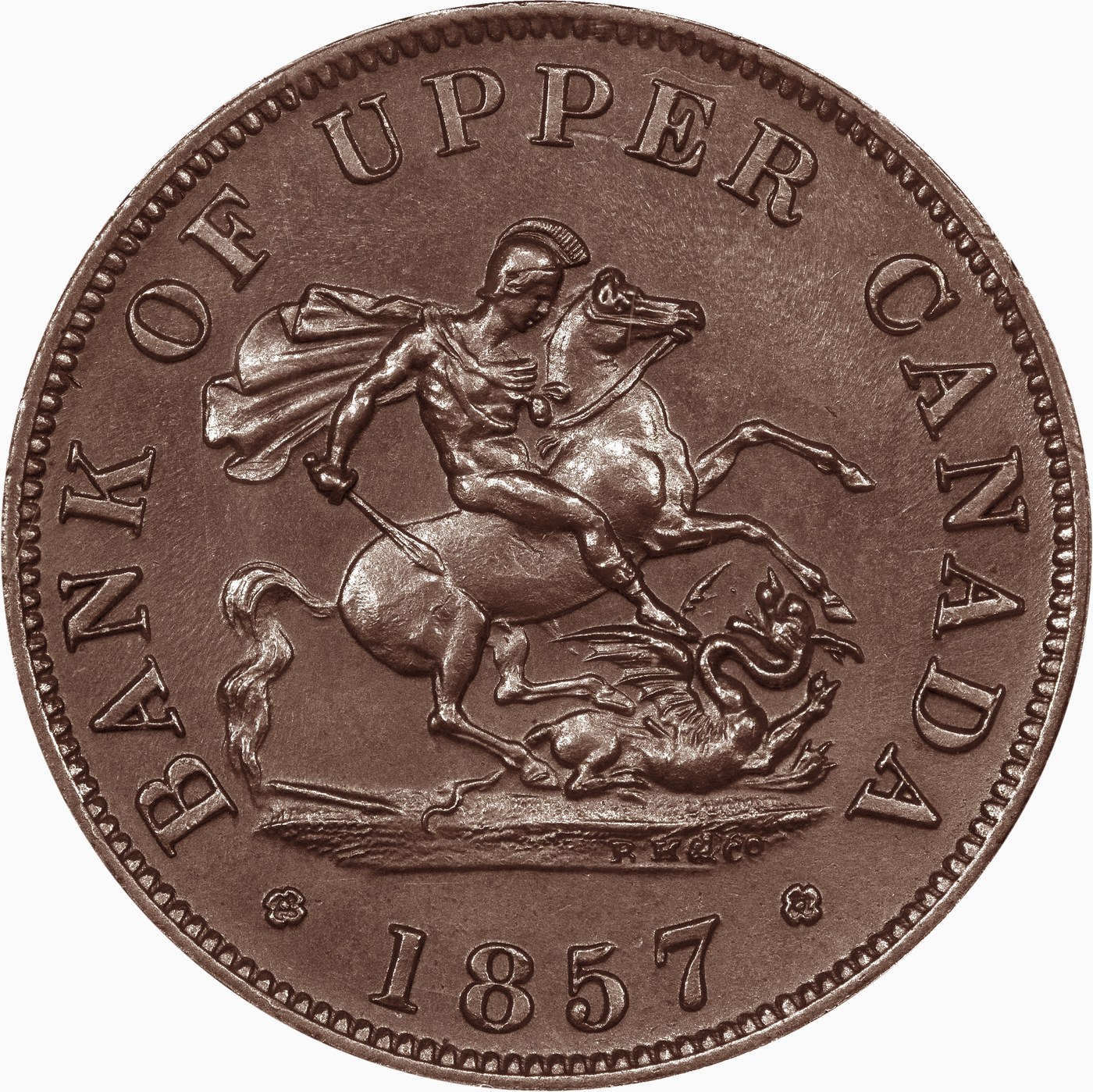
Start with the obverse image. The defining marker is St. George on horseback spearing a dragon, with the date in the exergue beneath the ground line. If your token shows this dragon-slaying scene and reads BANK OF UPPER CANADA on the other side, you have the right issuer; the 1857 example pictured is a standard piece of the series.
Study the reverse arms. You are looking for a crowned heraldic shield bearing the Bank of Upper Canada's arms, surrounded by the legend BANK OF UPPER CANADA and the denomination HALF PENNY. The shield's emblems, which include an anchor and a cornucopia among others, identify the bank specifically. Do not mistake these arms for the royal arms of Great Britain, which appear on regal coins and on some other tokens of the era.
Confirm the denomination by size. The St. George and arms designs are used on both the halfpenny and the larger penny token, so the imagery alone will not tell them apart. Read the HALF PENNY legend and measure the coin: the halfpenny is roughly 28 mm across, while the penny is noticeably bigger at about 34 mm. Weighing the piece is a useful further cross-check.
Test the metal and read the date. The token should be copper: brown to reddish and non-magnetic. Confirm the date against the known half-penny years of 1850, 1852, 1854, and 1857; a date outside that list, or a brassy or magnetic planchet, is a warning sign of a reproduction or an unrelated piece. A caliper, a small scale, and a magnet quickly separate a genuine copper token from later imitations.
Mind the look-alikes and condition traps. Other pre-Confederation bank and merchant tokens circulated alongside these and can look similar at a glance, so always read the full legend and confirm the bank name. Because the tokens saw heavy use, expect wear; be cautious of cleaned, tooled, or re-cut surfaces, and compare the date's font and spacing against a known-genuine example before concluding you have a scarce date or variety.
Frequently asked questions
How do I know it is a half-penny and not a penny?
Read the denomination legend, which states HALF PENNY, and check the diameter. The halfpenny is about 28 mm; the penny uses the same designs but is larger at roughly 34 mm, so size settles it when the wording is worn.
Is the metal a reliable clue?
Yes, as a cross-check. The token is copper, which is brown to reddish and non-magnetic. A brassy, gilded, or magnetic piece is likely a reproduction or an unrelated token rather than a genuine copper BUC halfpenny.
Do the arms on the reverse identify the issuer?
Yes. The crowned shield carries the Bank of Upper Canada's own arms, with emblems such as an anchor and cornucopia, and the surrounding legend names the bank. These are not the royal arms of Great Britain, which appear on other coins of the period.
Should I get the token authenticated?
For common circulated dates careful measurement is usually enough. For anything that looks like a scarce date, an unusual variety, or a high grade, have it reviewed by a Canadian-token or colonial-coin specialist before relying on the attribution.