
How to Identify the Austrian Thaler (Joseph II)
The Austrian Thaler of Joseph II is a large silver coin from the Holy Roman Emperor's reign, featuring his portrait and the Habsburg double-headed eagle, identifiable by its heavy silver weight and Latin legends.
Read the full Austrian Thaler (Joseph II) encyclopedia entry →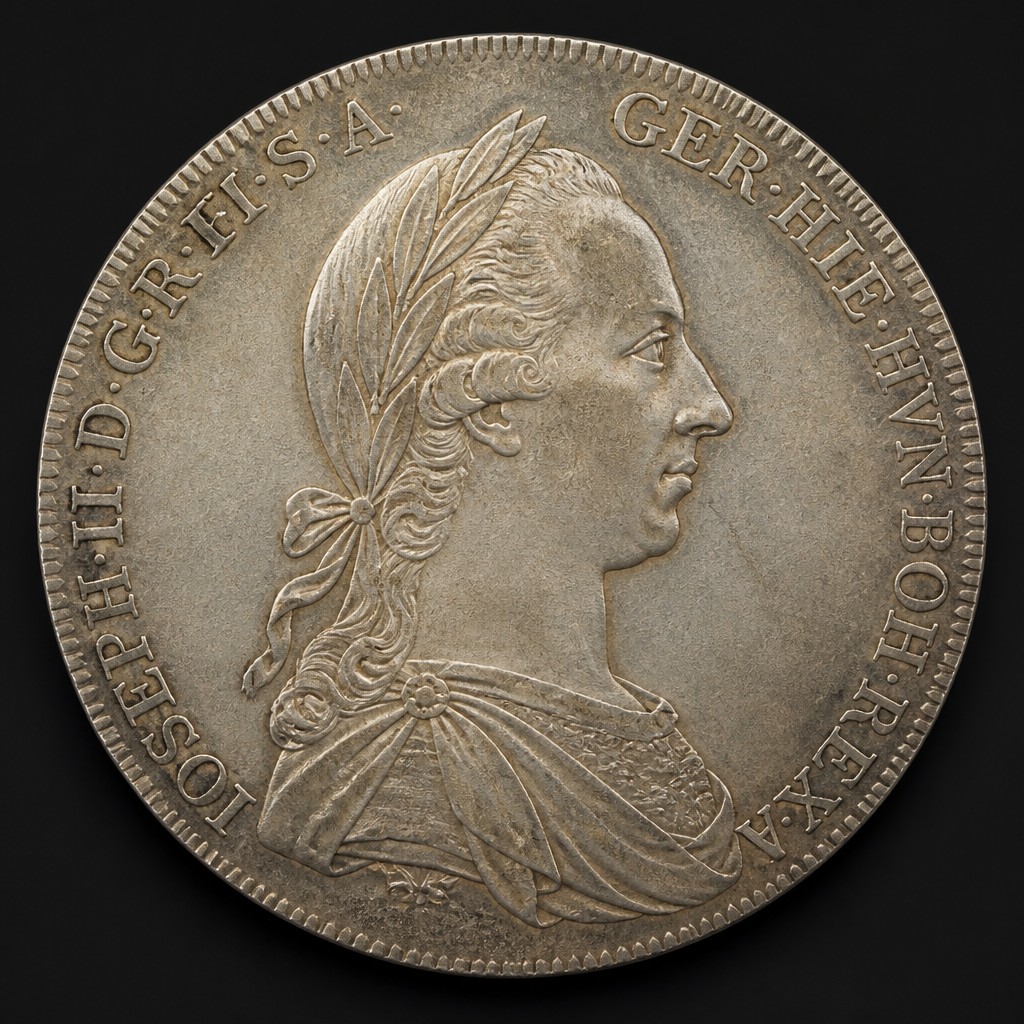
What It Is
This large silver thaler was struck during the reign of Joseph II, Holy Roman Emperor and co-ruler of the Habsburg lands from 1765 (sole ruler from 1780) until his death in 1790. It circulated widely across the Austrian territories and neighboring trade regions, following the standard weight of the broader European thaler tradition. Joseph II is remembered for sweeping administrative and religious reforms, and coinage from his reign reflects the more restrained, neoclassical portrait style favored in Habsburg engraving during this period.
Obverse Design
The obverse shows a laureate or bare-headed portrait bust of Joseph II in profile, usually facing right, dressed in period armor or draped clothing. A Latin legend circles the rim listing his titles, commonly abbreviated forms referencing "IOSEPHUS II" along with references to Roman Emperor, and King of Germany, Hungary, and Bohemia.
Reverse Design
The reverse typically displays the Habsburg double-headed eagle with the Austrian shield on its breast, sometimes accompanied by additional heraldic shields for the various territories under Habsburg rule, along with the mint date and denomination indicators woven into the legend.
Size, Weight & Metal
As a standard-weight silver thaler, the coin is large and substantial, generally around 40mm in diameter and roughly 28 grams, struck in silver of approximately .833 fineness typical of the era's thaler standard. The heft and diameter alone distinguish it from smaller fractional Austrian coinage.
Mint Marks and Where to Find Them
Small mint letters or initials for the striking mint (such as Vienna, Günzburg, or Milan under Habsburg control) usually appear in the legend near the base of the bust or within the reverse field, often alongside the engraver's initials in tiny letters near the truncation of the portrait.
Telling It Apart from Similar Coins
Joseph II thalers are sometimes confused with the far more commonly restruck Maria Theresa thaler (dated 1780), which continued to be produced long after her death for trade purposes. The key difference is the portrait: Joseph II's thaler shows his own likeness and titles, not his mother's, and the legend wording differs accordingly.
Judging Condition at a Glance
Wear shows first on the high points of the portrait — the cheek, hair curls, and shoulder drapery — and on the eagle's wing feathers and crown details on the reverse. A well-preserved coin retains crisp lettering all the way around the rim without flattening.
Authenticity Red Flags
Because thalers of this era were widely used as bullion trade coins, later-era imitations and lightweight strikes exist. Watch for coins with soft, indistinct lettering, an unusually light weight for the diameter, or a portrait that looks stylistically "off" compared to the finely engraved originals, which can indicate a cast or low-quality struck copy. A genuine piece should also have a properly executed edge consistent with 18th century minting technology, either finely reeded or lettered depending on the specific mint, rather than a smooth or crudely tooled edge.
Frequently asked questions
How do I tell a Joseph II thaler apart from a Maria Theresa thaler?
Look at the portrait and legend: Joseph II's coin shows his own bust and titles, while the Maria Theresa thaler shows her portrait and is usually dated 1780, a design later restruck for centuries.
What is the approximate silver content of this coin?
It follows the common thaler standard of roughly .833 fine silver, though exact fineness can vary slightly by mint and period.
Where should I look for the mint mark?
Check the legend near the bottom of the portrait bust or in the reverse field for small mint initials indicating the striking location.
Is this coin the same size as other European thalers of the period?
Yes, it generally matches the broad, heavy thaler standard of about 40mm diameter and 28 grams common across German and Austrian states in the 18th century.