How to Identify the Austrian Levantine Thaler (Maria Theresa Thaler)
A famous Austrian silver trade thaler bearing Empress Maria Theresa's bust, perpetually dated 1780 on modern restrikes, long used as a trusted trade coin across the Middle East and Africa.
Read the full Austrian Levantine Thaler (Maria Theresa Thaler) encyclopedia entry →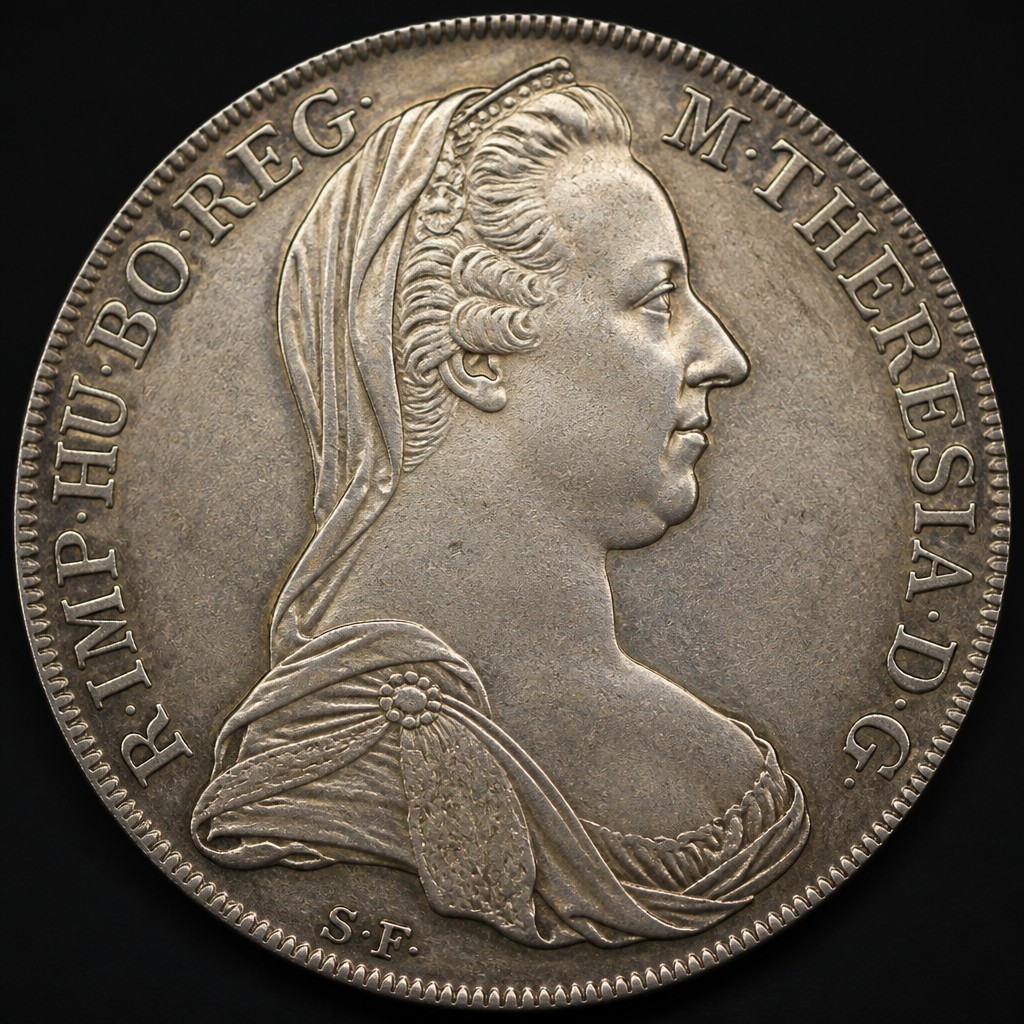
What It Is
The Maria Theresa Thaler, also known as the Levantine Thaler, is a silver trade coin originally struck to honor Empress Maria Theresa of Austria. It became so trusted for its reliable silver content and consistent design that after her death in 1780, various mints (including Austrian, Italian, and later British and other mints) continued producing restrikes using the original 1780 date indefinitely, making it one of the most widely restruck trade coins in history, especially popular in trade across the Arabian Peninsula, East Africa, and other parts of the Levant and Middle East.
Obverse Design and Inscriptions
The obverse shows a right-facing bust of Maria Theresa wearing an ornate veil, a widow's dress, and a jeweled brooch, reflecting her widowed status after 1765. The Latin legend surrounding her reads "M THERESIA D G R IMP HU BO REG" (Maria Theresa, by the grace of God, Roman Empress, Queen of Hungary and Bohemia).
Reverse Design and Inscriptions
The reverse displays the crowned double-headed Habsburg eagle holding an orb and scepter, with a small shield on its breast bearing the combined arms of Austria, Hungary, Burgundy, and other Habsburg territories, along with the continuous Latin title legend and the fixed date "1780" beneath the eagle on virtually all genuine restrikes.
Size, Weight, Metal, and Edge
The coin is crown-sized, approximately 39-41 mm in diameter, struck in .833 fine silver and weighing about 28 grams, a specification that remained essentially unchanged across the many decades of restriking to preserve trust in its trade value. The edge carries a raised, incuse lettered motto, "IUSTITIA ET CLEMENTIA" (justice and clemency), which is a key security and authenticity feature.
Mint Marks and Where to Find Them
Because restrikes were produced by many different mints over the decades (including Vienna, Milan, London, Rome, and Bombay, among others), a tiny mint mark or small identifying letter appears on the edge or near the base of the bust, distinguishing the specific minting source even though the date always reads 1780.
Telling It Apart from Similar Coins
Because every genuine restrike bears the same 1780 date, this coin cannot be dated by its date alone; instead, collectors examine the specific bust style, the edge lettering, and small die details to identify the mint and approximate era of striking. It should not be confused with other Habsburg-era Maria Theresa commemorative coins that carry her portrait but a different reverse design or an actual variable date from her lifetime.
Judging Condition at a Glance
Look at the fine detail in Maria Theresa's veil lace pattern and hair curls, and the double eagle's feather detail on the reverse. A well-preserved, sharply struck coin shows crisp lace and feather texture, while a worn or heavily circulated example (common given the coin's centuries of active trade use) shows smoothed, indistinct veil and feather patterns.
Authenticity Red Flags
Given its long production history and continued demand in some markets, watch for coins with an incorrect edge lettering pattern or a plain (unlettered) edge where a lettered edge is expected, incorrect weight or diameter for the .833 fine silver standard, or a bust style that does not match any documented genuine die variety. A dull, grainy surface, blurred lettering, or a visible casting seam indicates a modern cast counterfeit rather than an authentic struck restrike.
Frequently asked questions
Why do all Maria Theresa Thalers show the date 1780?
After Empress Maria Theresa's death in 1780, mints continued restriking the coin using that fixed date because its trusted, unchanging design was key to its acceptance in trade across the Middle East and Africa.
How can I tell which mint produced a specific restrike?
Look for a small mint mark or letter on the edge or near the base of the bust, since the date alone (always 1780) cannot distinguish the striking source or era.
What makes the edge lettering important for authentication?
Genuine coins carry the incuse motto 'IUSTITIA ET CLEMENTIA' on the edge; a missing or incorrectly formed edge inscription is a warning sign of a counterfeit.
What silver content and weight should a genuine coin have?
About 28 grams at .833 fine silver and roughly 39-41 mm in diameter, a specification kept consistent across its long restriking history.
Is a worn Maria Theresa Thaler less authentic?
No, heavy wear is common and expected because these coins circulated actively as trade currency for generations; wear alone does not indicate a fake.
Austrian Levantine Thaler (Maria Theresa Thaler) identified by the community
Recent Austrian Levantine Thaler (Maria Theresa Thaler) coins identified with Coin Identifier.