
How to Identify the Austrian Gold Philharmonic
A visual guide to Austria's gold bullion coin, covering the Musikverein organ obverse, orchestral instrument reverse, purity, sizes, and authenticity checks.
Read the full Austrian Gold Philharmonic encyclopedia entry →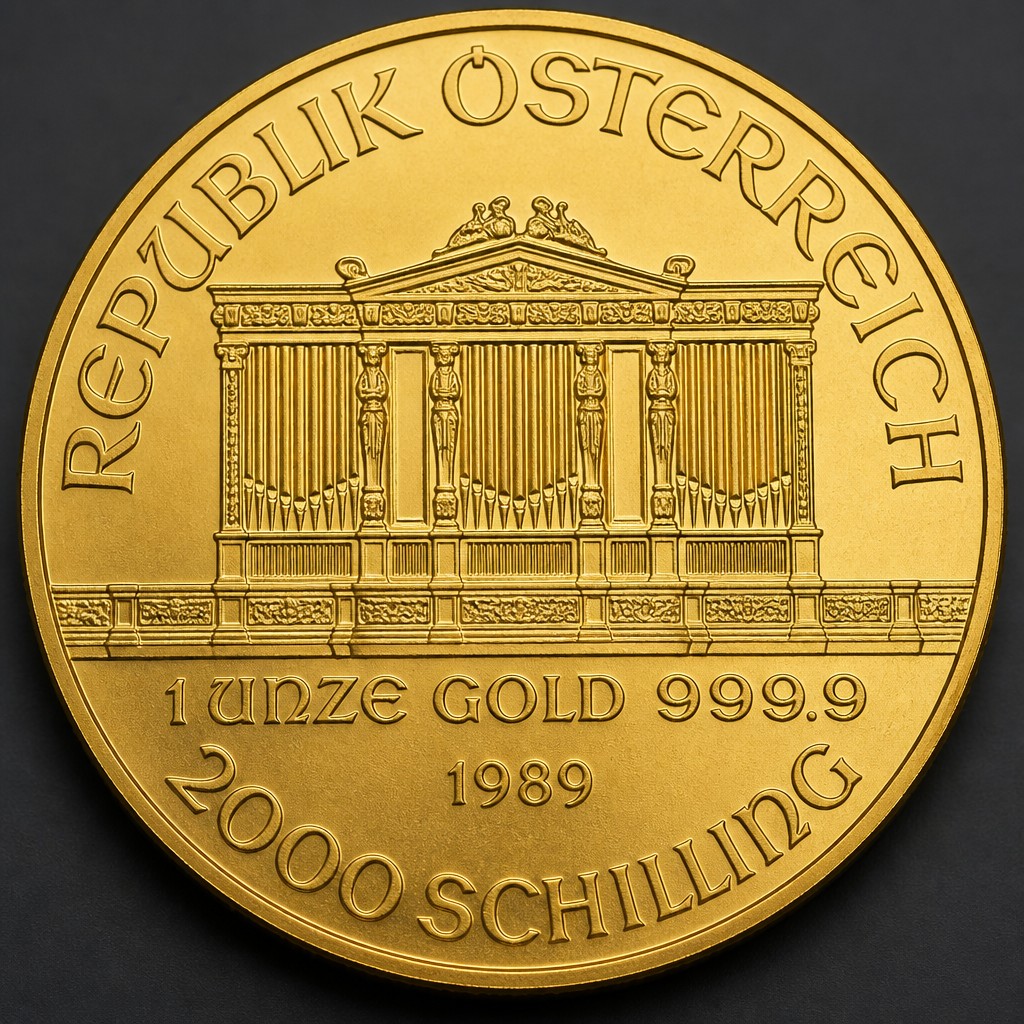
What Is the Coin
The Austrian Gold Philharmonic (Wiener Philharmoniker) is a gold bullion coin issued by the Austrian Mint (Munze Osterreich) since 1989. It is named for the Vienna Philharmonic Orchestra and is one of the best-selling gold bullion coins in Europe.
Obverse ("Value Side") Design
What collectors often call the obverse depicts the great pipe organ of the Golden Hall (Musikverein) in Vienna, home of the Vienna Philharmonic. The inscription reads "REPUBLIK OSTERREICH" above, with the face value and weight/fineness statement below the organ image.
Reverse Design
The reverse shows a grouping of orchestral instruments: a cello, bassoons, harp, and French horns arranged together, representing the orchestra as a whole. No additional lettering typically appears beyond the design itself.
Size, Weight, Metal & Edge
Struck in .9999 fine gold, the coin is issued in 1 oz, 1/2 oz, 1/4 oz, 1/10 oz, and, since 2014, a tiny 1/25 oz size. The 1 oz coin measures 37 mm in diameter and weighs 31.1 g, with a plain (smooth) edge, which is typical for this series across all sizes.
Face Value and Date Placement
Since the introduction of the euro in 2002, the face value is denominated in euros (e.g., 100 Euro for the 1 oz coin); earlier issues from 1989-2001 were denominated in Austrian schillings. The date appears on the organ side in small numerals, usually near the bottom of the design.
Telling It Apart From Similar Coins
The Philharmonic's smooth edge is a notable difference from many other gold bullion coins, which use reeded edges. Because the design has stayed essentially unchanged since 1989 aside from the currency switch, the coin is easy to recognize by the organ-and-instruments motif alone, distinguishing it clearly from coins like the Canadian Maple Leaf or Krugerrand.
Grading and Condition at a Glance
As a modern bullion product, condition assessment focuses on preserved luster and absence of scratches or edge dings rather than rarity. The flat, open fields of the organ pipes make surface marks easy to spot, so examine those areas closely under good light.
Authenticity Red Flags
Because the coin's smooth edge and fine detail in the organ pipes and instrument strings are hard to replicate precisely, blurred or flattened pipe details, incorrect diameter for the stated weight, or an edge that shows any reeding are signs of a counterfeit. Always compare weight and diameter to official Austrian Mint specifications for the specific fractional size, since underweight fakes are the most commonly reported problem for this series. Genuine coins are typically sold loose or in official Austrian Mint tubes and capsules rather than elaborate individual holders, so unusually ornate third-party packaging should not be treated as a substitute for checking the coin itself.
Frequently asked questions
Why does the coin show a pipe organ?
It depicts the organ of Vienna's Musikverein Golden Hall, symbolizing the Vienna Philharmonic Orchestra the coin is named after.
Is the edge reeded or smooth?
It is smooth (plain), unlike many other gold bullion coins that use reeded edges.
What currency is the face value shown in?
Euros since 2002; Austrian schillings on coins dated 1989-2001.
What sizes are available?
1 oz, 1/2 oz, 1/4 oz, 1/10 oz, and a 1/25 oz size introduced in 2014, all in .9999 fine gold.