
How to Identify the Austrian Florin (Gulden)
A silver coin of the Austro-Hungarian Empire bearing Emperor Franz Joseph I's portrait, identifiable by its 'EIN GULDEN' reverse denomination.
Read the full Austrian Florin (Gulden) encyclopedia entry →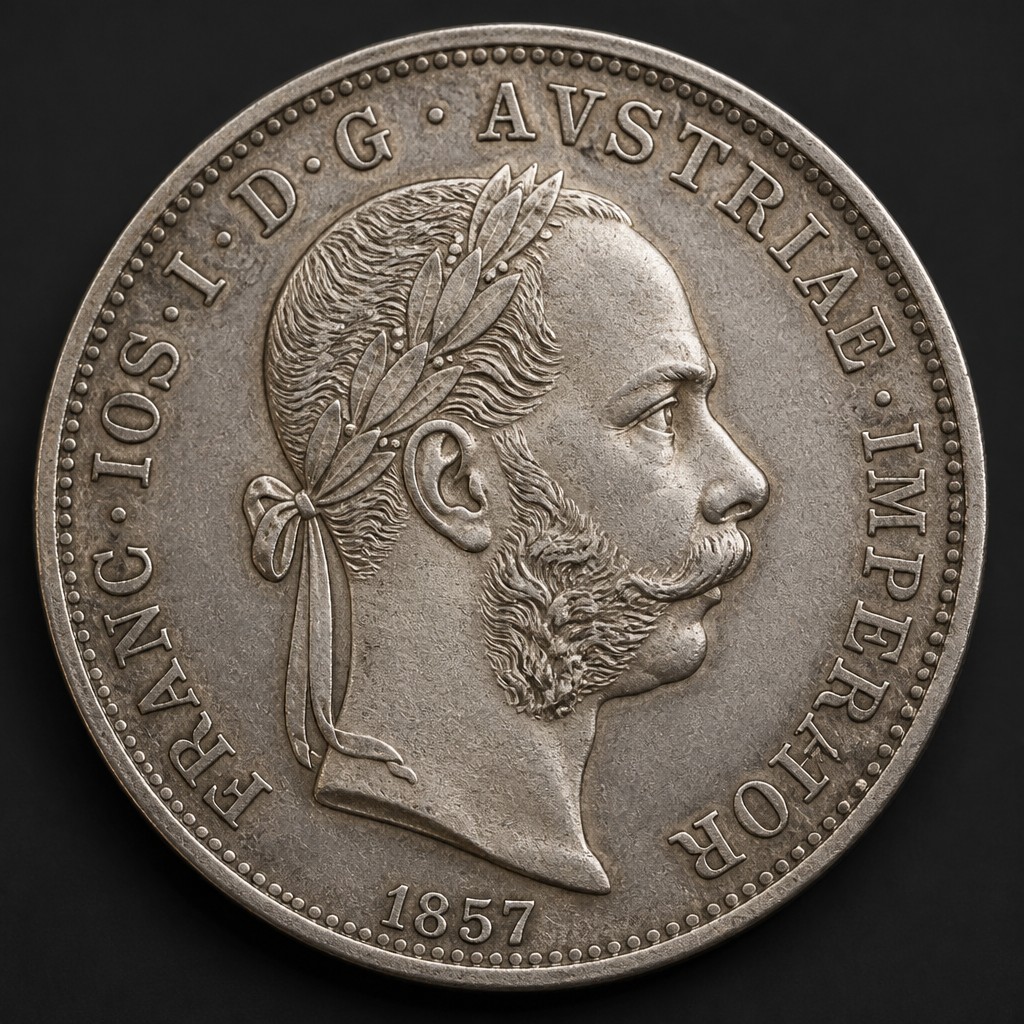
What Is the Austrian Florin (Gulden)?
The Florin, known domestically as the Gulden, was the standard silver coin of the Austrian Empire and later Austria-Hungary from 1857 until 1892, when the empire transitioned to the krone system. It was established under the Vienna Monetary Treaty of 1857, which set a common silver standard among several German-speaking states.
Obverse Design
The vast majority of surviving Florins show Emperor Franz Joseph I in profile, either bare-headed or wearing a simple laurel wreath depending on the issue year, with a Latin legend along the lines of "FRANC IOS I D G AVSTRIAE IMPERATOR" (Franz Joseph I, by the grace of God, Emperor of Austria).
Reverse Design
The reverse typically states the denomination directly as "EIN GULDEN" (one gulden) along with the date, often accompanied by a wreath of oak or laurel leaves. Some earlier or commemorative variants may instead show the Austrian imperial double-headed eagle.
Size, Weight & Metal
The coin is struck in .900 fine silver, weighs approximately 12.3 grams, and measures around 29 millimeters in diameter — a mid-sized silver coin, smaller than a full silver crown but larger than a typical minor coin.
Mint Marks
Austrian Florins were produced at several mints across the empire, including Vienna and Kremnitz (in present-day Slovakia), each identified by a small mint mark near the date. Vienna issues are the most frequently encountered in the market.
Telling It Apart from Similar Coins
Because Franz Joseph I reigned for nearly seven decades, his portrait also appears on many other Austro-Hungarian denominations, including the later krone coinage introduced after 1892. The clearest way to confirm a Florin/Gulden is the explicit "GULDEN" wording on the reverse, which distinguishes it from krone-denominated coins that instead read "KRONEN." Hungarian Forint coins from the same monetary union period share a similar silver standard but carry Hungarian-language legends and different heraldic emblems.
Judging Condition at a Glance
Look closely at the emperor's hair, moustache, and the wreath leaves (if present) on the reverse — these raised details wear down first. A well-preserved coin shows crisp, separated strands in the hair and sharply defined leaf edges, while a heavily circulated example shows a smoothed, rounded portrait and faint lettering.
Authenticity Red Flags
Check that the weight falls close to the expected 12.3 grams and that the edge reeding is even and well-formed. Because this coin was produced in large quantities across a long reign, most examples are genuine and affordable, but be wary of coins with a dull, lifeless strike, inconsistent lettering style compared to known genuine issues, or a noticeably discolored surface suggesting base-metal plating rather than solid silver.
Frequently asked questions
Who is shown on the Austrian Florin?
Emperor Franz Joseph I appears on nearly all surviving examples, shown in profile.
What does the reverse say?
It typically reads 'EIN GULDEN' along with the date, directly stating the denomination.
How is it different from an Austro-Hungarian krone coin?
Krone coins, introduced after 1892, read 'KRONEN' on the reverse instead of 'GULDEN,' reflecting the later currency reform.
What is the coin's silver content?
It is struck in .900 fine silver, weighing approximately 12.3 grams.
Where were these coins minted?
Primarily at Vienna, with some struck at Kremnitz, each marked with a small mint symbol near the date.