
How to Identify the Austrian Corpus Christi Thaler
A large silver thaler from the Austrian ecclesiastical states depicting a Corpus Christi procession scene, identified by its devotional imagery, Latin legends, and heavy hand-struck fabric.
Read the full Austrian Corpus Christi Thaler encyclopedia entry →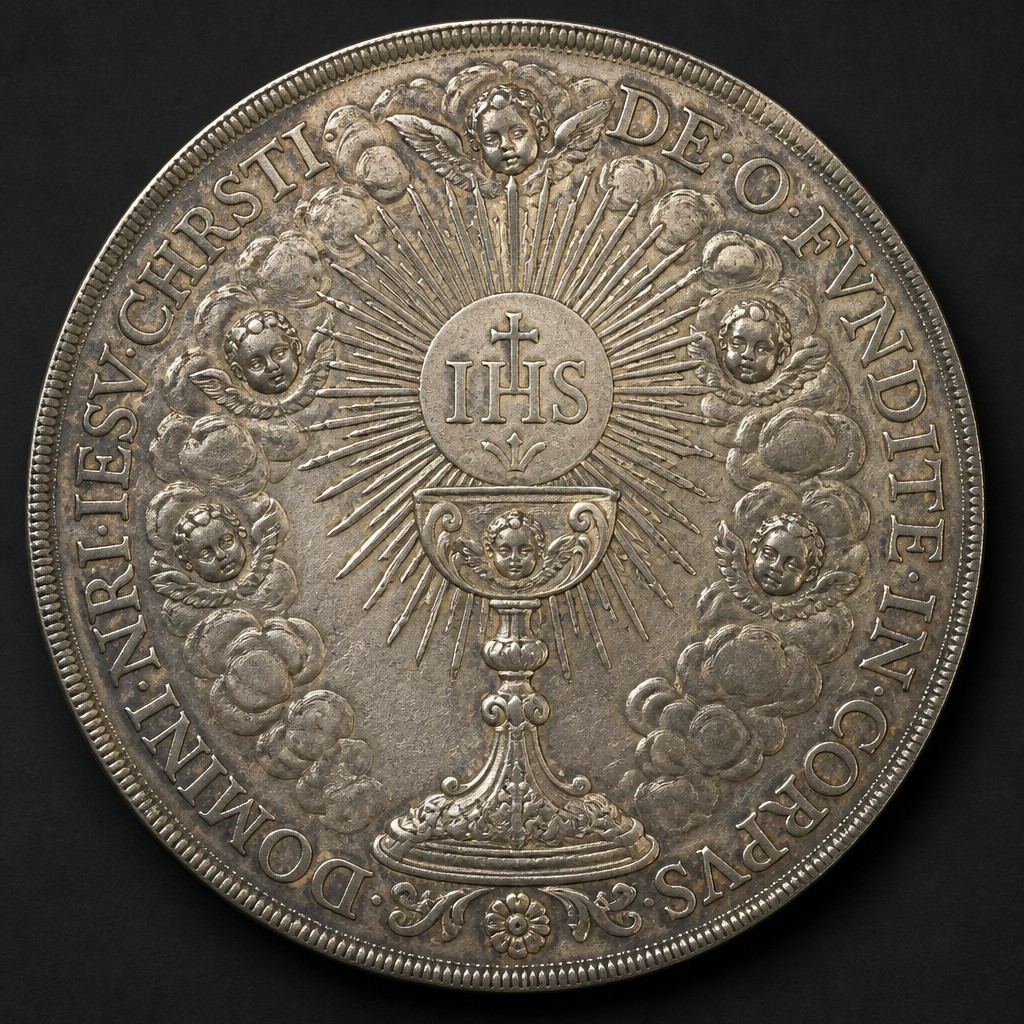
What It Is
The Corpus Christi Thaler is a large hand-struck silver thaler issued by Austrian ecclesiastical territories (most notably the prince-archbishopric of Salzburg) to commemorate the feast of Corpus Christi, a major Catholic holy day honoring the Eucharist. These pieces belong to the broader family of German-speaking "thaler" coinage of the 17th and 18th centuries and were struck as both circulating money and devotional presentation pieces. Because they were produced by a church-state rather than a royal mint, their imagery leans heavily on religious rather than dynastic symbolism.
Obverse Design and Inscriptions
The obverse typically carries the portrait, coat of arms, or monogram of the reigning prince-archbishop, surrounded by his titles in Latin abbreviation (such as "ARCHIEP" for archiepiscopus and "S R I PRINC" for a prince of the Holy Roman Empire). The lettering runs continuously around the rim, and the central device is often flanked by mitre and crozier symbols marking the issuer's ecclesiastical office.
Reverse Design and Inscriptions
The reverse is the coin's signature feature: a detailed scene of the Corpus Christi procession, showing clergy and townspeople parading a monstrance (the vessel that displays the consecrated host) beneath a canopy, sometimes with a church facade or town square in the background. A Latin legend referencing the feast or an invocation of divine protection curves around the scene. The engraving is often crowded with tiny figures, making sharpness of detail a key identification point.
Size, Weight, Metal, and Edge
Like most thalers of the period, these coins are struck in .833-.900 fine silver, roughly 40-45 mm in diameter, and weigh approximately 28-29 grams. The edge is plain or lightly milled, consistent with screw-press or hammered minting technology of the era, and the flan is often slightly irregular in shape, a hallmark of pre-modern minting.
Mint Marks and Where to Find Them
Because these were struck at a small ecclesiastical mint (typically Salzburg), there is no separate branch mint mark system as seen on later coinage. Instead, look for a mint master's initial or small privy mark tucked into the design near the rim or beneath the main device, which helps identify the specific striking period.
Telling It Apart from Similar Coins
Corpus Christi thalers are easily confused with other Salzburg or German ecclesiastical thalers that show a saint, a church building, or a simple coat of arms instead of a procession scene. The defining giveaway is the crowd-and-canopy procession imagery on the reverse, which is unique to Corpus Christi issues. Secular German thalers of the same era instead show a full royal portrait and a large state eagle or shield, without any religious procession.
Judging Condition at a Glance
Because the reverse procession scene contains fine detail, condition is best judged there: sharp folds in the clergy's vestments and a legible monstrance outline indicate a lightly circulated or mint-state example, while heavy wear smooths the crowd into an indistinct mass. On the obverse, check the crispness of the archbishop's mitre and the legibility of the surrounding Latin legend.
Authenticity Red Flags
Because these are old hand-struck coins, watch for cast copies, which show a grainy or pitted surface, rounded (rather than sharp) letter edges, and a seam line around the edge from the casting mold. A weight or diameter noticeably outside the typical thaler range, a suspiciously uniform or perfectly round flan, or blurred, shallow devices that look "melted" rather than struck are all signs of a later reproduction rather than a genuine period strike.
Frequently asked questions
What makes a Corpus Christi Thaler different from other Salzburg thalers?
Its reverse shows a detailed procession scene with clergy carrying a monstrance under a canopy, a design unique to Corpus Christi commemorative issues rather than a simple coat of arms or saint portrait.
How can I tell if my Corpus Christi Thaler is a modern cast copy?
Genuine struck coins have sharp, crisp lettering and design lines. Cast copies typically show a grainy or pitted surface, softened detail, and a visible seam around the edge.
Is there a standard mint mark on these coins?
There is no formal branch-mint system; instead look for a small mint master's initial or privy mark near the rim, which can help pinpoint the striking period.
What metal and size should I expect?
Most examples are .833-.900 fine silver, about 40-45 mm across, and weigh roughly 28-29 grams, consistent with standard German-region thalers of the period.