
How to Identify the Austrian 4 Ducat Gold
The Austrian 4 Ducat is a large, high-purity gold trade coin best known through its 1915-dated restrikes, identifiable by the Habsburg emperor's portrait and a double-headed eagle reverse.
Read the full Austrian 4 Ducat Gold encyclopedia entry →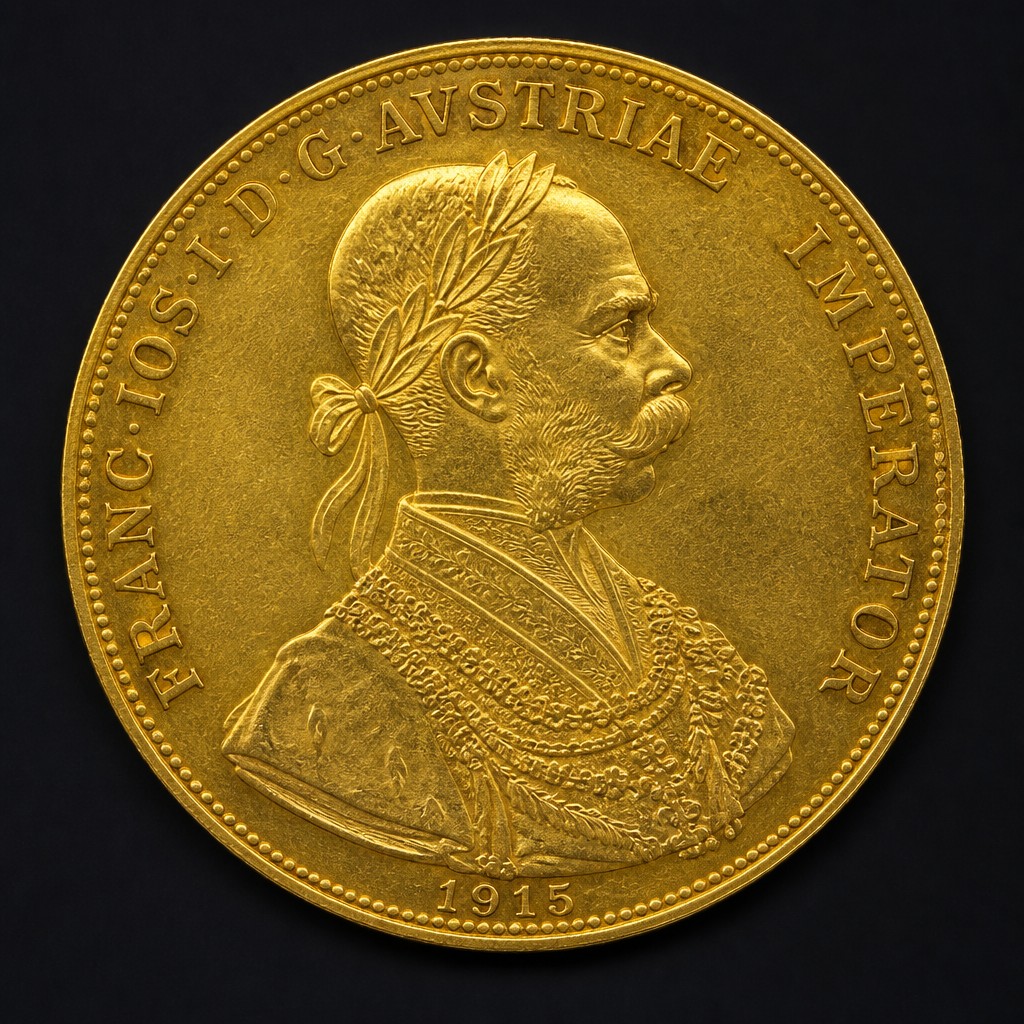
What Is the Austrian 4 Ducat Gold Coin
This gold trade coin was historically issued by the Austrian (Habsburg) Empire and prized for its high gold purity. The most commonly encountered version carries the date 1915 with a portrait of Emperor Franz Joseph I, which Austria continued to officially restrike for decades for bullion trade purposes. Ducat coinage of this style traces back centuries as a widely trusted international trade standard, valued across Central Europe for its consistent gold content long before it became primarily a bullion collectible.
Obverse Design and Inscriptions
The obverse shows a bust of Emperor Franz Joseph I in military uniform facing right, with the Latin legend "FRANC IOS I D G AVSTRIAE IMPERATOR" (Franz Joseph I, by the grace of God, Emperor of Austria) circling the rim.
Reverse Design and Inscriptions
The reverse depicts the Habsburg double-headed eagle with wings spread, crowned, holding an orb, scepter, and sword, with shields on its breast. The legend includes titles such as "HVNGARIAE BOHEMIAE REX," referencing the emperor's Hungarian and Bohemian crowns.
Size, Weight, Metal, and Edge
The coin is struck in .986 fine gold — notably higher purity than most circulating gold coins — weighing approximately 13.96 grams with a diameter near 40mm.
Mint Marks and Where to Find Them
Official restrikes carry a small mint mark near the base of the reverse design, which can help distinguish official government restrikes from earlier original-period issues. The Vienna mint has produced the overwhelming majority of surviving examples, since restriking became a long-running, officially sanctioned practice rather than a one-time historical production run.
Telling It Apart From Similar Coins
Compare it to the smaller 1 Ducat coin, which shares similar design elements at a much smaller size and lighter weight. The 4 Ducat's large diameter and heavier gold weight are the clearest identifiers, since it does not carry a large printed "4" on its face.
Judging Condition at a Glance
Since most surviving examples are bullion-purpose restrikes rather than heavily circulated coins, condition often centers on surface marks, scratches, or cleaning rather than wear. Look for sharp original mint luster and unblemished fields. Hairline scratches from improper cleaning or storage in non-archival holders are a common condition issue, so examine the fields under angled light for fine parallel lines that indicate past polishing.
Authenticity Red Flags
Because of its high gold content, this coin is a frequent counterfeit target. Check exact weight and diameter against known specifications, examine strike sharpness on the eagle's feathers, and be wary of coins that feel too light or show a dull, non-metallic luster suggesting base-metal or plated fakes. A simple non-destructive weight and diameter check is one of the most reliable first steps, since matching both figures closely rules out the majority of underweight base-metal counterfeits.
Frequently asked questions
Why do so many 4 Ducat coins share the same 1915 date?
Austria officially continued restriking the 1915-dated design for decades as a recognized gold bullion trade coin, so genuine restrikes carry that same date despite being produced much later.
How pure is the gold in this coin?
It is struck in .986 fine gold, one of the higher purities used in historical gold coinage.
What is the difference between an original strike and a restrike?
Official restrikes use the same design and date but were produced later purely for bullion purposes; distinguishing the two typically requires expert die analysis rather than visual inspection alone.
How much does a 4 Ducat coin weigh?
Approximately 13.96 grams.
What does the double-headed eagle represent?
It symbolizes Habsburg rule over multiple territories, including Austria, Hungary, and Bohemia.