How to Identify the Austrian 20 Corona Gold
A smaller gold coin from Austria-Hungary featuring Franz Joseph I, popular in the bullion market thanks to widely available 1915-dated restrikes.
Read the full Austrian 20 Corona Gold encyclopedia entry →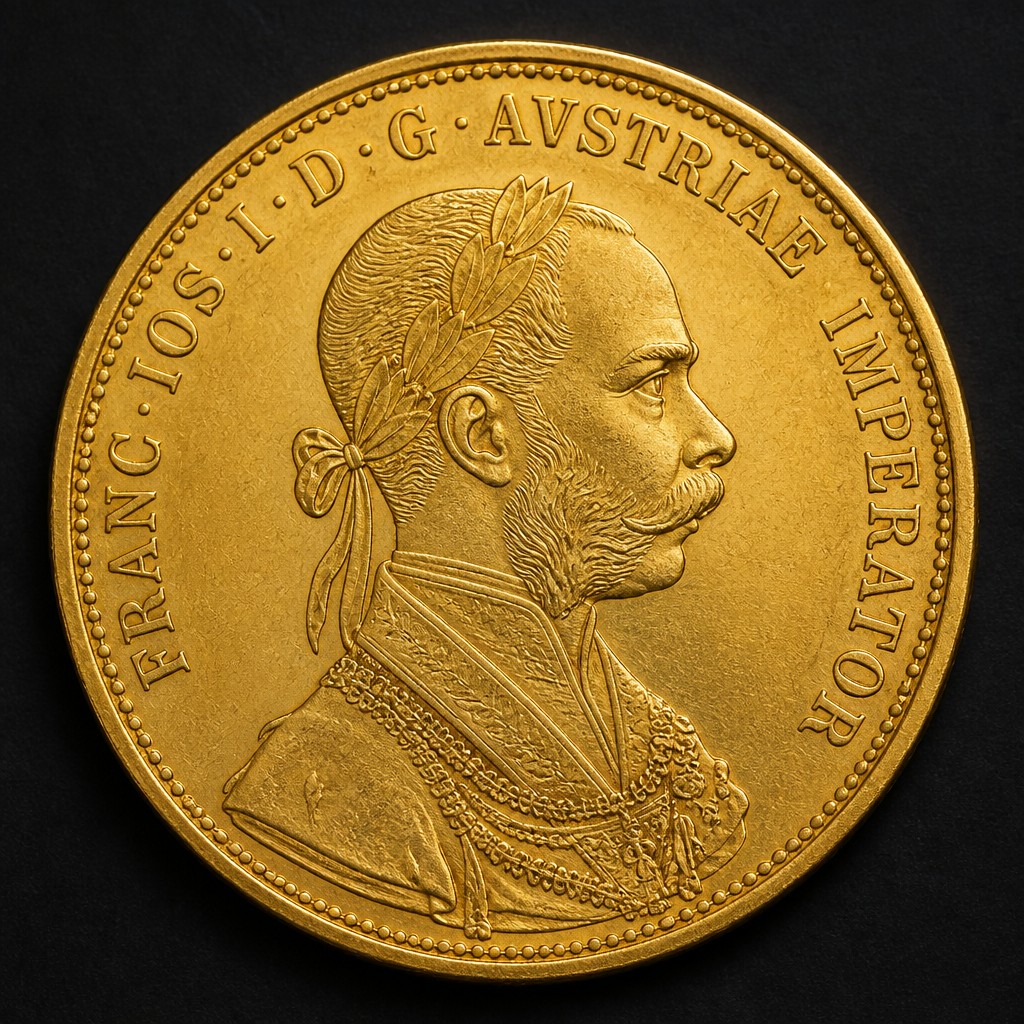
What It Is
The 20 Corona gold coin was introduced by Austria-Hungary in 1892 as part of the empire's move to a gold-based currency, the corona (or krone). Like its larger 100 Corona counterpart, the 1915-dated 20 Corona has been restruck by the Austrian Mint for many decades after the empire's dissolution, making that date extremely common in the bullion and jewelry markets today.
Obverse Design
The obverse features a right-facing portrait of Emperor Franz Joseph I with his characteristic mutton-chop beard and mustache, surrounded by his abbreviated Latin imperial titles and the date positioned at the bottom of the design.
Reverse Design
The reverse shows the crowned Austrian imperial eagle with outstretched wings, holding a scepter and orb, with a small shield bearing the Habsburg arms on its chest, and the denomination "20 CORONA" in the surrounding legend.
Size, Weight, and Metal
This coin is smaller than the 100 Corona, measuring about 21 mm in diameter and weighing roughly 6.78 grams in .900 fine gold, containing about 0.1960 troy ounces of pure gold. The edge is reeded.
Mint Marks and Where to Find Them
A small mint mark appears near the rim of the reverse, close to the eagle's base, indicating the original striking mint (chiefly Vienna or Kremnitz for period issues), which is retained on the standardized 1915 restrikes as well.
Telling It Apart from Similar Coins
The 20 Corona is often mistaken for the visually similar but larger 100 Corona, or confused with contemporary Hungarian 20 Korona coins that share the format but carry Hungarian titles and a different coat of arms referencing Hungary's crown of Saint Stephen. Checking the exact wording of the legend and the coat of arms design resolves the confusion quickly.
Judging Condition at a Glance
Look at the emperor's facial features and beard detail, along with the eagle's feather definition, for wear. Since most examples are common restrikes, condition mainly affects eye appeal rather than significant premium, but sharp, lustrous strikes are still preferred by collectors and buyers.
Authenticity Red Flags
Confirm the coin's diameter and weight against the official specifications, check that it does not respond to a magnet, and inspect the strike for crisp, well-defined lettering and portrait detail. Soft or mushy features, incorrect coloring, or a noticeably wrong size are signs of a counterfeit or base-metal replica.
Frequently asked questions
Is the 1915 20 Corona rare?
No, it is one of the most common gold bullion coins available because the Austrian Mint has continuously restruck that date for decades; original period examples are less common but not distinguished by date alone.
How much gold does a 20 Corona contain?
It contains about 0.1960 troy ounces of pure gold, struck in .900 fine gold at a total weight of roughly 6.78 grams.
How do I tell an Austrian 20 Corona from a Hungarian 20 Korona?
Check the legend wording and coat of arms: the Austrian version uses Franz Joseph's Austrian imperial titles and the Habsburg eagle, while the Hungarian version references the Hungarian crown and uses different arms.
What is the diameter of the 20 Corona?
It measures approximately 21 millimeters across, notably smaller than the 100 Corona.
Austrian 20 Corona Gold identified by the community
Recent Austrian 20 Corona Gold coins identified with Coin Identifier.