
How to Identify the Austrian 100 Corona Gold
A large gold coin from Austria-Hungary bearing Emperor Franz Joseph I, prized for its size, purity, and the well-known 1915 restrike still produced for bullion buyers today.
Read the full Austrian 100 Corona Gold encyclopedia entry →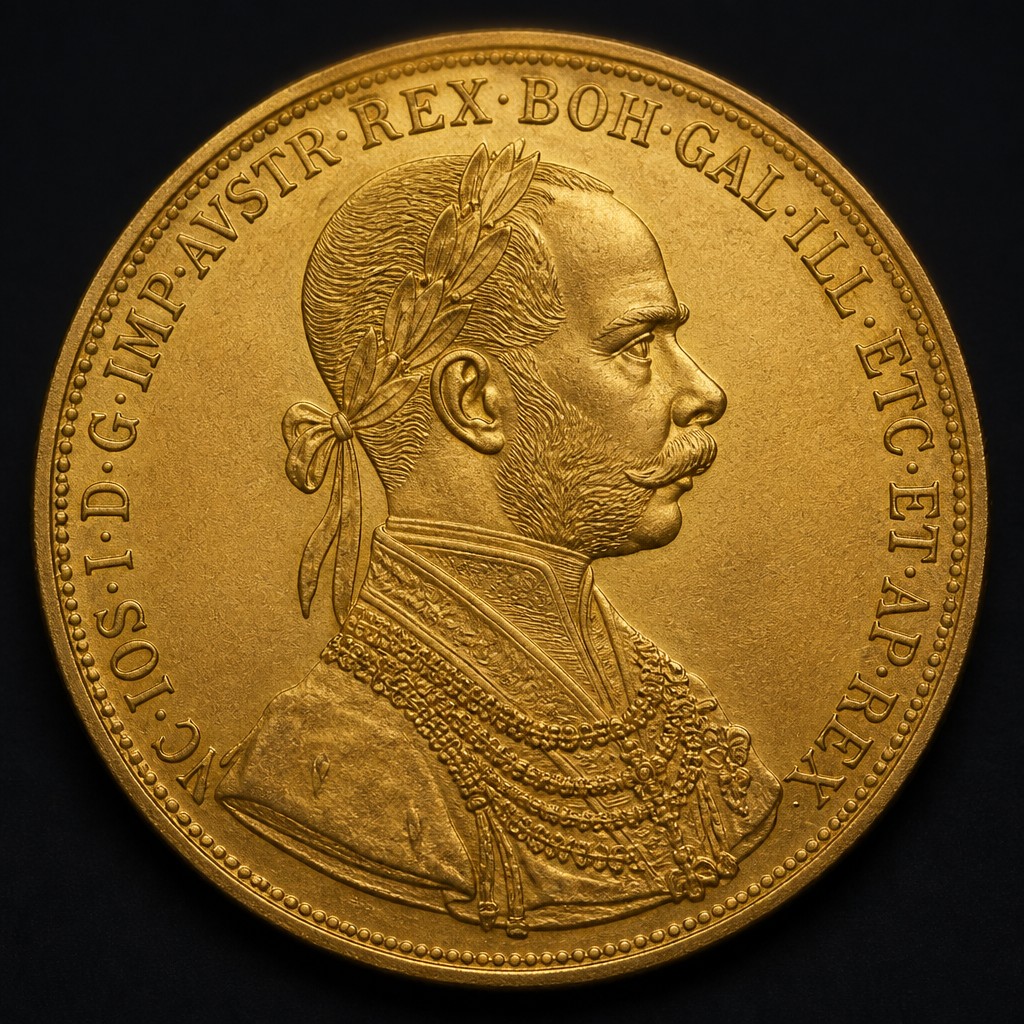
What It Is
The 100 Corona gold coin was struck by Austria-Hungary starting in 1892 as part of a new gold-based currency system. The most commonly encountered date is 1915, which was restruck continuously by the Austrian Mint for the bullion and jewelry trade long after the original monarchy ended, so a "1915" coin in your hand is very likely a later restrike rather than an original mintage piece.
Obverse Design
The obverse shows a right-facing portrait bust of Emperor Franz Joseph I in later life, with a full beard and mustache, wearing formal attire with a decorated collar. Around the rim reads a Latin-style legend naming him "FRANC IOS I D G IMP AVSTR REX BOH ET REG APOST HVNG" (an abbreviated version of his imperial titles), with the date at the bottom.
Reverse Design
The reverse depicts the crowned Austrian imperial double-headed eagle holding a scepter and orb, with a shield on its breast bearing the Habsburg-Lorraine arms. The denomination "100 CORONA" appears in the legend circling the design, along with the mint mark.
Size, Weight, and Metal
This is a large gold coin: about 37 mm in diameter, roughly 33.87 grams total weight, struck in .900 fine gold (about 0.9802 troy ounces of pure gold content). The edge is reeded.
Mint Marks and Where to Find Them
Look for a small mint mark near the rim on the reverse, close to the base of the eagle design. Original 1892-1915 issues were struck in Vienna and Kremnitz; the modern restrikes carry the same 1915 date and Vienna-style marks by law, which is how the mint distinguishes bullion restrikes from rare original pieces without needing a new date.
Telling It Apart from Similar Coins
It is easy to confuse the 100 Corona with the smaller 20 Corona and 10 Corona gold coins, which share the same portrait and eagle motifs but are noticeably smaller and lighter. Compare diameter and weight rather than design alone. It can also be confused with Hungarian companion issues that use "KORONA" and different regnal titles referencing the Hungarian crown.
Judging Condition at a Glance
Because most surviving pieces are the widely produced 1915 restrike, condition rarely commands a large premium; still, check the high points of the hair, mustache, and eagle's wing feathers for wear. Bag marks and light scuffs from vault storage are common and expected on bullion-grade pieces.
Authenticity Red Flags
Genuine pieces have a crisp, deep strike with sharp lettering; a mushy or flat portrait, incorrect diameter or weight, or a magnetic response (gold is not magnetic) all indicate a fake. Because this coin is a popular bullion item, check weight and diameter precisely against known specifications, and be wary of gold-plated base-metal copies sold as "restrikes."
Frequently asked questions
Is a 1915-dated 100 Corona a real antique or a modern restrike?
The vast majority in circulation today are official later restrikes still dated 1915, which the Austrian Mint has produced continuously for the bullion market; genuinely old examples exist but are far less common.
What is the gold content of the 100 Corona?
It is struck in .900 fine gold, weighing about 33.87 grams total, with roughly 0.98 troy ounces of pure gold.
How can I tell a 100 Corona from a 20 Corona?
Compare size and weight: the 100 Corona is much larger and heavier than the 20 Corona, even though both share a similar portrait and eagle design.
Why does the coin say things in Latin?
Austria-Hungary used Latin abbreviations for the emperor's lengthy list of titles across his territories, a common practice on Habsburg coinage.