
How to Identify the Australian Holey Dollar and Dump
Created in 1813 by punching the center from Spanish silver dollars, the Holey Dollar and its center Dump were colonial New South Wales' solution to a severe coin shortage.
Read the full Australian Holey Dollar and Dump encyclopedia entry →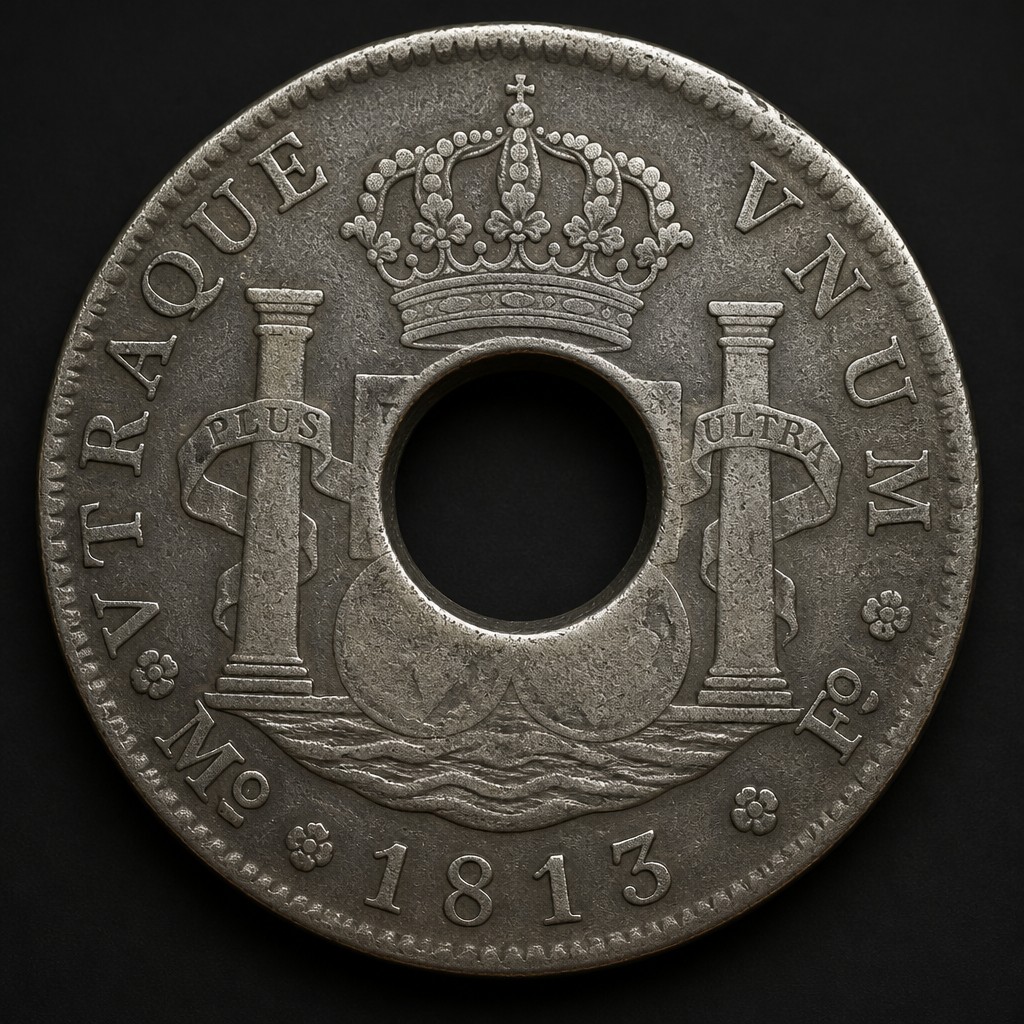
What This Coin Is
Facing a chronic shortage of circulating currency in the colony of New South Wales, Governor Lachlan Macquarie ordered thousands of imported Spanish eight-real silver dollars to have their centers punched out in 1813. The outer ring became the "Holey Dollar," valued at five shillings, and the small circular plug became the "Dump," valued at fifteen pence. Together the two pieces were worth more than the original dollar, discouraging the coins from being exported.
Obverse Design & Inscriptions
The Holey Dollar retains the original Spanish colonial design around its ring — typically a portion of the bust of the Spanish king (often Charles IIII) and Spanish legends — with a New South Wales counterstamp added over the top. The counterstamp reads "NEW SOUTH WALES 1813" around the rim. The Dump, being the small punched-out center, carries a newly struck design showing a crown and the words "NEW SOUTH WALES" around the edge.
Reverse Design & Inscriptions
On the reverse of the Holey Dollar, the original Spanish shield or pillar design remains visible around the hole, with "FIVE SHILLINGS" stamped across the field. The Dump's reverse carries "FIFTEEN PENCE" along with the date 1813, struck within a beaded or plain border.
Size, Weight, Metal & Edge
The Holey Dollar is a silver ring roughly the diameter of the original Spanish dollar (about 38–40 mm outer diameter) with a hole punched from the center. The Dump is a small silver disc cut from that same center, only a few grams in weight. Both pieces are silver, and edges are irregular where the punching process left tool marks, unlike a machine-milled edge.
Mint Marks & Where to Find Them
There is no separate mint mark as such; instead, authenticity rests on the New South Wales counterstamp and date, which should appear crisp and centered rather than blurry or off the rim.
Telling It Apart From Similar Coins
Because so few genuine examples survive and they are extremely valuable, the vast majority of Holey Dollars and Dumps encountered today are replicas, reproductions, or later fantasy pieces clearly marked as such, sold as souvenirs or educational items. A genuine 1813 piece will show an underlying original Spanish colonial coin design of the correct type and date beneath the counterstamp, not a generic or anachronistic host coin.
Judging Condition at a Glance
Look at how sharp the counterstamped lettering and crown design remain, and whether the host Spanish coin's original design elements are still legible. Circulation wear, cleaning, or corrosion around the punched hole all reduce value, while a piece with strong, even wear and a clear counterstamp is considered well preserved for the type.
Authenticity Red Flags
Given the extreme rarity and value of genuine examples, any Holey Dollar or Dump offered without a well-documented pedigree and without inspection by a recognized coin-grading service should be treated with strong skepticism. Common warning signs include a host coin of the wrong date or country, counterstamp lettering that looks too crisp or modern, a hole that looks laser-cut or too perfectly round rather than hand-punched, and metal that does not match expected silver fineness.
Frequently asked questions
What coins were used to make the Holey Dollar?
Spanish colonial silver eight-real coins (Spanish dollars) imported to New South Wales were punched to create the design.
Are most Holey Dollars on the market genuine?
No. Genuine 1813 examples are extremely rare and valuable; most pieces sold today are replicas or souvenir reproductions.
What was the Dump worth compared to the Holey Dollar?
The Dump was valued at fifteen pence, while the ring-shaped Holey Dollar was valued at five shillings.
How do I know if a Holey Dollar is a replica?
Check whether the host coin design, date, counterstamp sharpness, and hole shape match documented genuine examples; unclear provenance or a professional grading opinion is essential before assuming authenticity.