
How to Identify the Augustus Aureus Gaius and Lucius Caesar
A gold aureus of Emperor Augustus honoring his adopted grandsons and intended heirs, identified by its reverse showing the two young princes standing with shields and spears.
Read the full Augustus Aureus Gaius and Lucius Caesar encyclopedia entry →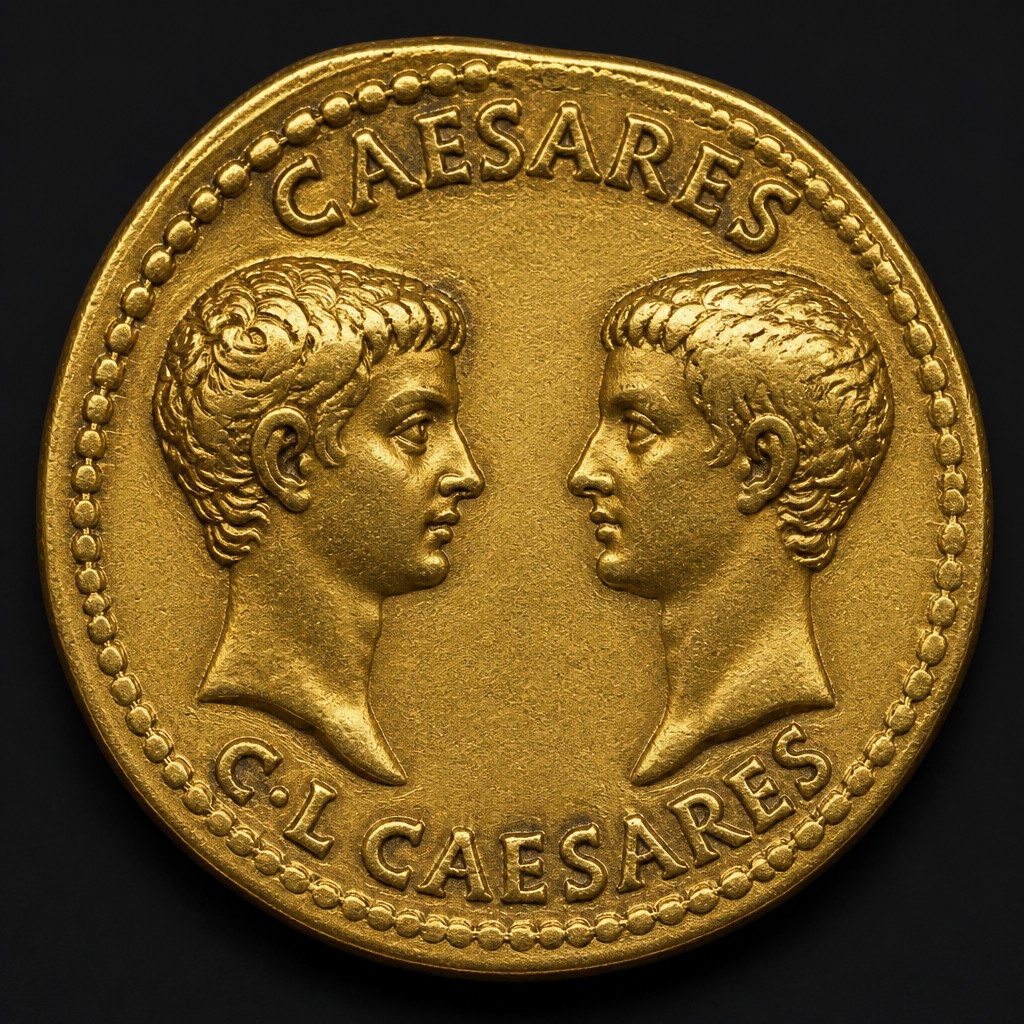
What This Coin Is
This gold aureus was struck under Augustus, the first Roman emperor, primarily in the years around 2 BC to 4 AD, and is dedicated to his grandsons and adopted sons Gaius and Lucius Caesar, whom he was grooming as his intended successors before both died young. It is one of the most historically resonant coins of the early Empire, capturing a pivotal and ultimately tragic succession plan.
Obverse Design & Inscriptions
The obverse shows a laureate head of Augustus facing right. The legend reads CAESAR AVGVSTVS DIVI F PATER PATRIAE ("Caesar Augustus, son of the deified [Julius Caesar], Father of the Fatherland"), reflecting his official titles adopted late in his reign.
Reverse Design & Inscriptions
The reverse depicts Gaius and Lucius Caesar standing facing, each resting a hand on a round shield set on the ground and holding a spear, with a simpulum (a ritual ladle used in sacrifice) and a lituus (an augur's curved staff) shown above the scene, both symbols of the priestly offices the young princes held. The legend reads AVGVSTI F COS DESIG PRINC IVVENT around the scene, identifying them as sons of Augustus, consuls-designate, and princes of the youth.
Size, Weight, Metal, and Edge
Struck in high-purity gold, this aureus follows the Augustan weight standard of approximately 7.7-7.9 grams and measures roughly 19-20mm in diameter. The edge is plain, as struck.
Mint Marks and Where to Find Them
Most examples of this type were struck at a mint associated with Lugdunum (modern Lyon), a major source of Augustan gold and silver coinage in the western provinces; there is typically no separate exergue mint mark, and attribution relies on established stylistic and die-based references for Augustan coinage from this mint.
Telling It Apart From Similar Coins
This type is easily recognized once the two standing youths with shields and spears are identified, since no other Augustan coin type repeats this exact scene, though later commemorative or family-themed Roman coins occasionally show paired standing figures in different contexts. Always confirm the specific legend naming Gaius and Lucius's honors (COS DESIG PRINC IVVENT) to distinguish this from other Augustus reverse types featuring different family members or subjects, such as his stepsons or later heir Tiberius.
Judging Condition at a Glance
Because gold resists corrosion, condition assessment centers on strike sharpness and wear rather than surface damage. Look for clear definition in the two youths' facial features, the shields' rims, and the simpulum and lituus above; a well-centered strike with a complete legend represents a higher-grade example, and genuine ancient gold often retains a warm, lustrous surface even after two thousand years.
Authenticity Red Flags
Given the strong historical importance and market value of this type, verify the weight closely against the roughly 7.7-7.9 gram Augustan gold standard, and examine the coin's color for a rich, consistent gold tone without unusual paleness suggesting a lower-purity alloy. Check the edge for file marks, solder seams, or other signs of tampering, and be wary of soft or indistinct details on the two figures that would be inconsistent with the crisp, high-relief die engraving typical of genuine Augustan gold. Because of its significance and value, professional authentication is strongly recommended before purchase.
Frequently asked questions
Who were Gaius and Lucius Caesar?
They were Augustus's grandsons, whom he adopted as sons and was grooming as his intended heirs, but both died young before they could succeed him, reshaping the imperial succession.
What do the simpulum and lituus symbols represent?
They are priestly ritual objects, a sacrificial ladle and an augur's staff, referencing religious offices held by the two young princes and reinforcing their elevated status.
What does PRINC IVVENT mean in the legend?
It stands for "princeps iuventutis," meaning "prince of the youth," an honorary title given to Gaius and Lucius marking them as leaders among Rome's young elite and heirs-apparent.
Why is this coin considered historically important?
It documents a specific, ultimately unrealized succession plan by Augustus, since both honored princes died before inheriting power, making the coin a snapshot of a pivotal moment in early imperial history.