
How to Identify the Athens New Style Tetradrachm
A collector's guide to the broad-flan owl: helmeted Athena, an owl on an amphora within an olive wreath, and dated magistrate marks.
Read the full Athens New Style Tetradrachm encyclopedia entry →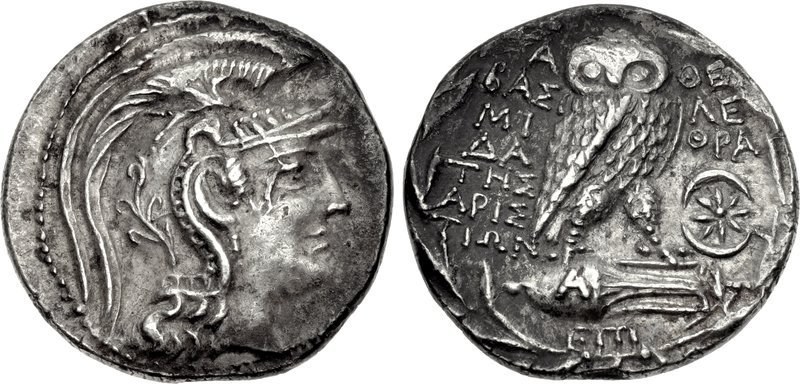
Begin with the coin's overall fabric, because it separates New Style owls from every earlier Athenian issue at a glance. These tetradrachms are struck on wide, thin flans roughly 28 to 35 mm in diameter, yet they still carry the full Attic weight of about 16.5 to 16.8 grams in good silver. If you have a compact, thick owl, you are looking at a Classical issue instead; the broad spread of metal is the New Style signature.
Read the obverse carefully. It shows the head of Athena facing right in a triple-crested Attic helmet ornamented with horse foreparts and a curling crest. Because the crest and hair flow together, an untrained eye or an automated scan can misread this as a long-haired or bearded male portrait, but the subject is always the goddess, never a king or emperor. Genuine dies show crisp helmet detail and a well-modeled cheek and eye; mushy, shallow features can indicate a cast copy.
The reverse is where identification is confirmed and dated. Look for an owl standing on a horizontal amphora, with the abbreviated ethnic A-Θ-E and the whole design ringed by a closed wreath of olive leaves. Then study the smaller marks: the amphora typically carries a single letter for the month of issue, monograms or symbols sit in the field, and one to three magistrate names run around the owl. These control marks are the key to attributing a coin to a specific year, such as the 86 BC date on the photographed example, using published die studies of the series.
Be aware of look-alikes and imitations. Some eastern mints and later imitators copied the New Style design, so check that the style of the Athena head, the wreath, and the lettering is consistent and competent. As with all high-value ancient silver, cast and struck forgeries exist; warning signs include a casting seam on the edge, a grainy or soapy surface, incorrect weight, tooling marks in the fields, and legends whose letter forms do not match authentic dies. For any significant purchase, favor coins with documented provenance or an attribution from a specialist in Athenian New Style coinage.
Frequently asked questions
What is the fastest way to confirm a New Style owl?
Check for a broad thin flan with an owl standing on an amphora inside an olive wreath. That combination of wide fabric, amphora, and enclosing wreath is unique to the New Style series and does not appear on earlier Athenian owls.
The obverse looks like a bearded man to me. Is it still Athena?
Yes. The triple-crested helmet and flowing hair can read as a long-haired or bearded head, but the New Style obverse always depicts the goddess Athena. There is no male-portrait version of this coin type.
How do I date a specific coin to a year like 86 BC?
Use the control marks: the letter on the amphora, the field symbols or monograms, and the magistrate names. These are cross-referenced against published die studies of the series to place a coin in its year. Precise dating usually requires specialist references.
What should make me suspect a forgery?
Watch for a wrong weight, an edge seam or grainy surface from casting, tooled fields, and lettering that does not match authentic dies. Given the coin's value, seek provenance or expert attribution before buying an expensive example.