
How to Identify the Athenian Owl Dekadrachm
A visual guide to the extremely rare Athenian silver dekadrachm, distinguished from the common owl tetradrachm by its much larger size, weight, and the same Athena/owl design struck massive.
Read the full Athenian Owl Dekadrachm encyclopedia entry →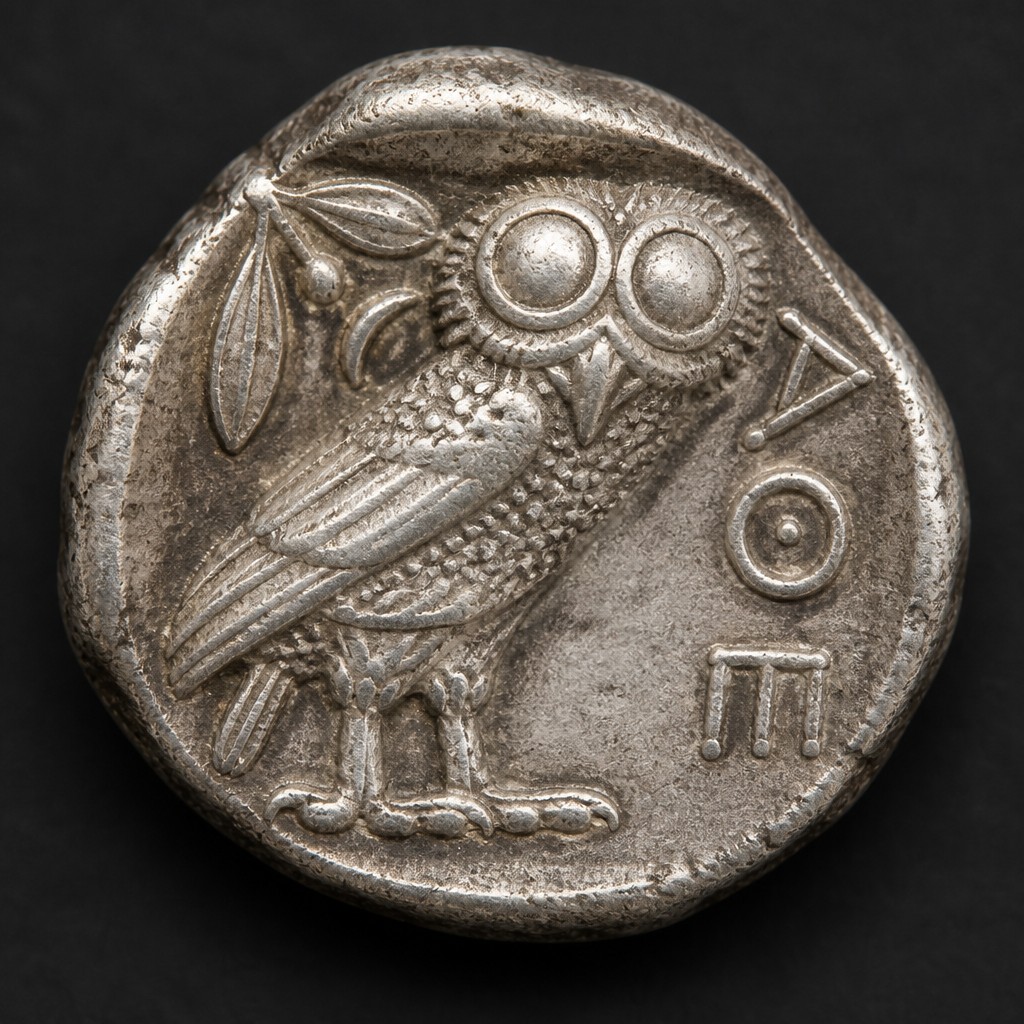
What It Is
The Athenian dekadrachm is a large silver coin struck in Athens in the decades after the Persian Wars, roughly the second quarter of the 5th century BC, worth ten drachms (twice the weight of the familiar owl tetradrachm). It shares the classic Athena and owl design of Athens' famous "owl" coinage but is far rarer, since it appears to have been struck in limited quantity, possibly to commemorate a military victory or mark a special payment. Most known examples trace to a small number of hoards, including one uncovered in Egypt in the 1970s.
Obverse
The obverse shows the helmeted head of Athena facing right. The crested Attic helmet is often decorated with a row of olive leaves and a scroll-like palmette on the bowl, and Athena wears an earring and a beaded necklace. The eye is rendered in the archaic-to-early-classical "almond" style typical of mid-5th-century Athenian dies.
Reverse
The reverse shows Athens' sacred owl standing right with its head turned to face forward, flanked by an olive sprig and crescent moon in the upper left field. To the right runs the abbreviated inscription ΑΘΕ (for Athenaion, "of the Athenians"). The design sits within a plain field rather than a deep incuse square, matching the reformed Athenian style of the period.
Size, Weight, and Metal
Genuine examples weigh close to 43 grams (roughly ten times the ~4.3-gram Athenian drachm) and measure around 34-36 mm across, noticeably larger and thicker than a tetradrachm. The metal is high-purity silver mined from the Laurion district near Athens, with a dense, heavy feel in hand.
Identifying the Mint and Period
There is no separate mint mark; the ΑΘΕ inscription and Attic-style Athena head are themselves the mint signature, identical in spirit to the ordinary owl tetradrachm but scaled up. Style of the eye, helmet decoration, and flan shape help specialists place a piece within the mid-5th-century Athenian series.
Telling It Apart From Similar Coins
The dekadrachm is most easily confused, at a glance, with an unusually large or double-struck tetradrachm. The decisive test is weight and diameter: a genuine dekadrachm is dramatically heavier and broader than any normal owl tetradrachm (~17.2 grams), not merely a thick example of the smaller coin.
Grading and Condition
Because so few exist, any example should be evaluated for centering, strike sharpness on Athena's helmet crest and the owl's feathers, and surface preservation. Test cuts, banker's marks, or old cleaning scratches are common on ancient silver of this size and do not necessarily indicate a fake, but should be noted.
Authenticity Red Flags
Given its rarity and value, this is one of the most heavily reproduced ancient coin types. Warning signs include incorrect weight or diameter, a suspiciously sharp or "too perfect" strike lacking natural die wear, cast-coin texture (tiny pits or a grainy surface rather than crisp metal flow lines), and seams from mold-based casting. Any example of this scale and rarity should be examined by a specialist in ancient Greek numismatics before assuming it is genuine.
Frequently asked questions
How rare is the Athenian owl dekadrachm?
It is one of the rarest widely recognized ancient Greek coin types, known from only a small number of surviving examples, mostly traced to a handful of hoards.
How do I tell a dekadrachm from a regular owl tetradrachm?
Weight and size are decisive: the dekadrachm weighs around 43 grams and is noticeably larger and thicker than the roughly 17.2-gram tetradrachm.
What does the ΑΘΕ inscription mean?
It is an abbreviation of Athenaion, meaning 'of the Athenians,' identifying the coin as an official Athens issue.
Why is this coin so often faked?
Its extreme rarity and high value make it an attractive target for casters and forgers, so any example should be checked carefully for cast texture, incorrect weight, or an unnaturally sharp strike.