
How to Identify the Armorican Billon Stater
An Iron Age coin from Armorica in ancient Brittany, struck in a silver-copper billon alloy with a highly abstract head and horse design derived from Greek prototypes.
Read the full Armorican Billon Stater encyclopedia entry →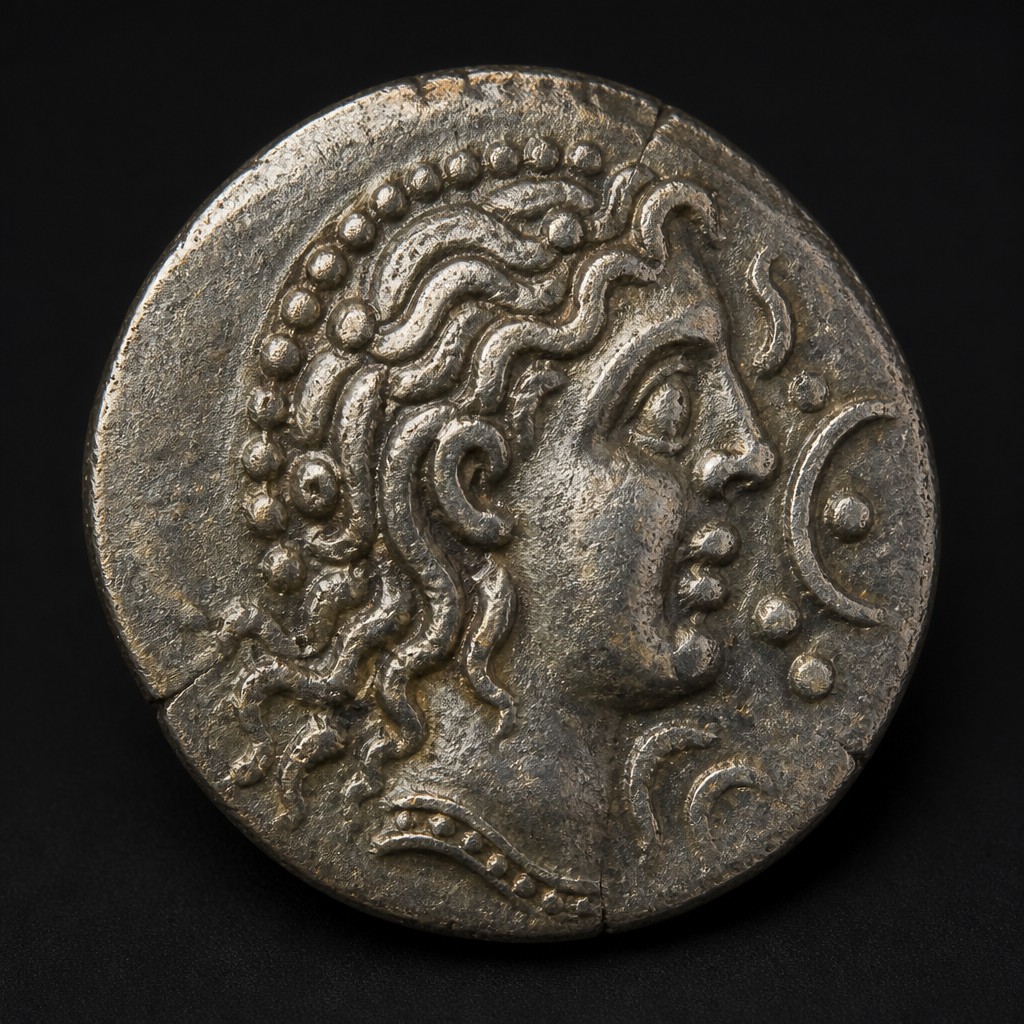
What the Coin Is
Armorican staters were struck by Celtic tribes of Armorica, the region roughly corresponding to modern Brittany in northwestern Gaul, during the Iron Age in the last couple of centuries BCE. Unlike the pure gold staters of some neighboring tribes, many Armorican issues were struck in billon, a debased alloy mixing silver with copper, reflecting regional minting practices and available metal supplies.
Obverse Design
The obverse carries a highly abstracted human head, ultimately derived like other Celtic coinage from Greek and Macedonian prototypes, commonly Philip II or Alexander-type staters, but rendered by Armorican die engravers in a bold, geometric style featuring exaggerated curls, dots, and crescent-shaped elements that can appear almost ornamental rather than representational.
Reverse Design
The reverse depicts a similarly stylized horse, often shown with disjointed or "exploded" body segments, pellet clusters, and small accompanying symbols scattered across the field, a hallmark of the increasingly abstract Armorican die-engraving tradition that pushed Celtic coin art toward striking, non-naturalistic patterns.
Size, Weight, Metal, Edge
Armorican billon staters are struck in a silver-copper alloy, typically weighing in the range of 5.5 to 6.5 grams with a diameter around 18-20 mm, though exact composition and weight vary by specific tribe and issue within the broader Armorican coinage tradition. The edge is plain and irregular, and the surface color often shows a duller gray-silver tone rather than the bright yellow of pure gold issues, reflecting the debased alloy.
Telling It Apart from Similar Coins
The metal itself is a key clue: a coin with a dull gray or silvery-gray surface rather than a rich gold color points toward a billon issue typical of many Armorican types, as opposed to the pure gold staters struck by some other Gallic tribes. Distinguishing between the many specific Armorican tribal issues, such as those attributed to the Coriosolites, Osismii, or Redones, generally requires comparing fine stylistic details of the head and horse, along with accompanying symbols, against documented tribal attributions.
Judging Condition at a Glance
Because billon can tone and corrode differently than pure gold or silver, look for even coloration without excessive pitting or corrosion spots, along with a clear, well-struck rendering of the abstract head and horse patterns. A well-centered strike that fully shows the geometric design elements is considered a stronger example of the type.
Authenticity Red Flags
Watch for a metal color or weight inconsistent with a genuine silver-copper billon composition, casting bubbles or seams suggesting a cast forgery, and stylistic elements, such as curl patterns, pellet arrangements, or horse proportions, that don't match documented genuine Armorican types. Because billon can be more easily replicated with base-metal alloys than gold, careful weight and specific gravity checks alongside stylistic comparison are especially useful for this series.
Frequently asked questions
What does "billon" mean?
Billon is a low-value alloy of silver mixed with a larger proportion of copper or other base metal, giving the coin a duller gray-silver appearance rather than bright gold or silver luster.
Why do Armorican coins look so abstract?
Like other Celtic coinages, Armorican types descend from repeated copying of Greek/Macedonian prototypes over generations, with each generation of die engravers pushing the design further from the original naturalistic image toward bold geometric abstraction.
How can I tell which Armorican tribe struck a given coin?
Compare specific stylistic details of the head and horse, along with any accompanying symbols, to documented examples attributed to tribes such as the Coriosolites, Osismii, or Redones.
What weight and metal should I expect?
Most examples are billon, a silver-copper alloy, weighing roughly 5.5-6.5 grams, noticeably duller in color than a pure gold or pure silver coin.
What's a sign the coin might be a modern fake?
A metal color or weight that doesn't match genuine billon composition, casting bubbles or seams, or stylistic details on the head or horse that don't correspond to documented genuine Armorican types.