
How to Identify the Arkansas Centennial Half Dollar
A 1935-1939 commemorative half dollar marking 100 years of Arkansas statehood, with a Native American and Liberty head pairing on the obverse and an eagle on the reverse.
Read the full Arkansas Centennial Half Dollar encyclopedia entry →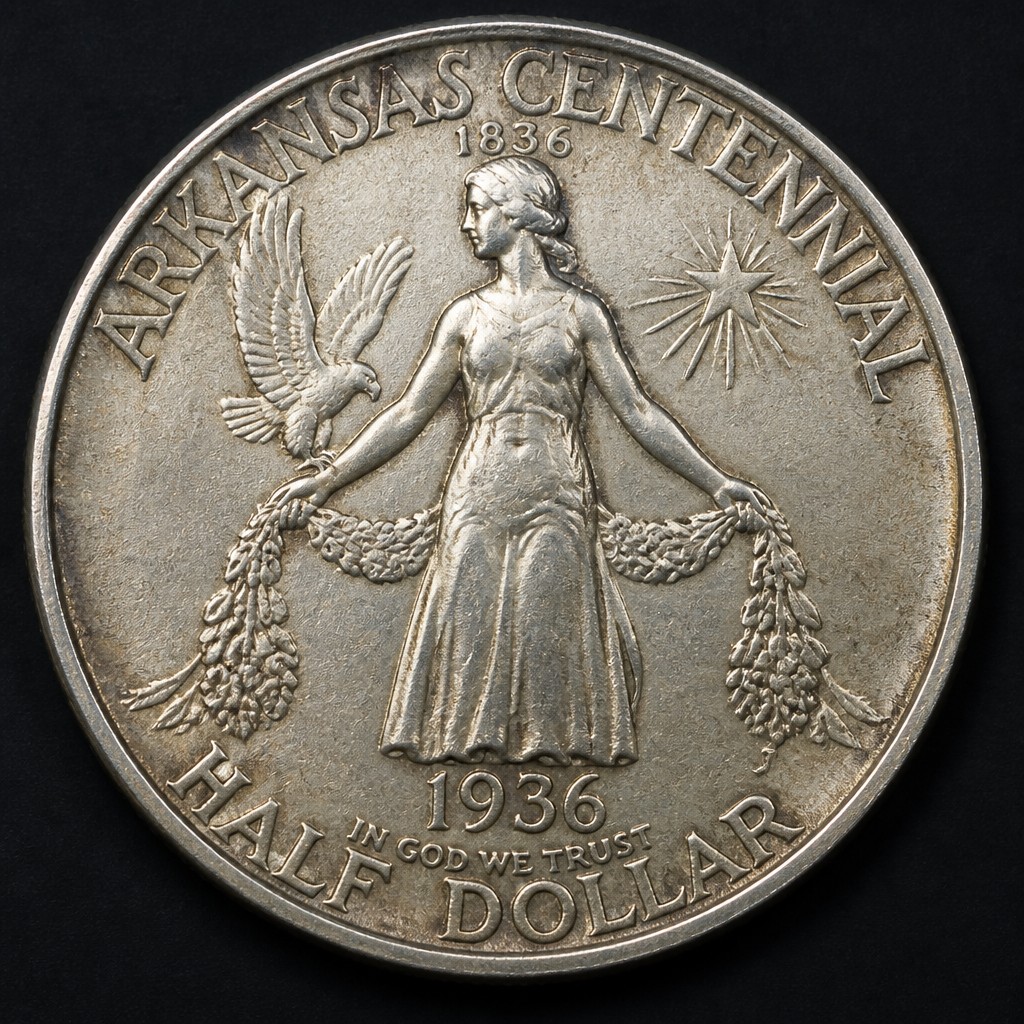
What This Coin Is
Issued from 1935 through 1939, the Arkansas Centennial Half Dollar commemorates the 100th anniversary of Arkansas statehood. It was designed by Edward Everett Burr with sculptural assistance, and like several 1930s commemoratives, it was struck across multiple years and mints, largely for sale directly to collectors.
Obverse Design & Inscriptions
The obverse shows two conjoined profile heads side by side — a Native American figure representing the past and an idealized Liberty-type female head representing the present — beneath an eagle with spread wings. "ARKANSAS CENTENNIAL" and the relevant date appear in the legend.
Reverse Design & Inscriptions
The reverse depicts an eagle with wings spread, with inscriptions referencing the state and the centennial theme, along with "HALF DOLLAR."
Size, Weight, Metal, Edge
Standard half dollar specifications: about 30.6mm in diameter, 12.5 grams, 90% silver, reeded edge.
Mint Marks & Where to Find Them
Coins were struck at Philadelphia, Denver, and San Francisco across the series, with mint marks appearing on the obverse or reverse near the design elements. Because the series spans five years across three mints, matching both date and mint mark is necessary to identify a specific issue.
Telling It Apart From Similar Coins
The dual conjoined heads on the obverse are distinctive to this series and not found on other commemoratives. Within the series, later-year issues (1938 and 1939) were struck in much smaller numbers than the initial 1935 issue, so date and mint combination matter significantly for identifying a specific coin's scarcity.
Judging Condition at a Glance
Because most issues were sold directly to collectors in complete sets rather than circulated, high-grade examples are common throughout the series. Check the two portrait heads for softness in the hair and profile details, and examine the eagle's wing feathers on both sides for flattening from handling.
Authenticity Red Flags
Confirm weight (12.5 grams) and diameter (30.6mm), and check for a magnetic reaction, which would indicate a fake. Because later, lower-mintage dates in this series carry noticeably higher premiums than the common 1935 issue, be cautious of mint marks or dates that appear altered, re-engraved, or added to a common coin to simulate a scarcer combination — have any example representing a specific date verified by a professional grading service before relying on it.
Frequently asked questions
What years and mints was this coin struck at?
1935 through 1939, at the Philadelphia, Denver, and San Francisco mints.
What's shown on the obverse?
Two conjoined profile heads, a Native American figure and an idealized Liberty-type head, beneath a spread-winged eagle.
Why are some dates in this series worth more than others?
Later years like 1938 and 1939 had much smaller mintages than the initial 1935 issue, sold mainly to collectors, making them scarcer.
What does the reverse show?
An eagle with wings spread, alongside inscriptions referencing Arkansas's statehood centennial.
How do I identify which mint struck a specific coin?
Look for a small 'D' or 'S' mint mark near the design elements; no letter indicates the Philadelphia Mint.