How to Identify the Argentine 8 Escudos Gold (1813)
The 1813 gold 8 escudos, struck at Potosí for the United Provinces of Río de la Plata, is famed for its radiant 'Sol de Mayo' sun design and is one of the most historic coins of early Argentine independence.
Read the full Argentine 8 Escudos Gold (1813) encyclopedia entry →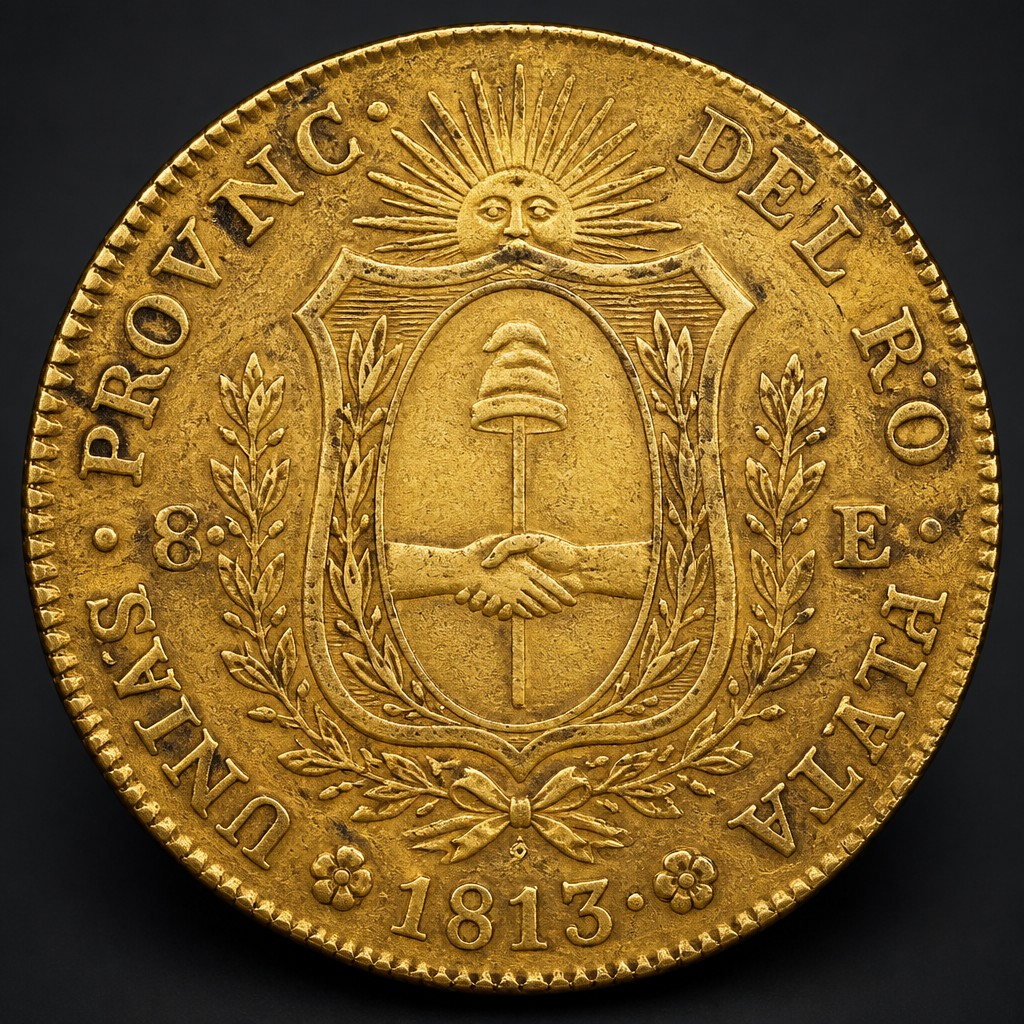
What the Coin Is
Issued in 1813 by the United Provinces of Río de la Plata (a precursor state to modern Argentina), this gold 8 escudos was struck at the Potosí mint using leftover colonial-era gold planchets and dies adapted for the new revolutionary government. It marks one of the first independent gold coinages of the region and is prized for its historical significance.
Obverse Design & Inscriptions
The obverse features the iconic "Sol de Mayo" — a radiant sun with a human face rising over a mountain range representing the Andes, with a pair of clasped hands emerging from clouds below, symbolizing the union of the provinces. A Phrygian liberty cap on a pole often appears near the hands, and the legend reads something to the effect of "PROVINCIAS DEL RIO DE LA PLATA" with the date 1813.
Reverse Design & Inscriptions
The reverse typically shows a wreath surrounding the denomination "8 ESCUDOS," with mintmark and assayer initials, plus a legend referencing the assay or fineness of the gold. Because these were struck hastily using older colonial equipment, reverse details can appear somewhat irregular compared to later, more refined coinages.
Size, Weight, Metal, Edge
Struck in gold at a fineness close to .875–.900, the 8 escudos weighs around 27 grams with a diameter near 37 mm — the same general size class as the Spanish colonial 8 escudos ("doubloon") it succeeded. The edge is typically lettered or reeded depending on the specific die pairing used.
Mint Marks & Where to Find Them
Look for "PTS" (Potosí) on the reverse near the wreath, accompanied by assayer initials of the period. Because dies were adapted quickly during a politically turbulent time, letter spacing and positioning can vary between individual dies.
Telling It Apart from Similar Coins
This coin is often confused with later Argentine gold issues or with the colonial Spanish 8 escudos it replaced. The key identifier is the revolutionary "Sol de Mayo" and clasped-hands design combined with the 1813 date and Río de la Plata legend, rather than a Spanish monarch's portrait.
Judging Condition at a Glance
Because these coins were struck under difficult wartime conditions, weak strikes and die irregularities are common even on coins with little actual circulation wear — this is normal for the issue and not automatically a sign of damage. True wear shows as smoothing on the sun's face and the clasped hands, the highest points of the design.
Authenticity Red Flags
Given its historical importance and value, this coin is a frequent target for replicas and fantasy pieces. Be wary of examples with overly sharp, modern-looking design elements inconsistent with the somewhat crude period striking, incorrect weight or diameter, or a yellow color that doesn't match the expected warm, slightly reddish hue of period colonial-fineness gold.
Frequently asked questions
What makes the 1813 8 escudos historically significant?
It's one of the earliest gold coins struck by an independent government in the Río de la Plata region, featuring a revolutionary sun design instead of a Spanish king's portrait.
What is the 'Sol de Mayo' design?
It's a radiant sun with a human face, referencing the May Revolution of 1810, and it appears over an Andean mountain range with clasped hands below.
Where was this coin minted?
It was struck at the Potosí mint, marked 'PTS' on the reverse, using equipment and planchets left over from the colonial period.
How heavy is the coin and what is it made of?
It's struck in gold at roughly .875–.900 fineness, weighing about 27 grams with a diameter near 37 mm.
Why do genuine examples sometimes look poorly struck?
Wartime minting conditions in 1813 led to irregular strikes and die wear, so soft details don't necessarily indicate a fake or heavily circulated coin.
Argentine 8 Escudos Gold (1813) identified by the community
Recent Argentine 8 Escudos Gold (1813) coins identified with Coin Identifier.