
How to Identify the Antoninianus of Claudius II
A collector's guide to recognizing a billon antoninianus of Claudius II Gothicus by its radiate portrait, legends, size, metal, and reverse type.
Read the full Antoninianus of Claudius II encyclopedia entry →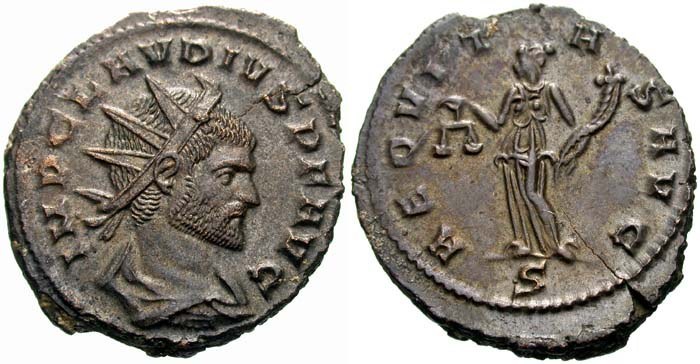
Begin with the portrait and crown. An antoninianus of Claudius II shows the emperor's head in right or left profile wearing a radiate crown, the ring of spikes that stands in for the sun's rays. This spiked crown is the single most important diagnostic: it marks the coin as an antoninianus rather than a laurel-wreathed denarius. Then read whatever survives of the obverse legend around the rim, looking for the name CLAVDIVS in forms such as IMP C CLAVDIVS AVG. Third-century legends are often partly worn or weakly struck, so reading even a few letters can be enough.
Check size, weight, and metal together. These coins are small, generally about 18 to 20 mm in diameter, and feel light in the hand. The fabric is billon or bronze, so a genuine piece almost always shows a brown, tan, green, or dark patina; a bright silvery surface is unusual and, on a coin this late, can be a warning sign of a modern reproduction or heavy cleaning. Do not expect fine, machine-perfect edges, as these were hand-struck on roughly prepared flans.
Study the reverse to narrow the exact type. The example here shows a standing deity or personification, a very common format. Note what the figure holds, such as a scepter, spear, cornucopia, patera, or small statue, and try to read the reverse legend, which names the god or virtue (for example PROVIDENTIA AVG, SALVS AVG, or PAX). A small mint mark or letters in the exergue, the space below the ground line, can help attribute the issuing mint. Together the reverse figure, its attributes, and the legend define which specific type you have.
Watch for look-alikes and posthumous issues. Claudius II's coins are easily confused with antoniniani of other soldier-emperors of the same era, such as Gallienus, Aurelian, or the Tetrici, which share the radiate portrait and standing-deity reverses; the obverse legend is what tells them apart, so always try to read the name. Be aware too of the abundant posthumous memorial coins struck after his deification, often with an altar or eagle and the legend CONSECRATIO. These are genuine ancient coins but represent a different, later series than his lifetime issues.
On authentication, most antoniniani of Claudius II are inexpensive enough that outright forgery is uncommon, but tooled surfaces, added or re-engraved detail, and modern casts do exist. Look for a natural, hard patina rather than a painted or powdery surface, and be cautious of coins with unnaturally sharp, soapy-looking detail. When in doubt on a more expensive example, buy from a reputable dealer or seek expert opinion.
Frequently asked questions
What is the quickest way to tell it is an antoninianus and not a denarius?
Look at the crown. An antoninianus shows the emperor in a spiked radiate crown, while a denarius uses a laurel wreath. The radiate crown is the fastest single indicator of the denomination.
How do I know the coin is Claudius II and not another emperor?
Read the obverse legend around the portrait for the name CLAVDIVS in forms like IMP C CLAVDIVS AVG. Because many third-century emperors share the radiate bust and standing-deity reverses, the legend is the reliable way to attribute it.
Should the coin look silver or bronze?
Expect bronze. By this period the antoninianus was billon with only a thin silver wash that has usually worn off, so a brown or dark patina is normal and a bright silvery surface is unusual for the type.
What is a CONSECRATIO coin of Claudius II?
It is a posthumous memorial antoninianus struck after Claudius II was deified, typically showing an altar or eagle with the legend CONSECRATIO. It is genuinely ancient but belongs to a later commemorative series, not his lifetime coinage.