
How to Identify the Anglo-Saxon Silver Penny
How to identify an Anglo-Saxon silver penny by its royal portrait obverse, cross or geometric reverse, moneyer's name, and mint town abbreviation.
Read the full Anglo-Saxon Silver Penny encyclopedia entry →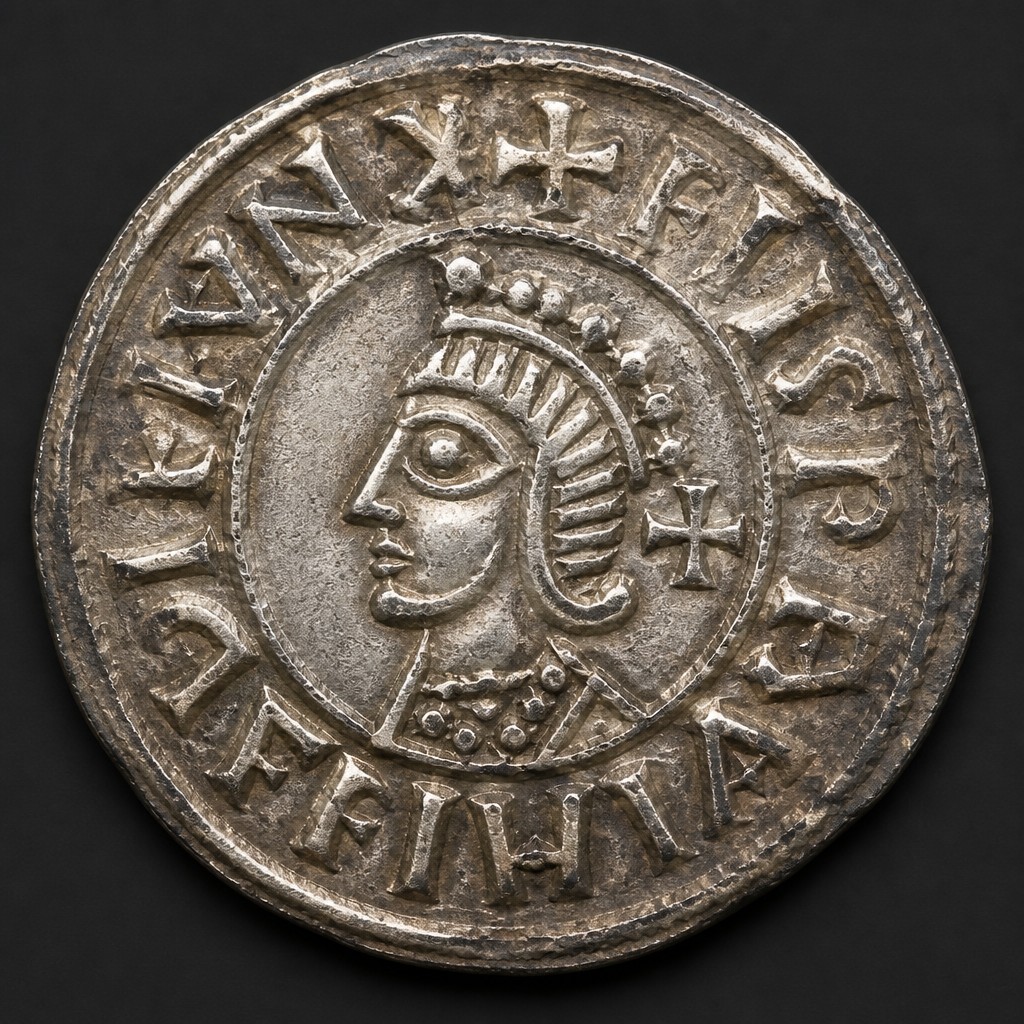
What It Is
The silver penny was the workhorse coin of Anglo-Saxon England, minted from around the 760s under King Offa of Mercia through the Norman Conquest of 1066 and beyond. It set the pattern for English coinage for centuries and is the direct ancestor of the later medieval penny.
Obverse Design & Inscriptions
Most pennies carry a bust or stylized portrait of the issuing king, ranging from crude and abstract on earlier types to more careful royal portraits later on. Around the border runs a Latin legend naming the king, such as "+OFFA REX" or, for later rulers, a fuller title like "+EADGAR REX ANGLOR."
Reverse Design & Inscriptions
Reverse designs vary considerably by period and ruler: small crosses, long crosses, geometric patterns, or symbolic motifs. Rather than a separate mint mark, the reverse legend names the moneyer (the official responsible for striking the coin) and the mint town, for example "+LEOFPINE ON LVND" for a moneyer named Leofwine working at London.
Size, Weight, Metal, and Edge
These are small, thin silver coins, typically 18-20mm across and weighing roughly 1.3 to 1.5 grams, hand-struck on a broad, often irregular flan with a plain edge.
Mint Marks & Where to Find Them
Rather than a symbol, the mint is spelled out in the reverse legend. Over seventy different mint towns operated across Anglo-Saxon England, including London, Winchester, York, and Canterbury, each abbreviated in the moneyer's inscription.
Telling It Apart From Similar Coins
Anglo-Saxon pennies can resemble later Norman pennies, which continue a similar format but carry different royal names and a somewhat different portrait style. Viking rulers in the Danelaw also struck imitative pennies copying Anglo-Saxon designs; these often show cruder lettering or blundered legends compared to genuine royal issues.
Judging Condition & Grade
Assess how clear the portrait, legend, and moneyer's name remain, and how well the design is centered on the irregular flan. Deliberate edge-clipping, done historically to shave off silver, is common and reduces both weight and eye appeal.
Authenticity Red Flags
Cast reproductions typically show a seam around the edge, a slightly porous surface, and incorrect weight. Modern electrotype copies (two shells fused together) may show a visible dividing line on the edge. On genuine but worn coins, watch for tooling intended to sharpen or fake a rare moneyer or mint name.
Frequently asked questions
How do I identify which mint struck an Anglo-Saxon penny?
The mint town is spelled out, usually abbreviated, in the reverse legend alongside the moneyer's name rather than shown as a separate symbol.
Why do some pennies look clipped or irregular around the edge?
Silver pennies were often deliberately clipped by contemporaries to shave off small amounts of silver, which is why many surviving examples are lighter and less round than when struck.
How can I tell a genuine coin from a Viking imitation?
Viking imitative pennies from the Danelaw often have cruder engraving or garbled, blundered legends compared to the cleaner lettering typical of official royal mints.
What is the moneyer's name on the coin?
It identifies the official personally responsible for striking that coin, a practice used to enforce quality and accountability rather than naming the mint alone.