
How to Identify the Angel
A visual guide to the English gold Angel, identified by its Archangel Michael slaying a dragon on the obverse and a ship bearing a shield and cross on the reverse.
Read the full Angel encyclopedia entry →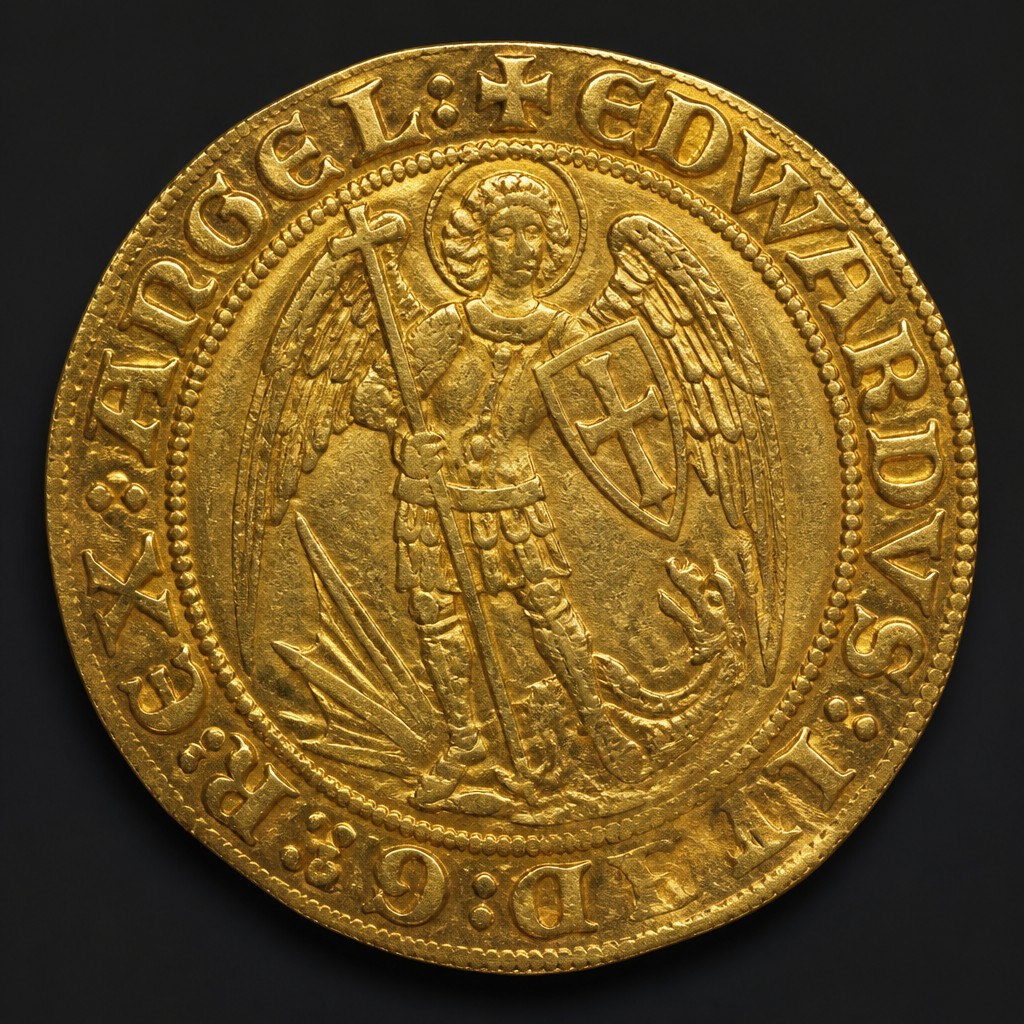
What It Is
The Angel was an English gold coin first introduced in 1465 under King Edward IV, taking its name from the depiction of the Archangel Michael on its obverse. Beyond its role as currency, the Angel became closely associated with the royal ceremony of "touching for the King's Evil," in which monarchs presented pierced Angels to those they ritually touched to cure scrofula, a practice that continued for generations. Its value shifted over time across different reigns before it was discontinued in the 17th century.
Obverse Design and Inscriptions
The obverse depicts the Archangel Michael standing and spearing a dragon beneath his feet, a powerful and immediately recognizable image. A Latin legend naming the reigning monarch runs around the border.
Reverse Design and Inscriptions
The reverse shows a ship with a large cross for a mast, often with a shield bearing the royal arms hanging from the side of the vessel, accompanied by a Latin religious inscription typical of English gold coinage from this period.
Size, Weight, Metal, and Edge
As a hand-hammered gold coin, the Angel's weight and diameter shifted somewhat across different reigns and re-tariffings, generally in the range of about 5 grams in its earlier form, with later adjustments as gold values and coinage standards changed. Being hammered rather than milled, it has a plain, somewhat irregular edge rather than a modern reeded one.
Mint Marks and Where to Find Them
Like other English hammered coins, Angels typically carry a small privy mark at the start of the legend, used by numismatists to help date the coin to a specific minting period within a monarch's reign; identifying these marks generally requires comparison with specialist hammered-coinage references.
Telling It Apart From Similar Coins
The combination of the Archangel Michael and dragon on the obverse is unique to the Angel among English coins and makes it readily distinguishable from the earlier Gold Noble (which shows a king in a ship) once genuineness is confirmed. Pierced examples, showing a small hole near the top, are notable survivors used historically as touch pieces rather than as ordinary currency.
Judging Condition at a Glance
Examine the fine detail of Michael's wings, the dragon beneath his feet, and the ship's rigging on the reverse, since hand-engraved dies from this era can vary in sharpness even on coins with little actual circulation wear. A clear, well-centered strike with legible legend is a good sign of quality for a hammered coin.
Authenticity Red Flags
Because genuine Angels are rare and historically significant, be alert to overly crisp, machine-like edges inconsistent with hand-hammering, incorrect weight, or artificially added piercing meant to imitate a genuine touch-piece. Given the specialized nature of hammered gold coinage, professional attribution is strongly recommended before relying on a visual assessment alone.
Frequently asked questions
What is depicted on the Angel coin?
The obverse shows the Archangel Michael spearing a dragon, and the reverse shows a ship with a cross-shaped mast, often bearing a royal shield.
Why do some Angels have a hole in them?
Pierced examples were used as 'touch pieces,' given by the monarch to people during the ceremonial touching for the King's Evil, a ritual believed to cure a skin disease called scrofula.
When was the Angel coin introduced?
It was first struck in 1465 during the reign of King Edward IV.
How is the Angel different from the Gold Noble?
The Noble shows a king standing in a ship, while the Angel shows the Archangel Michael slaying a dragon; the two have distinct obverse designs from different periods of English gold coinage.