
How to Identify the Ancient Greek Didrachm
A collector's guide to recognizing an ancient Greek silver didrachm by its two-drachm weight, bearded-head obverse, and horseman reverse.
Read the full Ancient Greek Didrachm encyclopedia entry →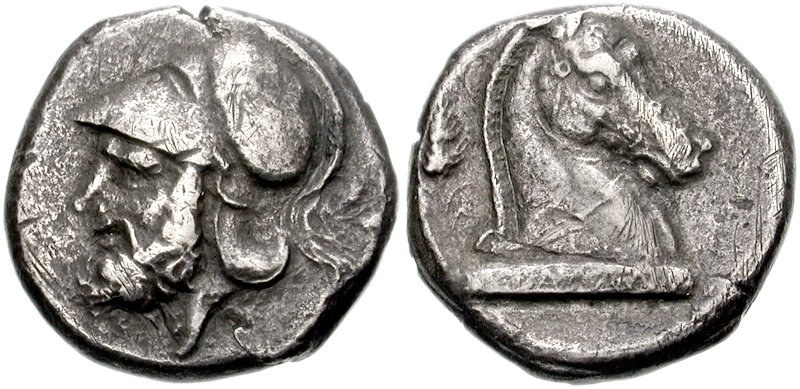
Begin with the denomination itself. A didrachm is a silver coin worth two drachms, so weight and diameter do much of the identification: it should sit above a single drachm and below a large tetradrachm on the relevant standard. Weigh and measure the coin and compare it against published figures for didrachms, since the same designs were sometimes struck in different denominations and the weight is what separates them.
Read the two faces closely. On this coin the obverse is a bearded male head facing left, and the reverse is a horse carrying a rider, a horseman. Record the facing direction of the head and horse, the styling of the beard and hair, whether the rider is nude, armed, or crowning the horse, and any small symbols, letters, or figures in the field. These details, not the denomination, are what tie the coin to a specific city and issue, and they distinguish it from other Greek silver that reuses similar heads and horses.
Hunt for the ethnic, the abbreviated Greek name of the issuing city, usually placed in the field or along the rim. When legible it is the single best clue to attribution; cities of Magna Graecia such as Taras are strongly associated with horseman reverses, but many mints used comparable types, so the legend and precise style are needed to be certain. Use good light and magnification, since on worn or off-center flans the letters are often partial.
Expect the look of ancient hand-striking: irregular flans, uneven centering, variable borders, and natural toning or patina. Genuine coins vary from strike to strike and are never perfectly uniform. Be wary of pieces that look too smooth, too sharp, or suspiciously flawless, as these can signal tooling, casting, or modern forgery. Because ancient Greek silver is heavily counterfeited, treat authentication, expert opinion, and documented provenance as part of the identification rather than an afterthought.
Frequently asked questions
How do I confirm a coin is a didrachm and not another denomination?
Weigh and measure it. A didrachm equals two drachms and has a characteristic weight and diameter on its standard, heavier than a drachm and lighter than a tetradrachm. Since similar designs appear on different denominations, weight is the deciding factor.
What should I look for on the two faces?
On this coin, a left-facing bearded male head on the obverse and a horse with a rider on the reverse. Note facing direction, the beard and hair style, whether the rider is armed or nude, and any field symbols or letters to narrow down the city and issue.
How can I tell which city struck it?
Look for the ethnic, the abbreviated Greek city name in the field or along the rim, and study the artistic style. Horseman reverses point toward Magna Graecia, but the legend and precise style are needed to attribute the coin to a specific mint.
How do I avoid buying a fake?
Ancient Greek silver is frequently forged, cast, or tooled. Favor coins with credible provenance, auction or dealer records, or third-party certification, and be cautious of pieces that look unnaturally smooth, sharp, or perfectly centered.