
How to Identify the Ancient British Gold Stater (Cunobelin)
A pre-Roman British gold coin of King Cunobelin, identified by its ear-of-grain design on one side and a horse with his name and mint abbreviation on the other.
Read the full Ancient British Gold Stater (Cunobelin) encyclopedia entry →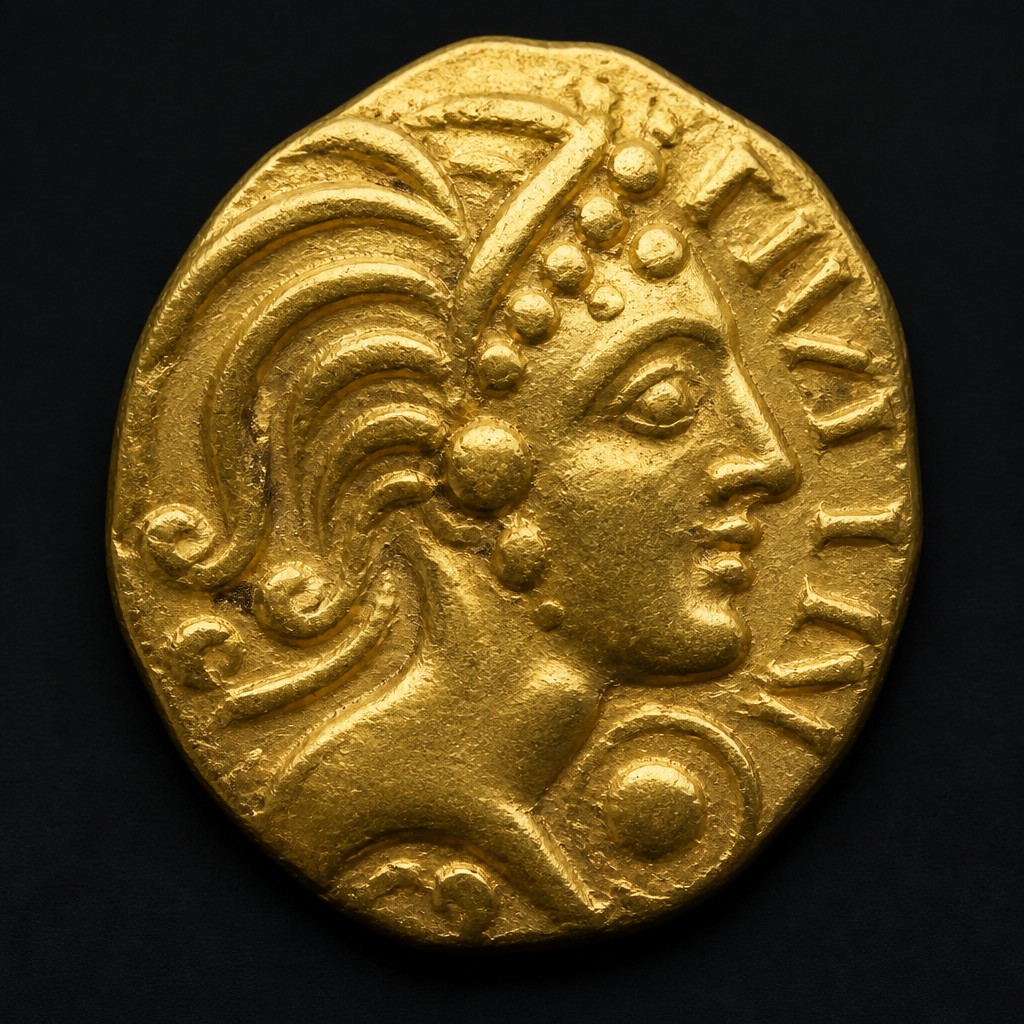
What the Coin Is
Cunobelin, the historical figure behind Shakespeare's "Cymbeline," ruled the Catuvellauni tribe and dominated much of southeastern Britain in the early 1st century CE, shortly before the Roman conquest. His gold staters, struck at his capital Camulodunum, modern Colchester, represent some of the most developed and recognizable native British coinage of the pre-Roman Iron Age.
Obverse Design & Inscription
The most common obverse type shows a stylized ear of grain, wheat or barley, dividing the legend, with the letters "CAMV," an abbreviation for Camulodunum, his capital and mint, typically placed within or beside the design. This agricultural motif reflects both regional imagery traditions and Cunobelin's economic power.
Reverse Design & Inscription
The reverse shows a horse galloping or rearing, a common Celtic coin motif ultimately derived from earlier Macedonian coin types, often accompanied by a small symbol such as a star, branch, or wheel above or below the horse. The ruler's name, typically abbreviated "CVNO" or spelled more fully as "CVNOBELIN," appears as part of the design, confirming the coin's attribution.
Size, Weight, Metal, Edge
These staters are struck in gold, generally weighing around 5.3 to 5.5 grams, with a diameter of roughly 17-18 mm. The edge is plain and irregular, as typical of ancient hand-struck coinage, and the flan is usually somewhat uneven in thickness.
Telling It Apart from Similar Coins
The "CAMV" mint abbreviation and "CVNO" or "CVNOBELIN" name together make Cunobelin's staters straightforward to distinguish from coins of earlier or contemporary British rulers, such as Tasciovanus, his likely predecessor, whose coins instead carry his own name and sometimes different mint abbreviations. Compared to Gallic staters from the continent, British staters of this period, including Cunobelin's, generally show more legible Latin-alphabet lettering and clearer, less abstracted design elements, reflecting increasing Roman cultural influence in Britain even before conquest.
Judging Condition at a Glance
Look for clear legibility of the "CAMV" and "CVNO"/"CVNOBELIN" inscriptions and well-defined detail in the grain ear and horse, since these are the key attribution features. A well-centered strike showing both inscriptions fully is considered a more desirable example than one with partial or off-center lettering. Because these staters were struck on hand-cut flans, minor doubling or light die wear on the horse's legs is common and does not necessarily detract much from an otherwise well-struck example.
Authenticity Red Flags
Modern forgeries may show lettering that doesn't match documented genuine die varieties, an incorrect gold color or weight, casting bubbles or seams indicating a cast rather than struck origin, or a horse and grain design that looks subtly off compared to well-documented genuine examples. Because Cunobelin's coinage is well studied, comparing letter forms, symbol placement, and weight against published genuine examples is the most reliable identification approach.
Frequently asked questions
What does "CAMV" stand for?
It abbreviates Camulodunum, Cunobelin's capital, modern Colchester, England, and the mint where these coins were struck.
How do I confirm the coin is attributed to Cunobelin specifically?
Look for his name, abbreviated "CVNO" or spelled "CVNOBELIN," as part of the design, usually alongside the horse on the reverse.
What is depicted on the obverse?
A stylized ear of grain, reflecting agricultural imagery and economic themes associated with Cunobelin's rule.
How much gold and what size should a genuine stater be?
Genuine examples typically weigh around 5.3-5.5 grams in gold, with a diameter of roughly 17-18 mm.
How is this different from coins of Tasciovanus?
Tasciovanus, generally considered Cunobelin's predecessor, issued coins bearing his own name and, in some cases, different mint abbreviations, so reading the ruler's name is the key distinguishing feature.