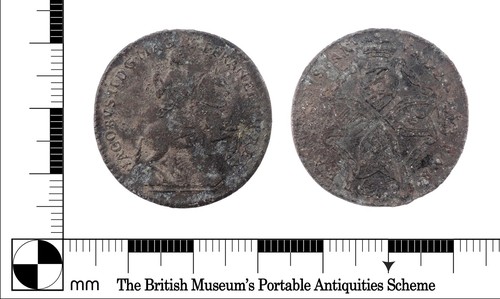
American Plantations Token
A 1688 tin token struck under James II for England's American colonies, valued at 1/24 of a Spanish real — the first regal-authorized coinage for British America.
- Country
- Britain (James II)
- Denomination
- Token (1/24 part of a Spanish real)
- Metal
- Tin alloy
Got a coin like this?
Identify any coin from a photo, free.
Overview
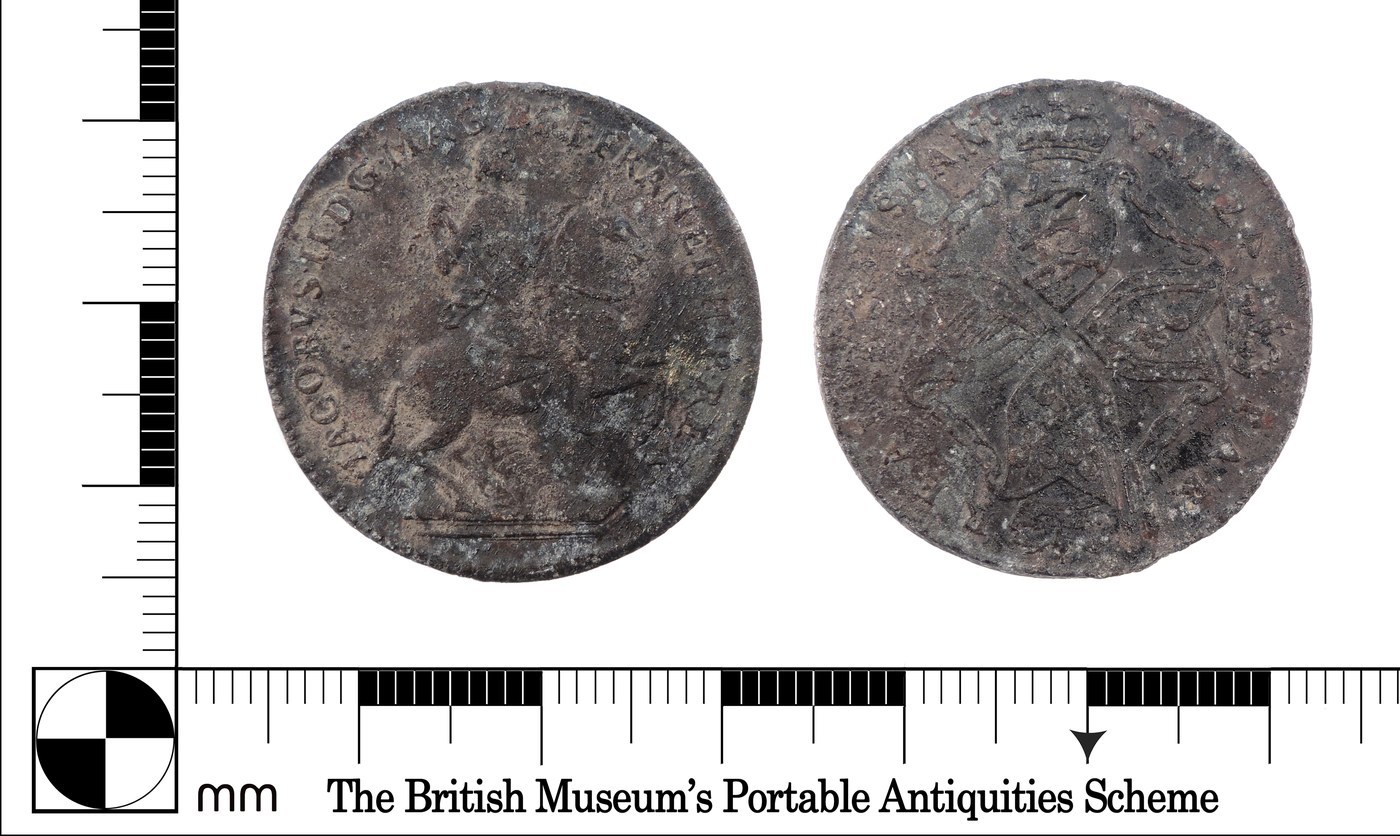
The American Plantations Token is a small tin piece struck in 1688 during the reign of James II, made to circulate as small change in England's American colonies. It carries a royal portrait and Latin legend on one side and heraldic shields on the other, and was rated at one twenty-fourth part of a Spanish real — the silver coin that dominated colonial trade.
Cast and struck in tin rather than silver or copper, the token is prized today less for its metal than for its place in history: it is generally regarded as the first coinage authorized under royal patent specifically for the British colonies in America. Surviving pieces are almost always found with some degree of surface corrosion, a consequence of the reactive tin from which they were made.
Because of this colonial connection, the token is a cornerstone type in early American numismatics and is actively collected alongside other pre-federal issues such as the Rosa Americana coins and the Elephant tokens.
History & Background
In 1688 King James II granted a patent to Richard Holt to strike tin tokens for use in the American plantations, chiefly the tobacco and sugar colonies. Tin was a deliberate choice — England had a domestic tin industry the Crown wished to promote — and the pieces were valued at 1/24 of a Spanish real so they could slot into the Spanish-silver economy that governed colonial commerce.
The project was short-lived. James II was deposed in the Glorious Revolution of 1688–89, and the political upheaval effectively ended the venture before the tokens saw broad circulation. As a result, genuine period examples are scarce and were never issued in the quantities the patent envisioned.
The original dies survived, and in 1828 restrikes were produced in England from those dies, again in tin. These later restrikes are more frequently encountered than true 1688 originals and are an important consideration for anyone attributing a piece — the two can look very similar at a glance.
How to Identify
The token is a small, thin tin piece. The obverse carries a laureate royal portrait with a Latin legend naming the king by the grace of God; on the observed example the head is that of the Stuart monarch with a "...D:G: REX" royal titulature reading. The reverse displays heraldic devices — crowned shields and arms arranged in cruciform — associated with the royal coat of arms, together with the statement of value as a fractional part of a Spanish real.
Metal is the single most telling diagnostic: the piece is tin, not silver or copper, so it has a soft grey, sometimes dull or frosty appearance rather than a bright white or reddish tone. Weight is light for its diameter, and the surfaces are frequently pitted, warty, or crumbling from "tin pest" (tin disease), a form of corrosion characteristic of the alloy.
Several minor die varieties exist, including differences in the arrangement and heraldry of the shields and in the punctuation of the legends. The presence of the 1688-style dies does not by itself prove a 1688 striking, since the 1828 restrikes used the same tooling — surface state, casting or striking sharpness, and provenance all factor into whether a piece is an original or a later restrike.
Value & Collectibility
Value depends heavily on whether a piece is a genuine 1688 original or an 1828 restrike, and on how badly the tin has corroded. Because tin disease attacks so many survivors, well-preserved examples command a strong premium while heavily pitted or crumbling pieces are worth considerably less.
As a general guide, corroded or lower-grade tokens tend to trade in the low-to-mid hundreds of dollars, while attractive, better-preserved originals can reach into the four-figure range and beyond at auction. Restrikes are generally more affordable than true originals of comparable eye appeal.
Because condition, variety, and originality swing the price so sharply, and because tin authentication is specialized, any potentially valuable example is best evaluated by a dealer or grading service experienced in colonial American coinage rather than by metal content, which is negligible.
Frequently asked questions
Is the American Plantations Token really silver?
No. Despite being valued in relation to Spanish silver reales, the token itself is struck in tin. It has a soft grey appearance and is often corroded, which is normal for the metal and not a sign of a fake.
Why is it called the first colonial coinage for America?
It was struck in 1688 under a royal patent granted by James II specifically for circulation in England's American plantations, which makes it one of the earliest — and most cited — regal-authorized coinages intended for British America.
What does the 1/24 part real mean?
The token was rated at one twenty-fourth of a Spanish real, the dominant silver trade coin in the colonies. Pegging the tin token to that unit let it function as small change within the Spanish-silver economy.
How can I tell an original from an 1828 restrike?
Both were struck from the same original dies, so design alone will not separate them. Attribution relies on surface condition, striking character, and provenance, and is best confirmed by a specialist in colonial coins.
Why is my token pitted and crumbling?
That is tin pest, or tin disease — a corrosion that affects tin objects over centuries. It is extremely common on these tokens and heavily reduces value, but it is authentic to the type rather than evidence of a reproduction.
American Plantations Token guides
In-depth guides for identifying, valuing, and collecting American Plantations Token.