
How to Identify the American Arts Commemorative Series Gold Medallion
A collector's checklist for confirming a genuine American Arts gold medallion — subject, series lettering, missing face value, weight, fineness, and look-alikes.
Read the full American Arts Commemorative Series Gold Medallion encyclopedia entry →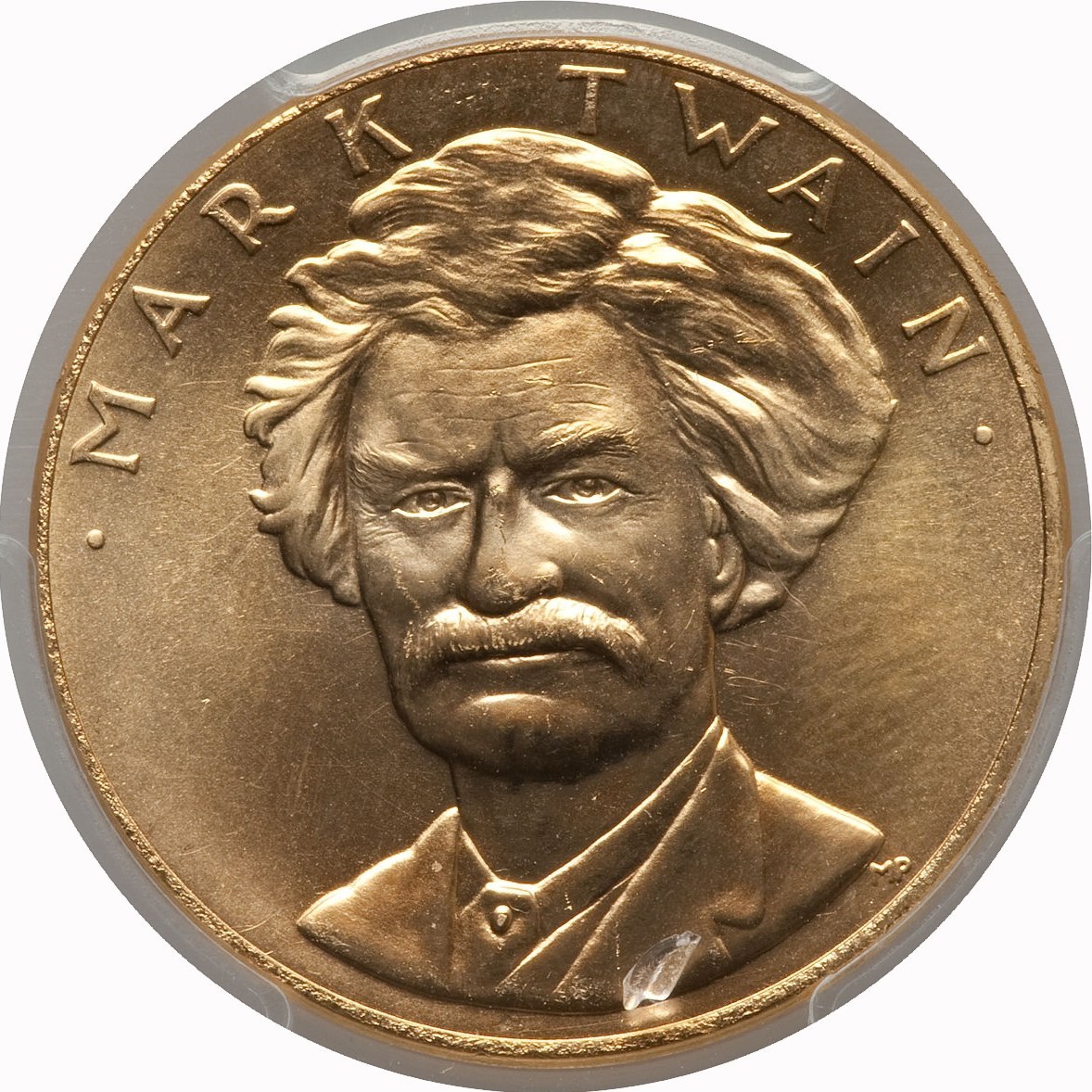
Begin with the portrait and the name. The obverse of each medallion honors a specific American artist, identified by name; the photographed 1981 one-ounce piece shows Mark Twain in left-facing profile with his prominent mustache. Confirming the named subject immediately tells you which issue in the 1980–1984 series you are holding.
Next, look for what is missing: there is no dollar face value anywhere on the piece. This is the single most reliable way to separate an American Arts medallion from a U.S. gold coin such as a Gold Eagle or a classic $20 double eagle, all of which state a denomination. Instead, the medallion is inscribed with its gold weight and fineness and with wording tying it to the American Arts Commemorative Series. The reverse shows an allegorical scene tied to the honoree rather than a national emblem.
Check the physical specifications against the stated weight. A one-ounce medallion contains one troy ounce of gold in a .900 fine alloy and measures roughly 32.7 mm in diameter; the half-ounce medallion is smaller and lighter. Because the gold is alloyed to 90%, the color is a warmer, slightly deeper yellow than pure 24-karat gold, comparable to a Krugerrand. A calibrated scale and calipers are the most dependable tools for confirming the size is right for the marked weight.
Do not look for a mint mark. These were struck at West Point but carry none, so its absence is normal and not a warning sign. Original examples often came in Treasury packaging or blister cards, which, when present, help confirm authenticity and can add a small premium.
Be cautious with authentication on any higher-value piece. Verify that the gold is non-magnetic, that weight and diameter match the marked content, and that relief and lettering are crisp. For expensive purchases, rely on reputable bullion dealers or third-party grading (PCGS, NGC) rather than eye appeal alone, since alloyed gold color can be imitated.
Frequently asked questions
How do I tell an American Arts medallion from a U.S. gold coin?
The medallion has no dollar face value and is marked with the American Arts series wording plus a gold weight and fineness. U.S. gold coins always state a denomination, so a missing face value points to the medallion.
Which artist is on my medallion?
Read the name on the obverse. The series ran 1980–1984 and honored figures including Grant Wood, Marian Anderson, Mark Twain, Willa Cather, Louis Armstrong, Frank Lloyd Wright, Robert Frost, Alexander Calder, John Steinbeck, and Helen Hayes.
What should a one-ounce medallion weigh and measure?
It holds one troy ounce of gold in a .900 fine alloy and measures about 32.7 mm in diameter. The half-ounce piece is smaller. Figures that don't match the marked weight are a counterfeit warning sign.
Should I be worried there is no mint mark?
No. The American Arts medallions were struck at West Point but carry no mint mark, so its absence is normal and expected for this series.