American Arts Commemorative Series Gold Medallion
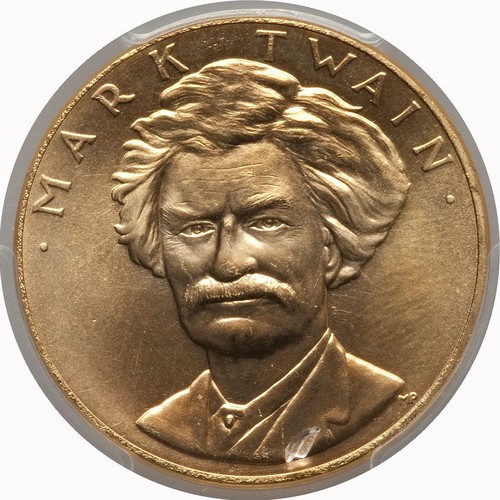
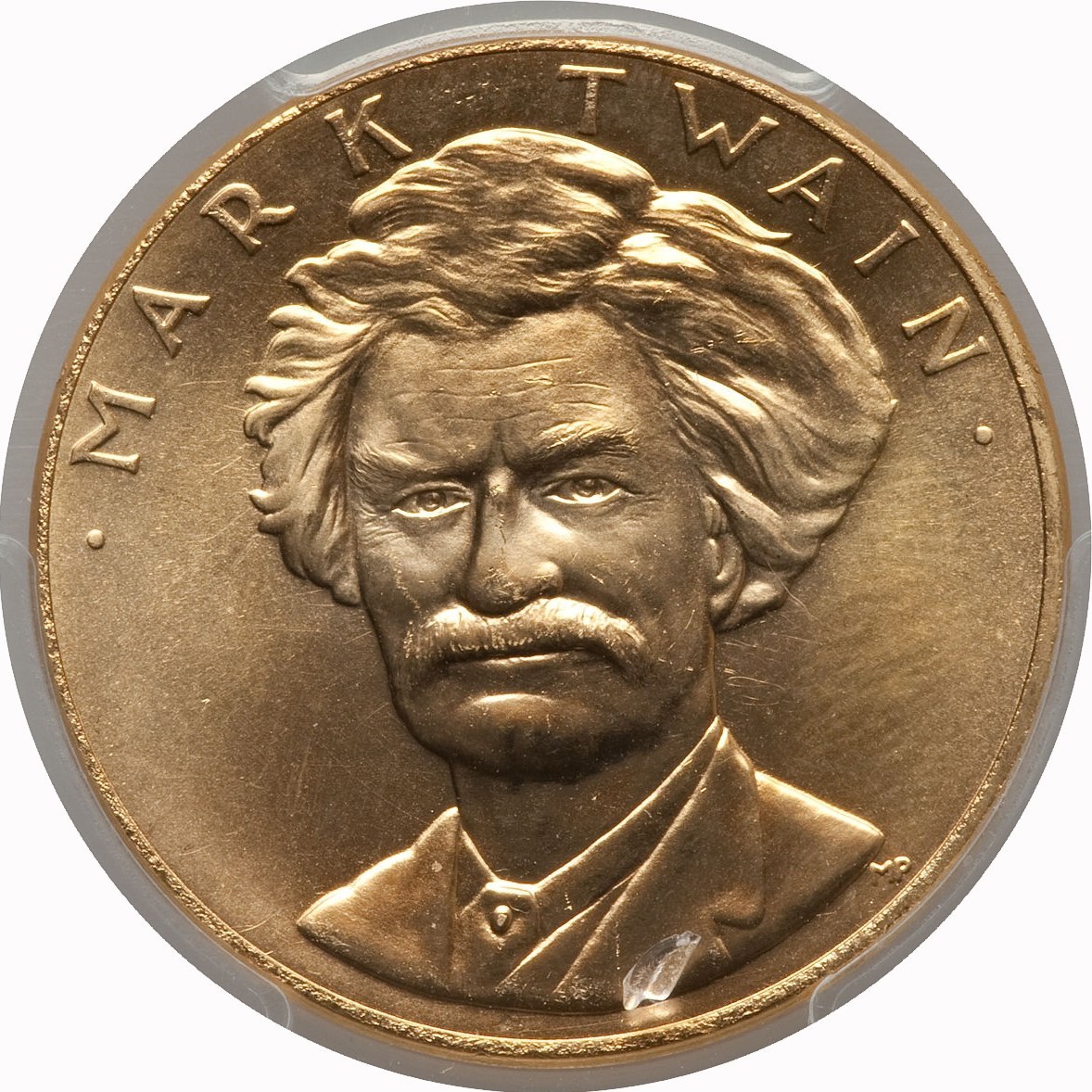
A U.S. Treasury gold bullion medallion series (1980–1984) honoring American artists; the photographed 1981 one-ounce piece features author Mark Twain.
- Country
- United States
- Denomination
- 1 oz / 1/2 oz (no face value)
- Metal
- Gold
Got a coin like this?
Identify any coin from a photo, free.
Overview
The American Arts Commemorative Series Gold Medallions are gold bullion medallions issued by the United States Treasury from 1980 to 1984. Each year honored two figures from American arts and letters, one on a one-ounce medallion and one on a half-ounce medallion. The photographed example is the 1981 one-ounce issue, whose obverse carries a left-facing portrait of author Mark Twain with his distinctive mustache.
Despite being produced by the U.S. Mint, these pieces are medallions rather than coins: they carry no denomination or legal-tender face value. Their purpose was to give Americans a convenient, government-made way to buy gold by weight, in the years after private gold ownership was restored and before the American Gold Eagle bullion program began in 1986.
Values today are driven almost entirely by the gold each medallion contains — one troy ounce or one-half troy ounce of gold — plus a modest collector or dealer premium.
History & Background
Congress authorized the series through the American Arts Gold Medallion Act, and the Treasury issued the medallions in five annual pairs from 1980 through 1984. The program was intended to let ordinary Americans purchase bullion-grade gold in a familiar, domestically produced format, competing with popular foreign bullion pieces such as the South African Krugerrand.
Each year paired a one-ounce and a half-ounce medallion honoring notable Americans in the arts. The 1981 program featured Mark Twain on the one-ounce piece and author Willa Cather on the half-ounce piece; other years honored figures such as Grant Wood, Marian Anderson, Louis Armstrong, Frank Lloyd Wright, Robert Frost, Alexander Calder, John Steinbeck, and Helen Hayes.
Sales of the series were generally disappointing, hampered by an awkward ordering and pricing system rather than by the gold itself. The program ended after 1984, and its role as the government's public gold-bullion offering was effectively taken over by the American Gold Eagle in 1986.
How to Identify
Identify the type first by its subject and lettering. The obverse of the 1981 one-ounce medallion shows Mark Twain in left-facing profile with his heavy mustache, identified by name. The reverse carries series lettering identifying it as part of the American Arts Commemorative Series along with the gold weight and fineness; the reverse imagery is an allegorical scene chosen to reflect the honored artist rather than an eagle or national emblem.
Because these are medallions, not coins, there is no dollar face value anywhere on the piece — this is a key distinguishing feature from U.S. gold coins. Instead the medallion states its gold content, such as one troy ounce of .900 fine gold. The one-ounce piece measures roughly 32.7 mm across and the half-ounce piece is noticeably smaller.
The medallions were struck at West Point but carry no mint mark. The gold is alloyed (nominally .900 fine, 90% gold), so the color is a slightly warmer, deeper yellow than pure 24-karat bullion, similar in tone to a Krugerrand.
Value & Collectibility
As a bullion medallion, an American Arts piece is worth chiefly the gold it contains. A one-ounce medallion tracks roughly the spot price of one ounce of gold, and a half-ounce medallion about half that, in each case plus or minus a small premium.
Because the series was made only to hold gold and was not widely collected, most examples trade close to melt value, and premiums tend to be modest compared with popular coin series. Pieces still in original Treasury packaging, or in pristine or professionally graded condition, can carry a somewhat higher premium.
For any specific medallion, current value should be checked against the live gold price and recent dealer or auction results, since the metal content dominates the price and moves daily with the gold market.
Frequently asked questions
Is the American Arts Gold Medallion a coin?
No. It is a bullion medallion made by the U.S. Mint for the Treasury, not legal tender. It carries no dollar face value, which is one of the easiest ways to tell it apart from U.S. gold coins.
Who is on the 1981 one-ounce medallion?
The 1981 one-ounce medallion features author Mark Twain in left-facing profile with his signature mustache. The 1981 half-ounce piece in the same series honors novelist Willa Cather.
How much gold does it contain?
The one-ounce medallion holds one troy ounce of gold and the half-ounce medallion holds a half troy ounce, struck in a .900 fine (90% gold) alloy. Its value is based on that gold content.
Why was the series made?
It was created to give Americans a convenient, government-produced way to buy gold by weight in the early 1980s, before the American Gold Eagle bullion program began in 1986.
Does it have a mint mark?
No. The medallions were struck at West Point but do not carry a mint mark, and they do not carry a face value either.
American Arts Commemorative Series Gold Medallion guides
In-depth guides for identifying, valuing, and collecting American Arts Commemorative Series Gold Medallion.