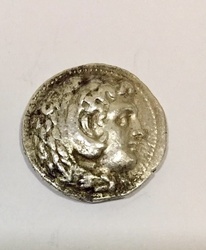
How to Identify the Alexander the Great Tetradrachm
A collector's guide to recognizing Alexander III's silver tetradrachm by its lion-skin Heracles head, enthroned eagle-bearing Zeus, weight and mint marks.
Read the full Alexander the Great Tetradrachm encyclopedia entry →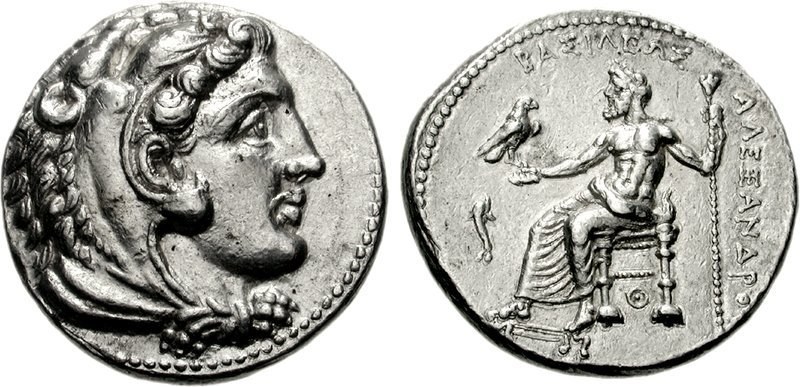
Start with the obverse head. A true Alexander tetradrachm shows a youthful male head facing right wearing the scalp of the Nemean lion, with the lion's ears and jaws visible above the brow and the paws sometimes knotted at the neck. The features are idealized and beardless. If the head is bare, bearded, or wears a diadem or ram's horns instead of a lion skin, you are likely looking at a different ruler's coinage, not an Alexander type.
Turn to the reverse and read the figure and the legend together. The reverse shows a seated deity on a backless throne holding a long scepter, with an eagle on the extended hand; this is the enthroned Zeus, and the eagle is the key attribute to confirm. Beside the figure runs the Greek name of Alexander, vertically in the field. A seated figure holding other objects, a different legend, or a standing figure points away from this type. Note the throne: whether the legs are plain or ornate, and whether Zeus's legs are parallel or crossed, are style features used to place the coin in the series.
Check size, weight and metal. The tetradrachm is a broad silver coin on the Attic standard, roughly 25-28 mm across and about 17 grams, and should feel dense with a natural grey toning. Genuine hand-struck examples show irregular flan shape, off-center strikes and honest die wear. A coin that is suspiciously light, undersized, or a bright modern white metal deserves caution.
Use the control marks, but do not expect a date. Small monograms, letters or symbols in the field or beneath the throne identify the mint and issue, and specialists use them, together with style, to attribute a coin to a place and approximate period. There is no year on the coin itself, so any specific dating comes from this analysis rather than a legend.
Be aware of look-alikes and authenticity risks. Alexander's successors and many cities struck the same Heracles-and-Zeus types for about two centuries, including issues in the name of Philip III and civic posthumous "Alexanders," so the exact attribution can be involved. Cast forgeries betray a seam around the edge, soft or bubbly surfaces and dull tone; tooled coins show unnaturally sharp detail added to worn metal. Because good tetradrachms carry real value, treat bargain offers with suspicion and, for an important purchase, rely on specialist attribution or third-party certification and documented provenance.
Frequently asked questions
How do I tell an Alexander tetradrachm from a similar successor coin?
Confirm the lion-skin Heracles head and the enthroned Zeus holding an eagle, then read the Greek legend for Alexander's name. Successor and civic issues often reuse these types, so the mint marks, throne style and exact legend are what a specialist uses to separate them.
There is no date on the coin. How is it dated?
Ancient tetradrachms carry no year. Attribution and dating come from the style, the form of the throne and figure, and the control marks or monograms that identify the mint and issue, compared against published references.
What weight and size should a genuine one be?
Expect a broad silver coin about 25-28 mm across and roughly 17 grams on the Attic standard. A markedly light, small or bright modern-looking piece is a warning sign worth investigating before buying.
What are the main signs of a fake?
A seam around the rim, soft or bubbly surfaces and a dull non-metallic tone suggest a cast copy, while unnaturally crisp, scratchy detail on otherwise worn metal suggests tooling. For valuable examples, seek specialist attribution or certification.
Alexander the Great Tetradrachm identified by the community
Recent Alexander the Great Tetradrachm coins identified with Coin Identifier.