
How to Identify the Alexander the Great Gold Stater
A collector's guide to recognizing Alexander's gold stater by its helmeted Athena, wreath-bearing Nike, Attic weight, mint controls, and gold fabric.
Read the full Alexander the Great Gold Stater encyclopedia entry →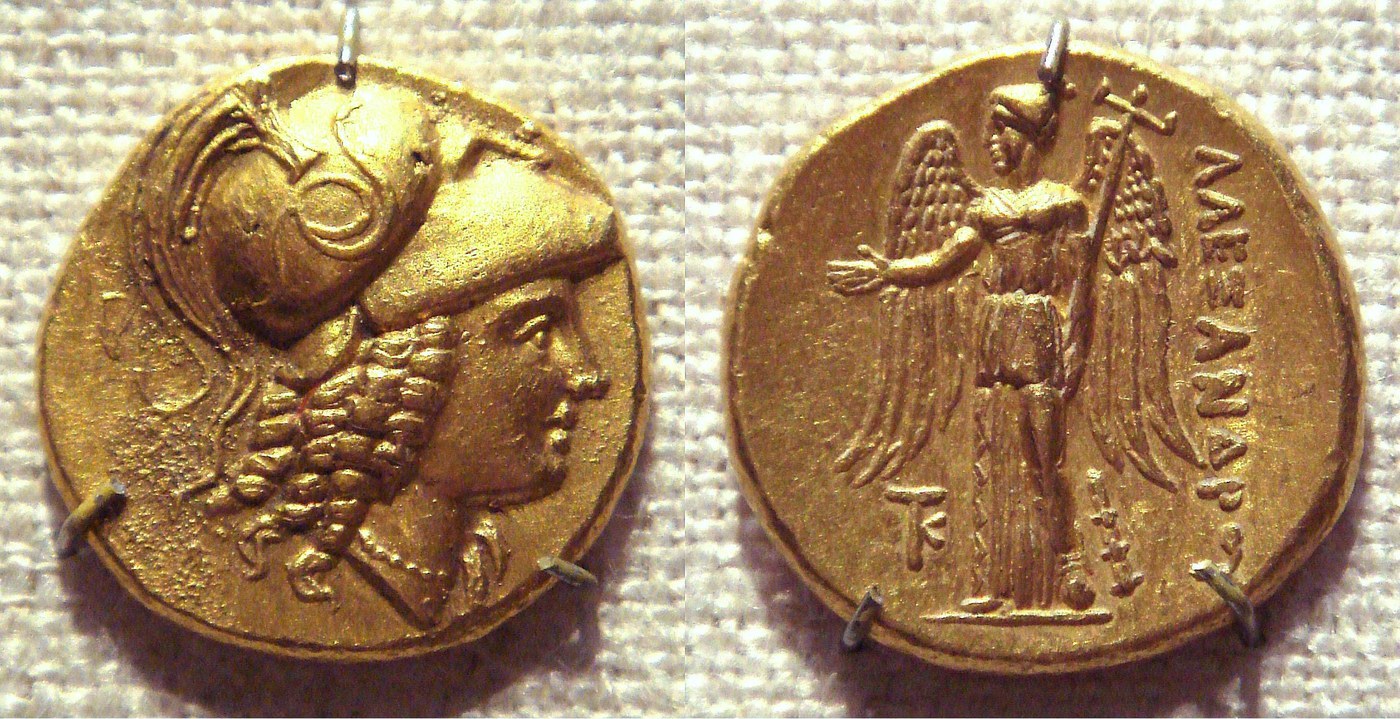
Start with the two types. A genuine Alexander gold stater pairs a helmeted head of Athena facing right on the obverse with a standing, winged Nike holding a wreath on the reverse. Athena's helmet is the crested Corinthian form pushed back on her head, typically with a coiled serpent or similar ornament on the bowl. If the obverse instead shows a bare male head, a lion skin, or a beard, you are looking at a different coinage, not an Alexander stater.
Read the reverse next. Nike should hold a wreath in one hand and a slender naval standard (stylis) in the other, with the Greek legend of Alexander's name running down the field. Look closely for small symbols, letters, or monograms placed near Nike or beneath her: these control marks identify the mint and issue and are the key to attribution. Their presence and style, rather than the main design, separate one Alexander stater from another and help distinguish official strikes from later imitations.
Confirm metal, size, and weight together. The stater is a small, thick, bright-gold disc on the Attic standard, on the order of about 8.5 grams and roughly 17-19 mm wide. Real ancient gold does not tarnish or tone; it stays warm yellow and feels dense and heavy for its diameter. A coin that is too light, off-color, or magnetic is not a genuine gold stater. Because these were hand-struck, expect an oval or slightly off-round flan and occasional off-center strikes that push part of the legend or wing to the rim.
Watch for look-alikes and denominations. Alexander also struck gold in smaller fractions and larger multiples, so weigh a coin before calling it a full stater. His successors and later kings, plus various imitators, copied the Athena/Nike design for generations, and modern replicas and jewelry copies of "the Alexander the Great gold coin" are extremely common. A pierced hole, a solder mark, or a smooth cast edge points to a mount or a copy rather than a struck coin.
Finally, be cautious with authentication. High gold value makes these coins a frequent target for forgery: cast fakes show a soft, bubbly surface and an edge seam, while modern die-struck copies may look unnaturally crisp and uniform. Style, fabric, and correct control marks all matter, and attributing the exact mint takes reference works. For any significant purchase, rely on specialist attribution or third-party certification and, where possible, documented provenance.
Frequently asked questions
How do I tell an Alexander stater from other Greek gold?
Look for the specific pairing: a helmeted Athena head on the front and a winged Nike holding a wreath and a naval standard on the back, with Alexander's name in Greek. Other Greek gold uses different deities and designs, so this Athena/Nike combination is the key marker.
What are the little letters and symbols by Nike?
They are mint control marks. Each issuing mint and issue added small symbols, letters, or monograms in the reverse field, so these marks are used to attribute the coin to a mint and date even though the main design is standard.
How can I check the weight and metal quickly?
The stater should weigh on the order of about 8.5 grams and measure roughly 17-19 mm, in bright untarnished gold that feels heavy for its size. A light, discolored, or magnetic piece is not a genuine gold stater.
Are fakes and replicas a big problem?
Yes. Because the gold and the name are valuable, these coins are widely copied, from ancient imitations to modern replicas and jewelry pieces. Cast seams, bubbly surfaces, mounting holes, or unnaturally perfect detail are warning signs, so certification is advisable for valuable examples.