
How to Identify the Akragas (Agrigentum) Eagle and Crab Tetradrachm
A guide to identifying the Sicilian city of Akragas's silver tetradrachm by its eagle obverse and crab reverse, two emblems tied to the city's patron deities.
Read the full Akragas (Agrigentum) Eagle and Crab Tetradrachm encyclopedia entry →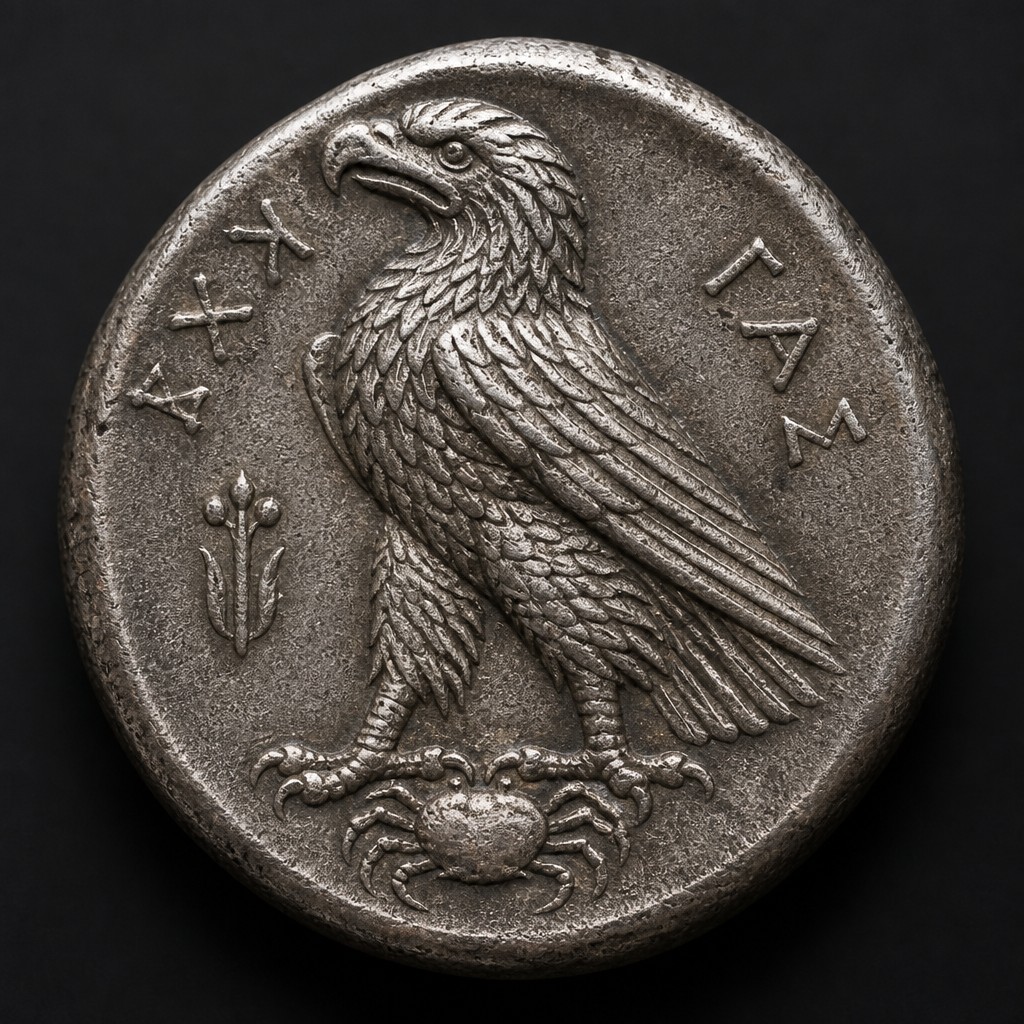
What It Is
Akragas (Roman Agrigentum), one of the wealthiest and most powerful Greek cities in Sicily, struck an extensive silver coinage from the mid-6th century BC through the later 5th and into the 4th century BC. Its most recognizable classical-period type pairs an eagle, sacred to Zeus, with a crab, likely a reference to the nearby river and the city's association with the sea god or local river deities.
Obverse
The obverse shows an eagle, most often standing with wings closed or in the act of tearing at prey, sometimes shown as a pair of eagles on richer, later issues. The bird is rendered with careful feather detail on well-preserved dies, standing on a small ground line.
Reverse
The reverse shows a crab viewed from above, its legs and claws spread across the field, sometimes accompanied by a small fish, shell, or other marine symbol beneath it. The city name AKPAГANTOΣ (or an abbreviated form) typically arches around or beside the crab.
Size, Weight, and Metal
The tetradrachm is silver, struck on the Attic weight standard at approximately 17.2 grams, matching the standard used by many major Sicilian and mainland Greek mints of the period. Akragas also issued a famous large decadrachm using a related eagle-and-crab theme combined with additional imagery, but the standard tetradrachm is the more commonly encountered denomination.
Identifying the Mint and Issue
The eagle-and-crab pairing together with the AKPAГANTOΣ legend is Akragas's clear mint signature. Variations in the number of eagles, their pose (standing versus tearing prey), and small field symbols help specialists place a given tetradrachm within the mint's chronological sequence.
Telling It Apart From Similar Coins
The eagle motif alone appears at several other mints (including Elis and later the Ptolemies), so the crab reverse is the decisive check confirming an Akragas attribution. It should not be confused with the much rarer and more elaborate Akragas decadrachm, which combines eagle-and-crab imagery with a chariot scene and additional detail on a larger, heavier flan.
Grading at a Glance
Look for full feather detail on the eagle and clearly articulated legs and claws on the crab, since both creatures occupy most of the coin's field and wear shows first on these raised details. A well-centered strike showing the complete crab without cropping at the flan edge is considered especially desirable.
Authenticity Red Flags
Watch for a flat or indistinct eagle with poorly defined feathers, a crab with blurred or asymmetrical legs, and an incomplete or garbled AKPAГANTOΣ legend. Confirm the weight matches the Attic tetradrachm standard, and be wary of cast surface graininess or an unnaturally uniform, mold-like texture across the design.
Frequently asked questions
Why does Akragas use an eagle and a crab together?
The eagle honors Zeus, while the crab is generally linked to the city's coastal setting and local river or sea deities, together forming Akragas's signature coin type.
Is this the same as the famous Akragas decadrachm?
No, the decadrachm is a separate, larger, and much rarer denomination that combines eagle-and-crab imagery with an additional chariot scene; the tetradrachm described here is the more common standard silver coin.
What weight standard was the Akragas tetradrachm struck on?
The Attic standard, at approximately 17.2 grams of silver.
How do I confirm a coin is from Akragas rather than another eagle-themed mint?
Check for the crab on the reverse combined with the AKPAГANTOΣ inscription; the eagle alone appears at other mints, but the crab pairing is specific to Akragas.