
How to Identify the Aigina Turtle Stater
A collector's guide to recognizing Aigina's sea-turtle stater by its pellet-backed shell, incuse reverse, thick fabric, and heavy weight.
Read the full Aigina Turtle Stater encyclopedia entry →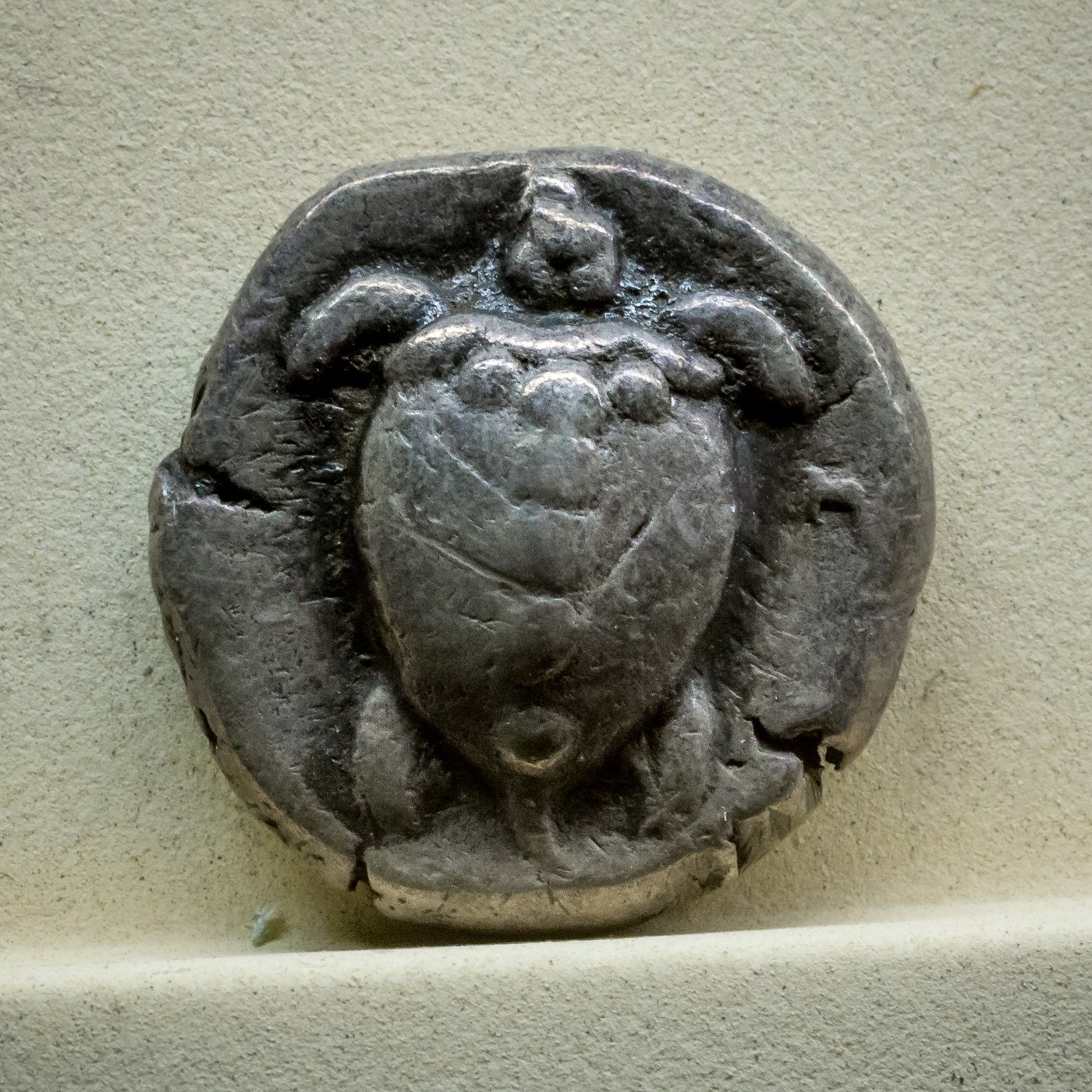
Begin with the obverse animal. A true Aigina stater shows a turtle from above, its shell filling most of the flan. To place it in the earlier sea-turtle series shown here, look for a raised line of round pellets running down the center of the shell like a spine, with a small head at one end and flippers at the sides. A smooth shell with a segmented collar and central band instead indicates the later land tortoise, struck after about 456 BC, which is a different phase of the coinage.
Turn to the reverse, which should be an incuse punch, not a picture. On issues of roughly 480-456 BC the sunken area is divided into geometric compartments, often described as a skew or mill-sail pattern. A completely rough, formless incuse points to an earlier turtle, while any figural reverse or an inscription is a red flag that the coin is not an Archaic-to-Classical Aiginetic stater at all.
Check fabric, size, and weight together. The stater is a thick, dumpy blank of high-silver metal on the Aiginetic standard, weighing on the order of about 12 grams and only high-teens to roughly 20 mm wide, so it feels dense and small for its mass. Genuine strikes show hand-made irregularity: an oval or off-round flan, slightly uneven edges, and centering that can push part of the turtle to the rim. There is no legend to read, so type and fabric do the identifying.
Be careful with fractions and look-alikes. Aigina and other cities struck smaller silver denominations, so a much lighter turtle coin may be a drachm or fraction rather than a full stater; confirm the weight before calling a piece a stater. Other Greek mints also used turtles or tortoises, and modern souvenir copies of "the famous Aegina turtle" are common.
Finally, watch for authenticity problems. Cast forgeries betray themselves with a seam around the edge, a soft or bubbly surface, and dull rather than metallic tone; tooled coins show unnaturally sharp, scratchy detail added to a worn shell. Because good sea-turtle staters are valuable, treat any bargain-priced example with caution and, for a significant purchase, rely on specialist attribution or third-party certification and, where possible, documented provenance.
Frequently asked questions
How can I tell the sea turtle from the land tortoise at a glance?
Look at the shell. The sea turtle has a raised row of pellets running down the middle like a spine; the later land tortoise has a smoother shell with a segmented central band and a collar of dots. The sea turtle is the earlier type, ending around 456 BC.
There is no writing on the coin. Is that normal?
Yes. Aigina's turtle staters carry no legend or name, which is typical of Archaic and early Classical Greek civic coinage. The coin is identified by its turtle obverse and incuse reverse, not by any inscription.
How do I know it is a stater and not a smaller turtle coin?
Weigh it. The full stater sits on the order of about 12 grams on the Aiginetic standard. Lighter turtle coins are drachms or smaller fractions, so the weight is the key distinction between denominations of the same type.
What are the main warning signs of a fake?
A seam around the edge, a soft or bubbly surface, and a dull non-metallic tone suggest a cast copy, while unnaturally sharp scratchy detail on an otherwise worn coin suggests tooling. For valuable examples, seek specialist attribution or certification.