
How to Identify the Aegina Sea Turtle Stater
A guide to one of the earliest Greek coin types, the silver stater of Aegina, covering its turtle-and-tortoise obverse designs, incuse reverse, and dating clues.
Read the full Aegina Sea Turtle Stater encyclopedia entry →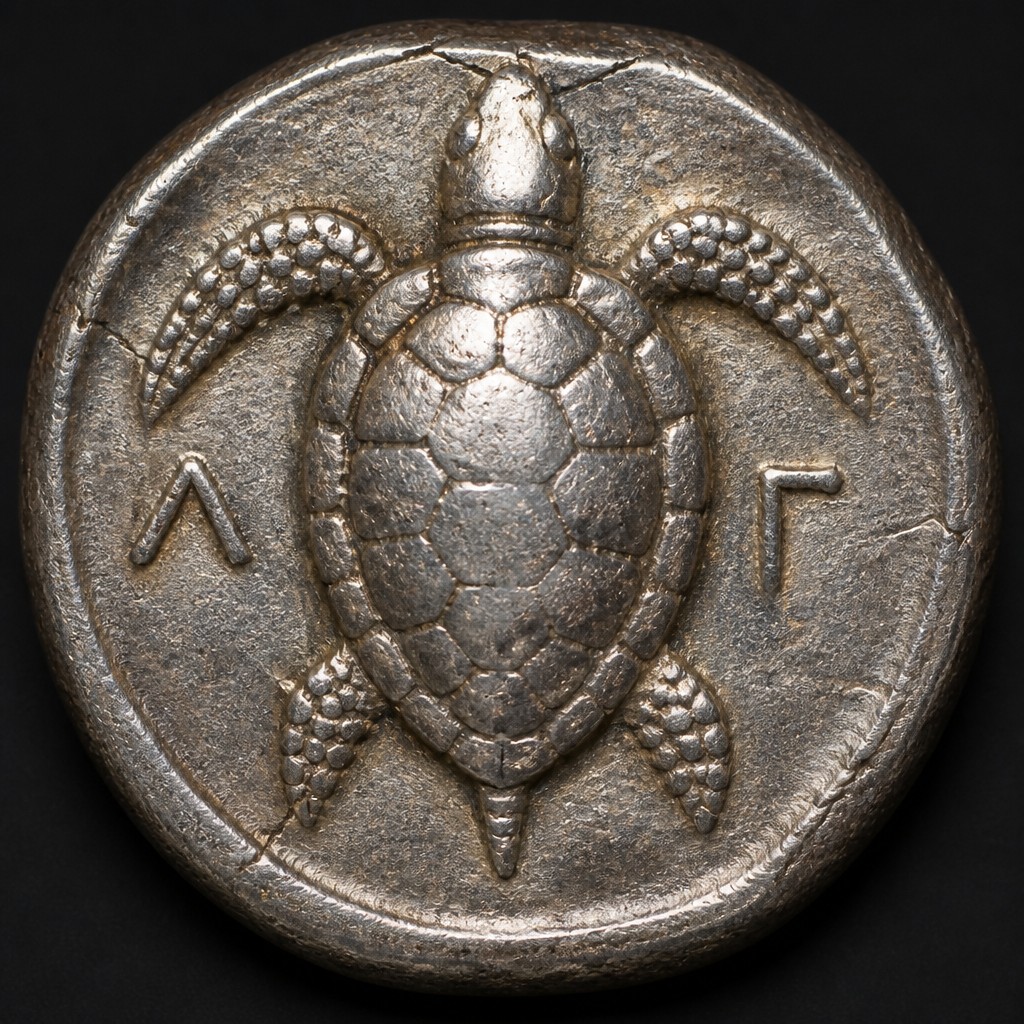
What Is the Coin
The Aegina stater is a silver coin struck by the island city-state of Aegina beginning in the 6th century BC, making it one of the earliest widely circulated coinages in the Greek world. Its distinctive turtle design gave rise to its common nickname, the "turtle" or "tortoise" coin.
Obverse Design
Early issues (roughly 6th century to about 456 BC) show a sea turtle viewed from above, with a row of raised dots running down the center of its shell, representing the animal's spine. After Athens defeated and controlled Aegina in the mid-5th century BC, the design was changed to a land tortoise with a differently textured shell, without the row of dots, marking a useful dividing line for dating a given coin to before or after this political change.
Reverse Design
The reverse shows only an incuse punch mark rather than a pictorial design. On earlier coins this is a simple, irregular incuse square; later issues developed a more structured incuse pattern of compartments sometimes described as a "windmill" or skew pattern, reflecting the evolving punch-die technology of the period.
Size, Weight, Metal & Edge
The coin is struck in silver and follows the "Aeginetic" weight standard, with a full stater weighing approximately 12.2 g and measuring roughly 20-22 mm in diameter. As a hand-struck ancient coin, there is no defined edge design, and smaller fractional denominations (drachms and smaller) were also issued on the same standard.
Identifying Features in Place of Mint Marks
There is no lettering on early Aegina staters, so attribution relies entirely on the turtle-versus-tortoise distinction and the style of the incuse reverse pattern, both of which numismatists use to place a given coin within the broader chronological sequence of Aeginetic issues.
Telling It Apart From Similar Coins
The sea turtle (with its dotted spine) versus land tortoise (without dots) distinction is the single most important visual clue for dating and should not be confused with similar-looking marine or animal motifs used by other Greek city-states, none of which share this specific combination of turtle imagery and the Aeginetic weight standard.
Grading and Condition at a Glance
Because these are among the oldest struck coins in wide circulation, moderate to heavy wear, off-center striking, and flan irregularities are common even on collectible genuine examples. A clearly readable shell pattern and a well-formed incuse reverse are the main things to look for in a better-preserved piece.
Authenticity Red Flags
Underweight examples, an oddly smooth or "too modern" shell texture, or an incuse reverse pattern that does not match documented styles for the claimed period are signs of a forgery. Given the coin's age and simple design, careful comparison of weight, style, and wear pattern to published reference examples is the standard approach to confirming authenticity.
Frequently asked questions
What is the difference between the turtle and tortoise types?
Earlier issues (before about 456 BC) show a sea turtle with a row of dots down its shell; later issues show a land tortoise without the dots, marking a useful dating boundary.
What appears on the reverse?
No pictorial design, only an incuse punch mark, which becomes a more structured compartmentalized pattern on later issues.
How much does a full stater weigh?
Approximately 12.2 g, following the Aeginetic weight standard used across the series and its smaller fractional denominations.
Is there any lettering on the coin?
No, early Aegina staters carry no inscriptions, so dating and attribution rely on the design style rather than text.