
How to Identify the Aegina Land Tortoise Stater
A guide to Aegina's later silver stater, identified by the land tortoise obverse with a segmented shell and the characteristic incuse punch reverse.
Read the full Aegina Land Tortoise Stater encyclopedia entry →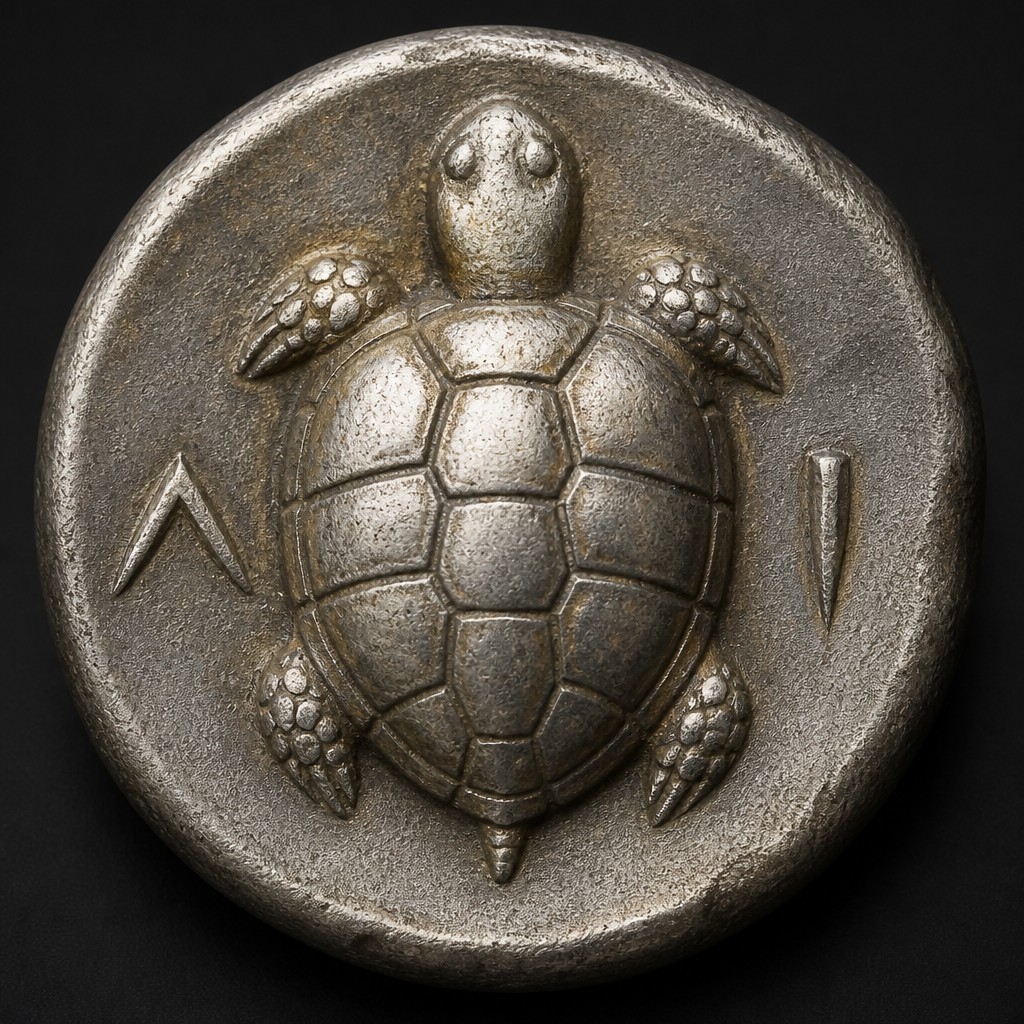
What It Is
Aegina was one of the earliest and most important mints in the Greek world, and its "turtle" coinage circulated widely across the Aegean for centuries. Early issues (7th-5th century BC) show a sea turtle with a smooth shell; after Aegina's power was broken by Athens around the mid-5th century BC, later issues switched to a land tortoise with a segmented shell, a change numismatists use as a key dating marker for the series.
Obverse
The obverse shows a tortoise viewed from above, filling most of the flan. On the later land-tortoise type that gives this coin its name, the shell is divided into a row of segments running down the spine, unlike the smooth-backed sea turtle of earlier issues. A raised collar or border often frames the edge of the flan.
Reverse
The reverse carries no pictorial design at all; instead it shows a large incuse (sunken) punch mark divided into compartments, commonly described as a "windmill" or "mill-sail" pattern on the later coins, replacing the simpler two- or five-part incuse square used earlier in the series.
Size, Weight, and Metal
These are silver coins struck on the Aeginetic weight standard, the standard from which the whole system takes its name, with a full stater weighing approximately 12.2 grams and drachm fractions weighing about half that. The flans are thick and dumpy, with a rounded, high-relief tortoise dominating the obverse.
Identifying the Mint and Period
Aegina's coinage carries no city-name inscription at all; the tortoise design itself is the mint signature. The land tortoise with segmented shell and windmill-pattern incuse identifies a later issue (after the mid-5th century BC), while a smooth-shelled sea turtle with a simpler incuse pattern marks an earlier issue.
Telling It Apart From Similar Coins
Because Aegina's turtle types were widely imitated and the Aeginetic standard was used by other Greek cities for their own designs, the key check is the tortoise itself: no other major mint used this exact design. Confusing the sea turtle (early) with the land tortoise (late) is common among newcomers, so examining the shell texture is the fastest way to place a coin within the series.
Grading at a Glance
Look for a well-centered tortoise with clear shell segmentation and a sharply struck incuse reverse pattern. Because the flans are thick and the design high-relief, wear typically shows first as flattening on the raised center of the shell.
Authenticity Red Flags
Watch for a shell pattern that is blurred, mismatched, or anachronistic (for example, land-tortoise shell texture combined with an early-style simple incuse reverse, a combination that would not occur naturally), as well as cast-metal graininess, incorrect weight, and an incuse punch that looks too shallow or symmetrical compared to genuine irregular hand-struck examples.
Frequently asked questions
What is the difference between Aegina's sea turtle and land tortoise types?
The earlier sea turtle has a smooth shell, while the later land tortoise has a shell divided into segments; the switch happened after Athens defeated Aegina in the mid-5th century BC.
Why is there no city name on Aegina's coins?
Aegina's coinage predates the common practice of adding a city ethnic; the tortoise design itself served as the recognizable mint signature throughout the Greek world.
What does the reverse of an Aegina stater look like?
It shows no image at all, only a large incuse punch mark divided into compartments, sometimes called a windmill or mill-sail pattern on later issues.
How much does a genuine Aegina stater weigh?
A full stater weighs approximately 12.2 grams of silver, the basis of the Aeginetic weight standard.