
How to Identify the Abbasid Copper Fals
A collector's guide to attributing an Abbasid copper fals: reading its Arabic legends, mint and Hijri date, judging metal and size, and spotting look-alikes.
Read the full Abbasid Copper Fals encyclopedia entry →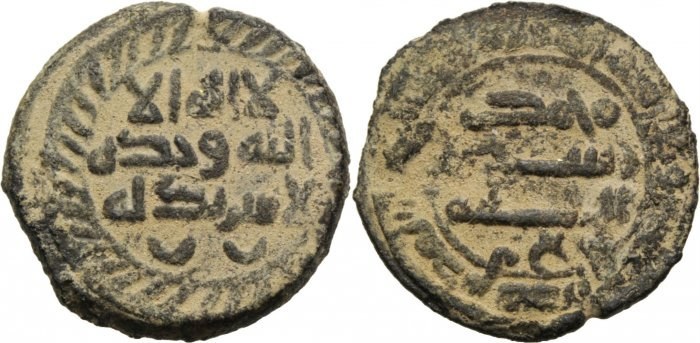
Start by confirming that the coin is entirely epigraphic. An Abbasid copper fals carries only linear Arabic script on both faces, with no portrait, animal, or figural device anywhere. The obverse of this type shows Arabic inscriptions accompanied by decorative elements, and the reverse carries further Arabic text that includes a mint designation. If you see any human or animal image or any Latin lettering, you are not looking at an Abbasid fals.
Read the legends to attribute the piece. The central inscriptions are religious formulas typical of Islamic coinage, while the reverse mint-and-date formula is the key to a specific attribution: it names the mint where the coin was struck and the year, both spelled out in Arabic words rather than numerals. On this coin the date is AH 219 (834–835 CE). Being able to read, or match against a reference, the mint name and the Hijri year is what separates one Abbasid fals from another.
Check the physical coin. This is a copper piece, so expect a reddish-brown to dark oxidized surface, sometimes with green corrosion products. Fulus are small, hand-struck coins that are often slightly irregular in outline and unevenly centered, with part of the legend running off the edge because the dies were larger than the flan. Copper is non-precious and will not have the bright tone of silver; weight and diameter vary from mint to mint since fulus were not held to a strict standard.
Watch for look-alikes and be cautious about attribution. Umayyad, later Abbasid, and various successor and provincial dynasties all struck superficially similar all-Arabic copper coins, so the specific mint and date legend — not the general appearance — is what pins a coin to AH 219 and to the Abbasid series. Worn or corroded fulus with illegible legends often cannot be attributed with confidence and should be described cautiously.
Apply sensible authentication checks. Genuine fulus are struck, showing the slightly uneven relief and flan shape of hand production; be wary of cast copies with soft, blurry detail, seams, or air bubbles, and of pieces with artificially applied "patina" hiding tooled or modern surfaces. When the legend cannot be read clearly, compare the coin against a specialist catalog of early Islamic copper coinage or seek an expert opinion before accepting a firm attribution.
Frequently asked questions
How do I read the date on an Abbasid fals?
The date is written out in Arabic words as part of the reverse mint-and-date formula, not as numerals. It is given in the Hijri (AH) calendar; on this coin it reads AH 219, which converts to 834–835 CE.
Where is the mint name?
The mint is named within the reverse legend as part of the phrase stating that the coin was struck at a particular place. Reading or matching that mint name against a reference is essential for a precise attribution.
How can I tell it apart from other Islamic copper coins?
Many dynasties struck similar all-Arabic copper coins, so appearance alone is not enough. The specific religious formulas plus the mint and Hijri date in the legend are what identify it as an Abbasid fals of AH 219 rather than a related issue.
How do I spot a fake or a tooled coin?
Genuine fulus are struck, with the uneven relief and irregular flan of hand production. Watch for casting seams, bubbles, and mushy detail, and for artificial patina concealing modern or tooled surfaces. Verify doubtful pieces against a specialist catalog.