
How to Identify the 500 Yen Bicolor Clad
A collector's checklist for Japan's two-tone 500 yen coin: its bimetallic look, floral face, value side, edge security features and common look-alikes.
Read the full 500 Yen Bicolor Clad encyclopedia entry →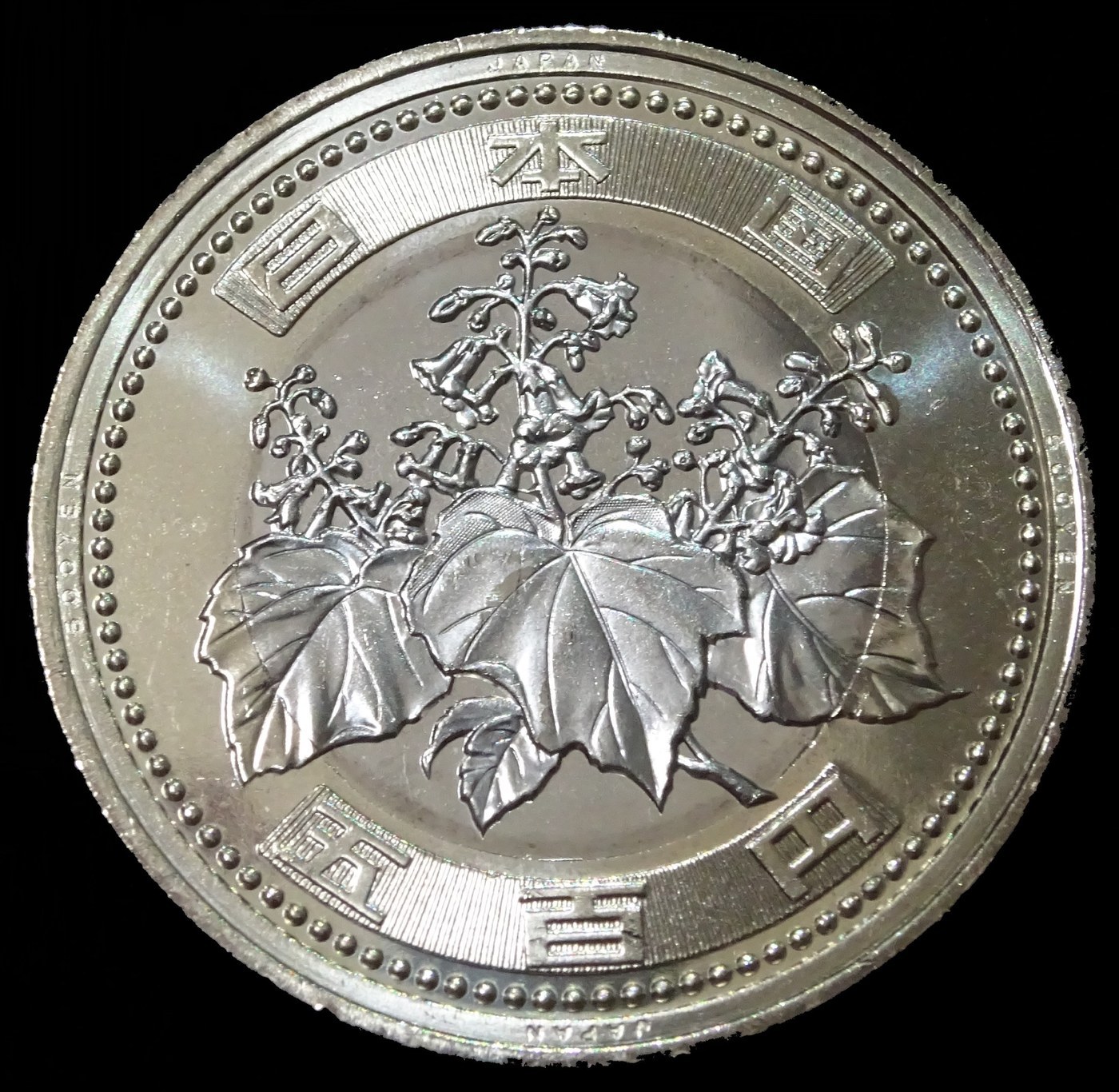
Begin with the overall look and size. The 500 Yen Bicolor Clad is a large coin with an unmistakable two-tone appearance, a silvery center disc inside a golden ring. It is the biggest coin in current Japanese change, so if you have a sizeable bimetallic coin with Japanese characters, you are in the right family. A single-color golden 500 yen is the older, non-bicolor version of the same denomination.
Examine the floral face. Expect a design of blossoms and flowers surrounded by fine pearl-like beading, the botanical motif carried by the 500 yen. The detail should be crisp and evenly struck, with the beading forming a neat border. Soft, blurred or off-center flowers on a lightweight coin can signal a novelty copy rather than a mint product.
Check the value face. It shows the large denomination numerals with Japanese inscriptions, including the country name and a Japanese era date, plus small leaf or plant devices and official marks framing the value. Reading the era name and number, then converting it, gives the exact year, since the coin does not use a Western calendar date.
Inspect the edge and security features, which are the strongest confirmation of the modern bicolor type. Look for micro-engraved lettering, a genuine bimetallic ring-and-center join, and helical or slanted edge grooves and lettering rather than a plain or simply reeded edge; some issues also carry a latent image that shifts as the coin tilts. These are difficult to reproduce and separate real circulation coins from imitations.
Apply authentication caution and rule out look-alikes. The bicolor 500 yen has historically been targeted by fakes and by altered foreign bimetallic coins used to fool vending machines, so weigh and measure any doubtful piece and compare it against a known-genuine example. A coin that is the wrong weight or diameter, lacks the micro-lettering, or has a mismatched two-tone join should be treated with suspicion.
Frequently asked questions
What is the fastest way to recognize this coin?
Its size and two-tone color. The 500 yen is the largest coin in Japanese circulation and has a silvery center inside a golden ring. A big bimetallic coin with a floral face and Japanese value numerals is almost certainly a 500 yen.
How is the bicolor version different from the older 500 yen?
Earlier 500 yen coins were single-colored (cupronickel, then a golden nickel-brass). The bicolor version combines two alloys into a ring and center and adds security features like micro-lettering and special edge work. The two-tone look is the quick giveaway.
Where do I find the date?
On the value side, written with a Japanese era name and number rather than a Western year. Identify the era and figure and convert it to get the exact year of issue.
How do I spot a fake or altered coin?
Check weight and diameter against a genuine example, look for crisp micro-lettering and a clean bimetallic join, and inspect the edge grooves and any latent image. Wrong dimensions, missing micro-text or a mismatched center and ring point to a fake or an altered foreign coin.