
How to Identify the 40 Francs Napoleon
A collector's guide to the early gold 40 francs of Napoleon's Consulate — reading the Bonaparte Premier Consul bust, the laurel 40 FRANCS reverse, size, mint marks and authentication.
Read the full 40 Francs Napoleon encyclopedia entry →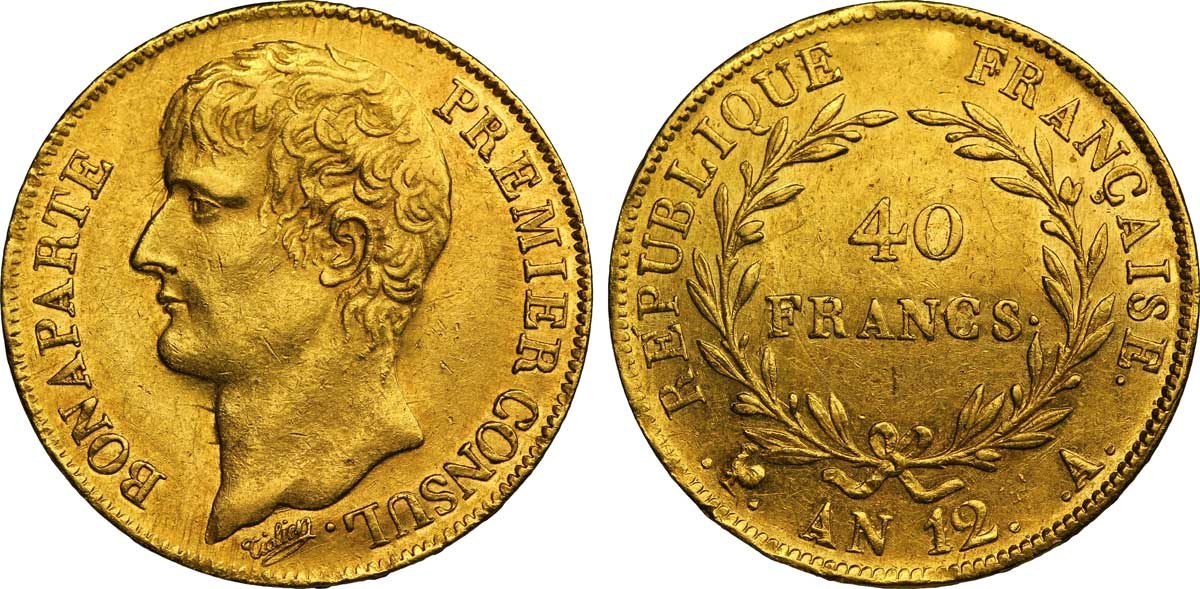
Start with the obverse legend and portrait, because they date the coin more precisely than anything else. A Consulate 40 francs shows a bare-headed bust of Bonaparte facing left — no crown, no laurel — encircled by BONAPARTE PREMIER CONSUL. This is the diagnostic that separates it from later imperial gold, which reads NAPOLEON EMPEREUR and often gives him a laurel wreath. Look for the engraver's signature in small letters beneath the neck.
Turn to the reverse to confirm the denomination and era. The centre carries the value 40 FRANCS inside an open laurel wreath, with REPUBLIQUE FRANCAISE around the rim and the date below; on this piece it reads 1804. Do not skip this step: the same portrait style appears on the far more common 20 francs, so the number in the wreath is what fixes the coin as the larger forty-franc denomination. Note that French coins of this moment may also show a revolutionary-calendar year such as An 12 alongside or instead of the Gregorian date.
Use size, weight and metal as a cross-check. The 40 francs is a large gold coin, roughly twice the weight and clearly bigger across than the 20 francs, struck in high-fineness gold with a deep yellow colour and a heavy, dense feel in the hand. If a supposed 40 francs is light, thin, pale, or magnetic, treat it with suspicion. The genuine coin also has a lettered edge rather than a plain or simple reeded one.
Find the mint mark and privy symbols. Early French gold carries a small mint letter and tiny privy marks near the value or date that identify the striking mint and its officials. These are part of a correct attribution and can affect scarcity, so record them rather than overlook them, and check that they are consistent with a known combination for the type and date.
Finally, take authentication seriously. Because this is a high-value early gold type, it is a realistic target for cast and struck counterfeits and for altered dates or legends. Weigh and measure the coin against published specifications, examine the portrait and lettering sharpness against reference images, and for any purchase or sale of consequence rely on third-party grading or a specialist dealer rather than eye appeal alone.
Frequently asked questions
How do I know it is a Consulate coin and not an imperial one?
Read the obverse legend. A Consulate 40 francs says BONAPARTE PREMIER CONSUL with a bare head, while imperial issues say NAPOLEON EMPEREUR, usually with a laurel-crowned portrait and an EMPIRE FRANCAIS reverse. The Premier Consul wording marks the earlier type.
How can I be sure it is the 40 francs and not the 20 francs?
Check the value in the reverse wreath: it will read 40 FRANCS, not 20 FRANCS. As a physical cross-check the 40 francs is a larger, much heavier coin, about double the weight of the 20 francs, since the portrait style can look similar.
What should the coin weigh and what is it made of?
It is a high-fineness gold coin containing roughly a third of a troy ounce of gold, so it feels dense and has a rich yellow tone. Exact specifications are published for the type; a piece that is underweight, pale, thin or magnetic is a warning sign.
Is it worth having a 40 Francs Napoleon authenticated?
Yes. Its high gold value and status as a scarce early type make it a counterfeiting target, so third-party grading or a specialist's opinion is worthwhile before any significant purchase or sale, rather than judging by appearance alone.