
How to Identify the 4 Escudos
A collector's walkthrough for identifying the Spanish gold 4 Escudos, its armored bust and crowned arms, mint marks, and authenticity checks.
Read the full 4 Escudos encyclopedia entry →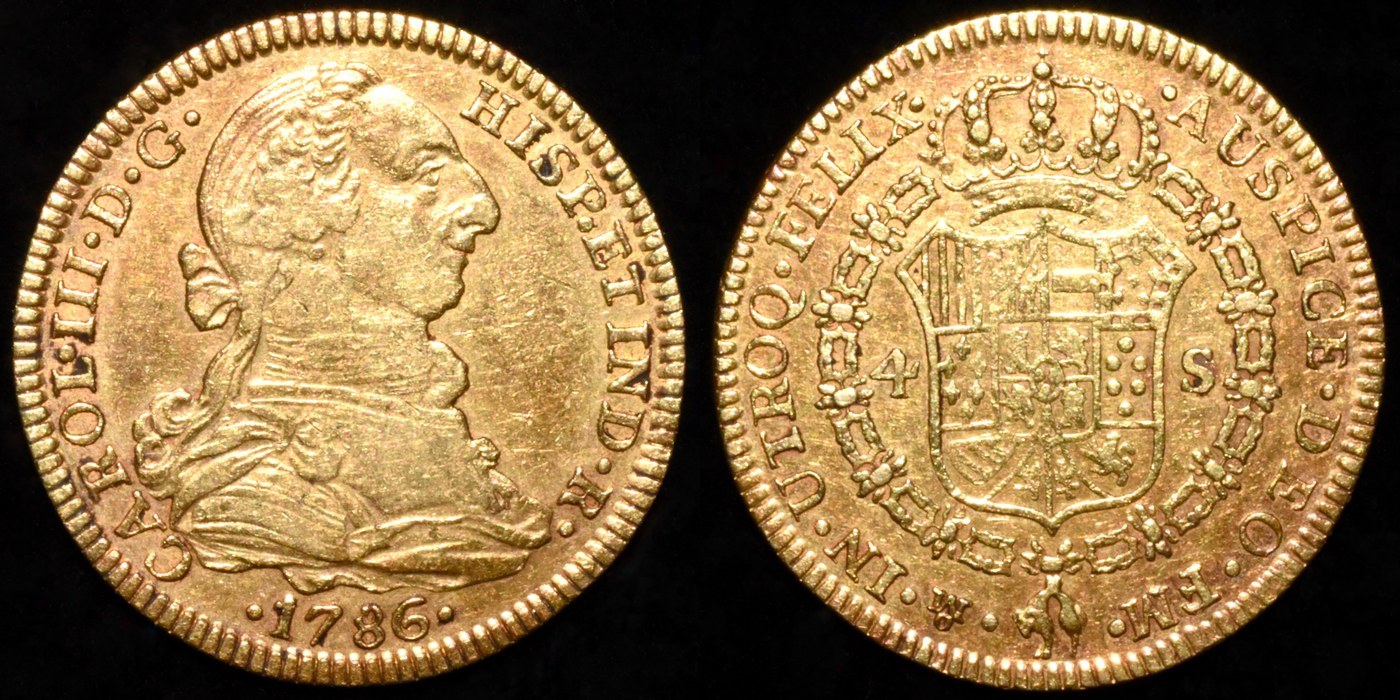
Begin with the two faces. The obverse of this type shows a profile bust of the king facing right, wearing ornate armor, surrounded by a Latin legend giving his name and titles together with the date. The reverse shows the crowned Spanish royal coat of arms within heraldic ornament, with the numeral 4 marking the denomination. Reading both sides is the first step, since the legend and the value numeral confirm the denomination and the likely ruler.
Measure and weigh the coin. A genuine 4 Escudos of the 1780s is gold, about 29 to 30 mm across and near 13.5 grams, at a fineness of roughly .901. That is half the mass of the 8 Escudos and double that of the 2 Escudos, so weight and diameter quickly separate the denominations. A caliper and an accurate scale are essential screening tools, and gold's non-magnetic, dense character is part of the check.
Attribute the mint. On the reverse, near the arms, look for a small mint mark and the assayer's initials. These identify whether the coin came from a peninsular mint such as Madrid or Seville or from a colonial mint such as Mexico City, Lima, Popayan, Santa Fe de Bogota, or Potosi. Mint and assayer combinations, together with the date, are what determine scarcity, so record them carefully and match them to catalog references.
Watch for look-alikes and imitations. The 4 Escudos is easily confused with the larger 8 Escudos and smaller 2 Escudos of the same design family, so rely on measured size and weight rather than the design alone. Because these are valuable gold coins, cast copies, tooled pieces, and modern counterfeits exist; soft or mushy portrait detail, seams, casting pits, incorrect weight or diameter, and lettering that does not match references are common warning signs.
When money is on the line, do not price on eye appeal. Confirm the gold content and the mint attribution, and for any coin sold at a significant premium seek third-party authentication and grading. With eighteenth-century Spanish gold, verified metal and verified authenticity should drive the valuation.
Frequently asked questions
How do I tell a 4 Escudos from an 8 Escudos?
By size and weight. The 4 Escudos is about 29 to 30 mm and near 13.5 grams, roughly half the diameter-area and mass of the 8 Escudos. The reverse denomination numeral (4 versus 8) also confirms it.
How do I find out which mint struck my coin?
Check the reverse near the coat of arms for a small mint mark and the assayer's initials. Those symbols, read alongside the date, identify the specific Spanish or colonial mint and help establish scarcity.
What are the main red flags for a fake?
Off-standard weight or diameter, magnetic response, soft or blurry portrait and lettering, visible seams or casting pits, and legends or mint marks that do not match documented references. Any of these warrant caution.
Should I have it authenticated?
Yes, for any piece sold at a meaningful premium. Confirm the gold content and obtain third-party authentication and grading rather than relying on the design or the seller's description alone.