
How to Identify the 2000-P Sacagawea/Washington Quarter Mule
An extremely rare mint error pairing a Washington quarter obverse die with a Sacagawea dollar reverse die on a golden dollar planchet, one of the most famous modern U.S. mint errors.
Read the full 2000-P Sacagawea/Washington Quarter Mule encyclopedia entry →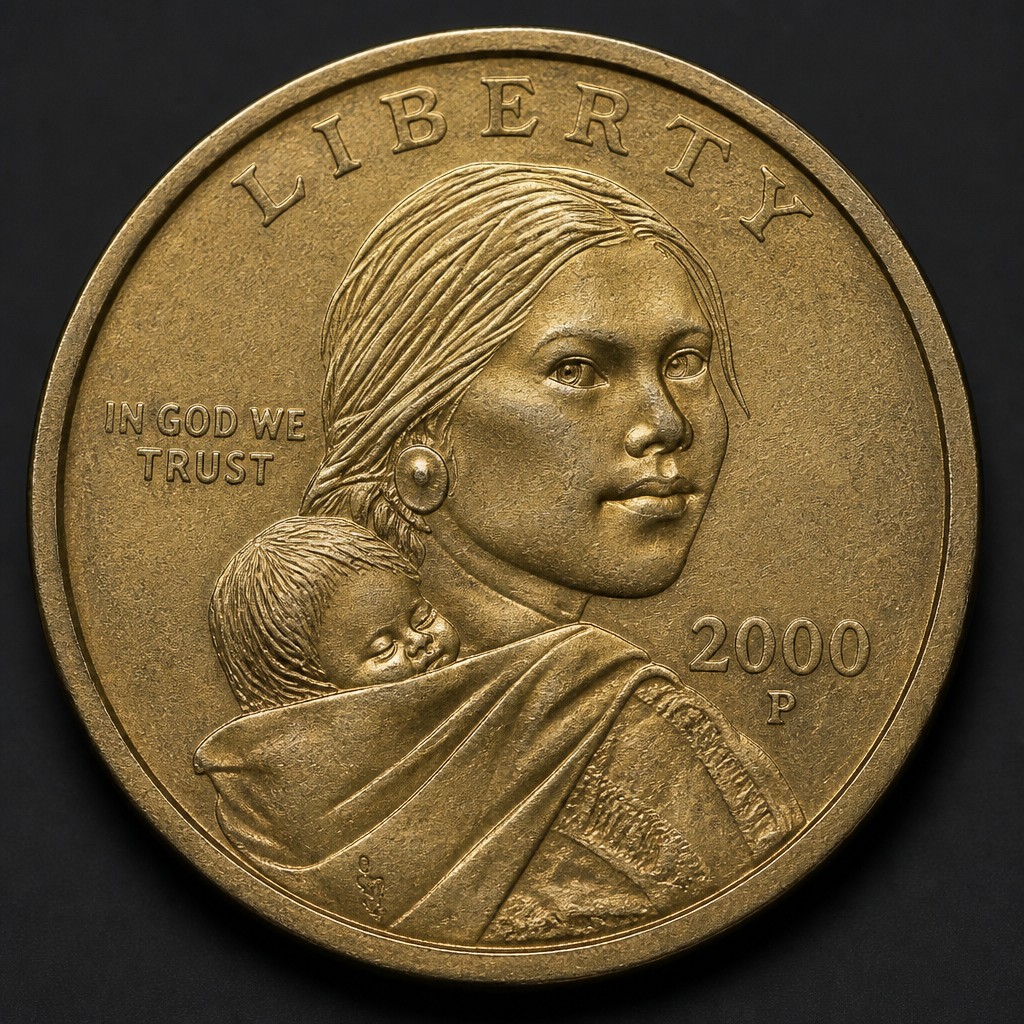
What It Is
A "mule" error occurs when two dies that are not intended to be paired together are accidentally used to strike the same coin. This variety combines the obverse die of a 2000-dated Washington quarter with the reverse die of a Sacagawea dollar, struck on a golden dollar-sized planchet. Very few examples are known to have surfaced, making it one of the most celebrated modern U.S. mint errors.
Obverse Design and Inscriptions
The obverse shows the standard Washington quarter portrait facing left, with "LIBERTY" above, "IN GOD WE TRUST" to the left, and "2000" below the bust, exactly as it appears on a normal quarter. This is the unexpected pairing, since a quarter obverse should never appear on a dollar-sized coin.
Reverse Design and Inscriptions
The reverse shows the Sacagawea dollar's eagle design, with an eagle in flight surrounded by stars, along with "UNITED STATES OF AMERICA" and "ONE DOLLAR" around the rim. Pairing this reverse with a quarter obverse, rather than the intended Sacagawea portrait obverse, is the defining feature of the error.
Size, Weight, Metal, and Edge
Despite showing a quarter's obverse design, the coin is struck on the golden dollar planchet: approximately 26.5 mm in diameter and 8.1 grams, composed of a copper core with outer layers of manganese-brass, giving it a golden color. The edge is plain, matching Sacagawea dollar specifications rather than the reeded edge of a normal quarter.
Mint Marks and Where to Find Them
Genuine examples carry a "P" mint mark for Philadelphia, positioned on the obverse in the standard Washington quarter mint mark location near the ribbon. Because both the quarter and Sacagawea dollar programs were produced at Philadelphia in 2000, confirming the mint mark alone will not distinguish a genuine mule; the design and planchet mismatch are the defining features.
Telling It Apart From Similar Coins
The unmistakable identifier is a coin with a Washington quarter obverse but a golden-colored planchet sized and weighted like a Sacagawea dollar, paired with the dollar's eagle reverse rather than a quarter eagle reverse. A normal quarter is silver-colored copper-nickel clad and smaller; a normal Sacagawea dollar shows Sacagawea's portrait on the obverse, not Washington's.
Judging Condition at a Glance
Because so few genuine examples exist and each has been closely studied, condition is typically assessed the same way as any modern coin: checking Washington's hair and the eagle's feather detail for sharpness, and confirming the surfaces show a normal mint luster consistent with the coin's true age and handling history.
Authenticity Red Flags
Given the extreme rarity and value associated with this error, be highly skeptical of claimed examples, since fabricating a convincing mule by combining or altering two genuine coins is exceptionally difficult but not unheard of for lesser errors. Any suspected example should be examined for evidence of altered or transplanted metal, mismatched edge thickness, or inconsistent luster between the obverse and reverse, and professional authentication is strongly advised before treating any example as genuine given how few authentic specimens are known.
Frequently asked questions
What does 'mule' mean in coin collecting?
A mule is a coin accidentally struck using two dies that were never meant to be paired together, such as combining a quarter obverse with a dollar reverse.
What color and size should this coin be?
It should be golden-colored and sized like a Sacagawea dollar (about 26.5 mm, 8.1 grams), not silver-colored and smaller like a normal quarter.
How rare is this error?
It is considered one of the rarest modern U.S. mint errors, with only a small number of genuine examples known to exist.
Why is professional authentication recommended for this coin?
Because of its extreme rarity and value, and the difficulty of definitively ruling out an altered or fabricated example without expert examination.