
How to Identify the 2000-P Sacagawea Cheerios Dollar
A rare early-release Sacagawea dollar distributed in Cheerios cereal boxes in 2000, distinguished by enhanced tail feather detail on the eagle reverse.
Read the full 2000-P Sacagawea Cheerios Dollar encyclopedia entry →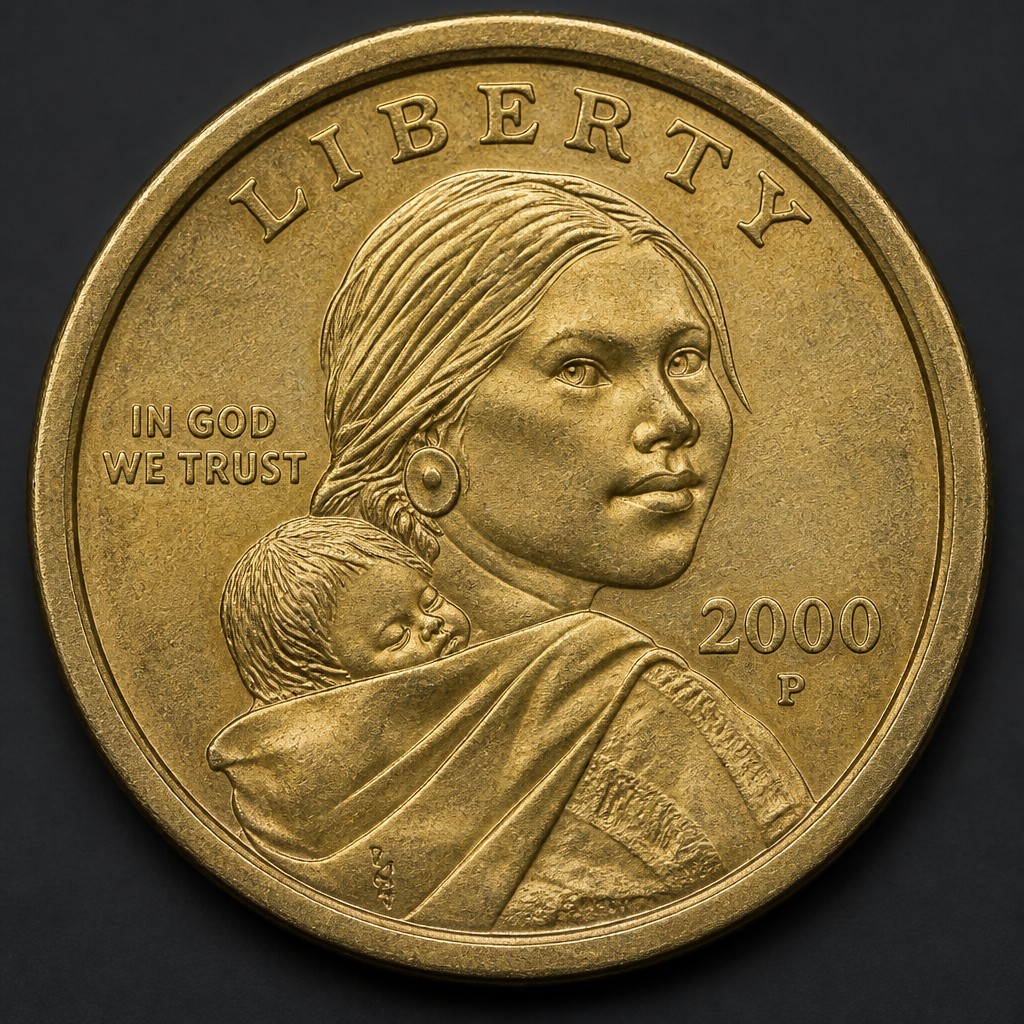
What It Is
In early 2000, roughly 5,500 Sacagawea dollars were included as a promotional insert in boxes of Cheerios cereal ahead of the coin's official public release. These coins, all struck at the Philadelphia mint, are now recognized as one of the more significant rarities in modern US coinage due to a subtle but distinct design difference from the coins that followed.
Obverse Design
The obverse, designed by Glenna Goodacre, shows Sacagawea facing forward-right, carrying her infant son Jean Baptiste on her back, with LIBERTY above and IN GOD WE TRUST to the side, along with the date 2000 and the mint mark.
Reverse Design
The reverse, designed by Thomas D. Rogers, shows an eagle in flight surrounded by seventeen stars representing the states in the Union at the time of Sacagawea's journey, with UNITED STATES OF AMERICA and ONE DOLLAR around the rim.
The Key Identifying Feature: Enhanced Tail Feathers
The defining trait of the Cheerios dollar is the eagle's tail feathers on the reverse, which show noticeably more detail and separation than the simpler, less defined tail feathers found on the regular Sacagawea dollars released to circulation later in 2000. Comparing the two side by side under magnification is the most reliable way to distinguish them, since the difference is subtle and not visible at a glance.
Size, Weight, and Metal
The coin measures 26.5 mm in diameter, weighs 8.1 grams, and is struck in manganese-brass clad over a copper core, giving it a golden color, with a plain, smooth edge and no edge lettering, unlike the later Presidential dollar series.
Mint Marks
All known Cheerios dollars carry a "P" mint mark, found on the obverse near Sacagawea's shoulder, reflecting their exclusively Philadelphia origin.
Telling It Apart From Similar Coins
Since the obverse and general reverse layout match the standard 2000-P Sacagawea dollar exactly, the tail feather detail is the only reliable way to separate a Cheerios dollar from an ordinary circulation strike. General circulation 2000-P dollars vastly outnumber the Cheerios variety, so any claim of a Cheerios dollar should be backed by a close feather comparison, ideally against verified reference images, since visual differences are minor.
Authenticity Red Flags
Because genuine Cheerios dollars carry a substantial premium over common 2000-P Sacagawea dollars, be wary of coins claimed to have enhanced feathers without a clear, magnified comparison supporting that claim, as ordinary strikes can appear similar under casual inspection or poor lighting. Given the difficulty of visually confirming this variety, professional grading services are often used by collectors to certify genuine examples, since the distinguishing feature is too subtle for confident identification by eye alone in many cases.
Frequently asked questions
What makes the Cheerios dollar different from a regular 2000-P Sacagawea dollar?
It has enhanced, more detailed tail feathers on the reverse eagle, a subtle difference from the simpler feather design used on later circulation strikes.
How were these coins distributed?
About 5,500 were included as a promotional insert in boxes of Cheerios cereal in early 2000, ahead of the coin's official public release.
Can I tell a Cheerios dollar apart just by looking at it quickly?
Not reliably. The tail feather difference is subtle and usually requires magnification and side-by-side comparison with a verified reference image.
What mint mark do Cheerios dollars carry?
All examples carry a 'P' mint mark, found on the obverse near Sacagawea's shoulder.
Why do collectors often send these coins for professional grading?
Because the enhanced tail feather feature is so subtle, third-party grading services help confirm authenticity in a way that's more reliable than an unaided visual check.