
How to Identify the 20 Kronor
A collector's guide to spotting Sweden's gold 20 kronor by its crowned arms, denomination, gold weight, and 1925 date.
Read the full 20 Kronor encyclopedia entry →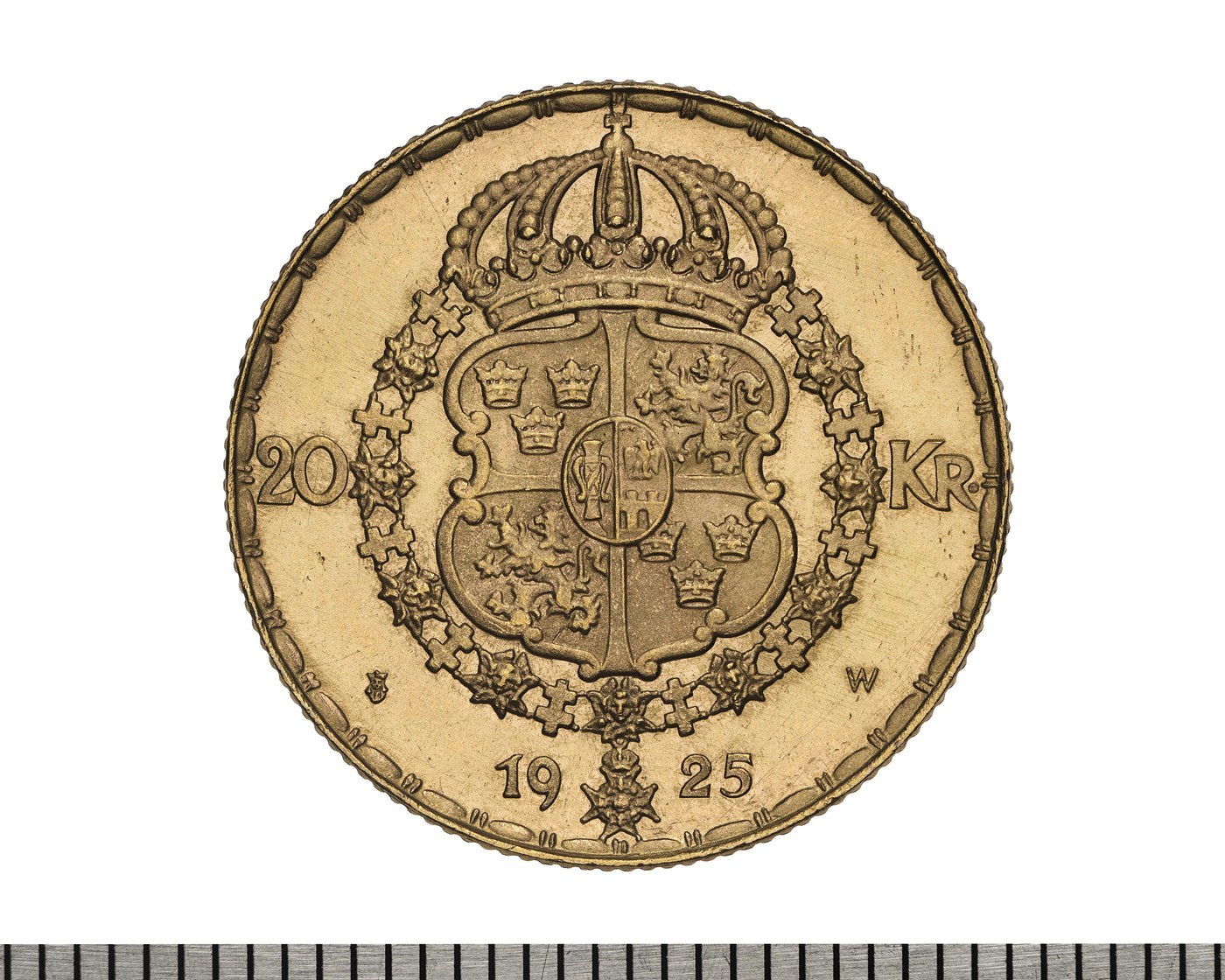
Begin with the obverse design. The 1925 Swedish 20 kronor shows a crown above the national coat of arms — a shield with crowns, capped by three small coronets — and no royal portrait. If your gold 20 kronor instead shows a bearded king's profile, it is an earlier Oscar II issue, not this arms type. Reading the legend confirms the language is Swedish rather than Danish or Norwegian.
Turn to the reverse. Look for the value 20 KR, the date, and a small mint mark (a mintmaster's privy symbol) near the denomination. On this coin the date reads 1925, the final year of the series. The date and mark are the primary tools for pinning down the exact issue.
Check metal, size, and weight. This is a gold coin of about 23 mm and roughly 8.96 g in .900 fineness. It should feel dense for its small size and be non-magnetic, with a rich yellow-gold tone. A piece that is oversized, lightweight, or magnetic is not a genuine gold 20 kronor.
Mind the look-alikes. Because the Scandinavian Monetary Union set a shared standard, the gold 20 kroner of Denmark and Norway are the same size and weight but carry different arms, legends, and rulers — read the country and design carefully. Also distinguish this small gold coin from the much larger silver 2 kronor and 5 kronor, which are base or silver, not gold.
For authentication, weigh and measure the coin precisely, inspect the arms and lettering under magnification for crisp detail, and check the edge. Gold fakes and modern replicas exist for popular European gold; soft strikes, wrong weight, seams, or a magnetic response are red flags. Given the value and the relative scarcity of the 1925 date, submit any important example to a professional grading service.
Frequently asked questions
How do I tell it apart from a Danish or Norwegian 20 kroner?
All three share the same gold weight and size under the Scandinavian Monetary Union, so read the coat of arms, the ruler, and the Swedish legend. Sweden's arms and 'KR' denomination differ from the Danish and Norwegian designs.
Is it an Oscar II or Gustaf V coin?
If it shows a king's portrait it is likely an Oscar II issue; the 1925 arms-only type shown here was struck under Gustaf V. The date and the presence or absence of a portrait tell them apart.
What is the mint mark on the reverse?
It is a small mintmaster's privy mark placed near the value, identifying the Stockholm mint's issue. Use it together with the date to confirm the exact coin against a catalog.
How can I confirm it is genuine gold?
Verify the weight (about 8.96 g) and diameter (about 23 mm), confirm it is non-magnetic, and look for sharp, correct detail. For a coin of this value, professional authentication or grading is the safest confirmation.