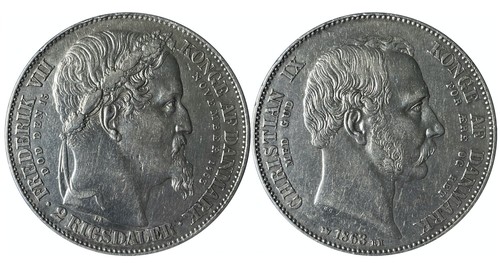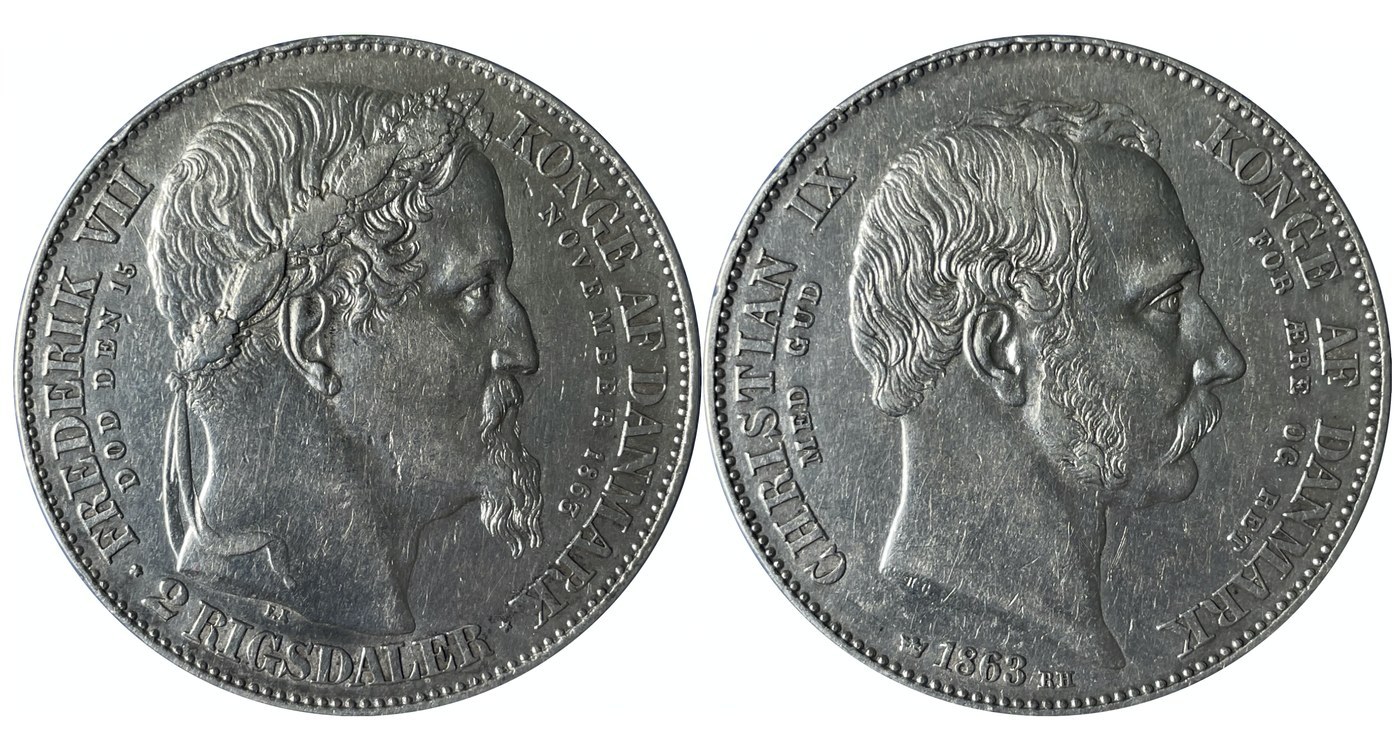
2 Rigsdaler (Gold)
A gold striking of Denmark's 1863 2 rigsdaler, with the right-facing bust of Christian IX and the crowned royal arms — a rare early piece of his reign.
- Country
- Denmark
- Denomination
- 2 Rigsdaler
- Metal
- Gold
Got a coin like this?
Identify any coin from a photo, free.
Overview
This is a gold example of Denmark's 2 rigsdaler dated 1863, the year the crown passed to Christian IX. The obverse carries his bare-headed bust facing right, and the reverse shows the crowned Danish coat of arms framed by decorative elements. Two rigsdaler was one of the larger denominations of the old Danish rigsdaler currency, and a piece struck in gold rather than the usual silver is an unusual, high-end survivor.
Standard 2 rigsdaler coins of this era circulated in silver; gold strikings from the same or closely related dies are scarce presentation-style pieces prized by collectors of Danish and Scandinavian coinage. Because these were produced in small numbers, most examples reach the market through specialist auctions rather than general dealers.
Collectors value the type both for its handsome mid-19th-century engraving and for its link to the 1863 change of monarch, a pivotal moment in Danish history.
History & Background
The rigsdaler was Denmark's principal unit of account for centuries before the modern krone. In 1863 the reigning king, Frederik VII, died in November, and the throne passed to Christian IX, founder of the Glücksburg line that still reigns in Denmark today. Coins dated 1863 therefore sit at the hinge between two reigns, and pieces bearing Christian IX's name are among the earliest of his long reign (1863–1906).
Denmark's coinage of this period was struck at the Copenhagen mint, traditionally marked with a small heart. The rigsdaler system, based on silver with occasional gold issues, remained in use only a little longer: in the early 1870s Denmark joined the Scandinavian Monetary Union and replaced the rigsdaler with the gold-standard krone (introduced 1873, circulating from 1875). That reform makes late rigsdaler coins like this one the closing chapter of an old monetary era.
Gold strikings of large-denomination Danish coins from this transitional decade were never made for everyday commerce. They survive in limited numbers and should be understood as scarce collector pieces rather than common circulation money.
How to Identify
Look first at the obverse: a right-facing bust of a bearded man with a surrounding legend naming Christian IX and his royal titles. The reverse carries the crowned Danish coat of arms — a shield quartered with lions, hearts and other charges — surrounded by decorative scrollwork, with the denomination and the date 1863. The pairing of a right-facing portrait with an armorial reverse is the core diagnostic of the type.
The defining feature of this particular piece is that it is struck in gold rather than silver. Gold gives a warmer yellow tone, a higher density (a gold coin feels noticeably heavier than a silver coin of the same size), and does not tarnish to the grey or black tones seen on old silver. Check the edge and the small mint mark and mint-master initials near the arms; Copenhagen issues typically show a heart symbol.
Confirm the denomination legend reads two rigsdaler (often rendered as "2 RIGSDALER" or in the older Danish form). Note the diameter and weight and compare them against catalogue references for the type, since a gold striking will not match the published weight of the ordinary silver coin.
Value & Collectibility
Value depends heavily on metal, condition, and whether the piece is a genuine period gold striking. Ordinary silver 2 rigsdaler coins of the 1860s are collectible but relatively affordable; a true gold example of the denomination is far scarcer and can command a substantial premium over its bullion content, often reaching well into the hundreds or thousands of US dollars at specialist auction depending on rarity and grade.
Because gold strikings of this type are uncommon, there is no simple fixed price. Realistic figures come from recent auction records for the exact type and grade rather than from generic price lists. Higher grades (sharp detail, original surfaces, no mount marks) bring disproportionately more.
Given the value and rarity involved, any gold 2 rigsdaler should be weighed, measured, and ideally authenticated and graded by a reputable service before buying or selling. Treat unverified "gold rigsdaler" offers with caution.
Frequently asked questions
Is the 2 rigsdaler normally a gold coin?
No. Circulating 2 rigsdaler coins were struck in silver. A gold example is an unusual, scarce striking rather than the standard issue, which is part of what makes it desirable to collectors.
Why is it dated 1863?
1863 is the year Frederik VII died and Christian IX became king of Denmark. Coins bearing Christian IX's portrait and this date are among the earliest of his reign, which lasted until 1906.
Who is on the obverse?
Christian IX of Denmark, shown as a bare-headed bust facing right, with a legend giving his name and titles.
What is on the reverse?
The crowned Danish royal coat of arms — a quartered shield with lions, hearts and other charges — surrounded by decorative scrollwork, along with the denomination and date.
How much is it worth?
A genuine period gold striking can carry a strong premium over its gold value, potentially hundreds to thousands of dollars depending on rarity and grade. Auction records for the exact type are the best guide; have it authenticated before relying on any figure.
2 Rigsdaler (Gold) guides
In-depth guides for identifying, valuing, and collecting 2 Rigsdaler (Gold).