
How to Identify the 1976 Bicentennial Kennedy Half Dollar
A special dual-dated 1776-1976 half dollar featuring Independence Hall on the reverse, struck to celebrate America's 200th anniversary.
Read the full 1976 Bicentennial Kennedy Half Dollar encyclopedia entry →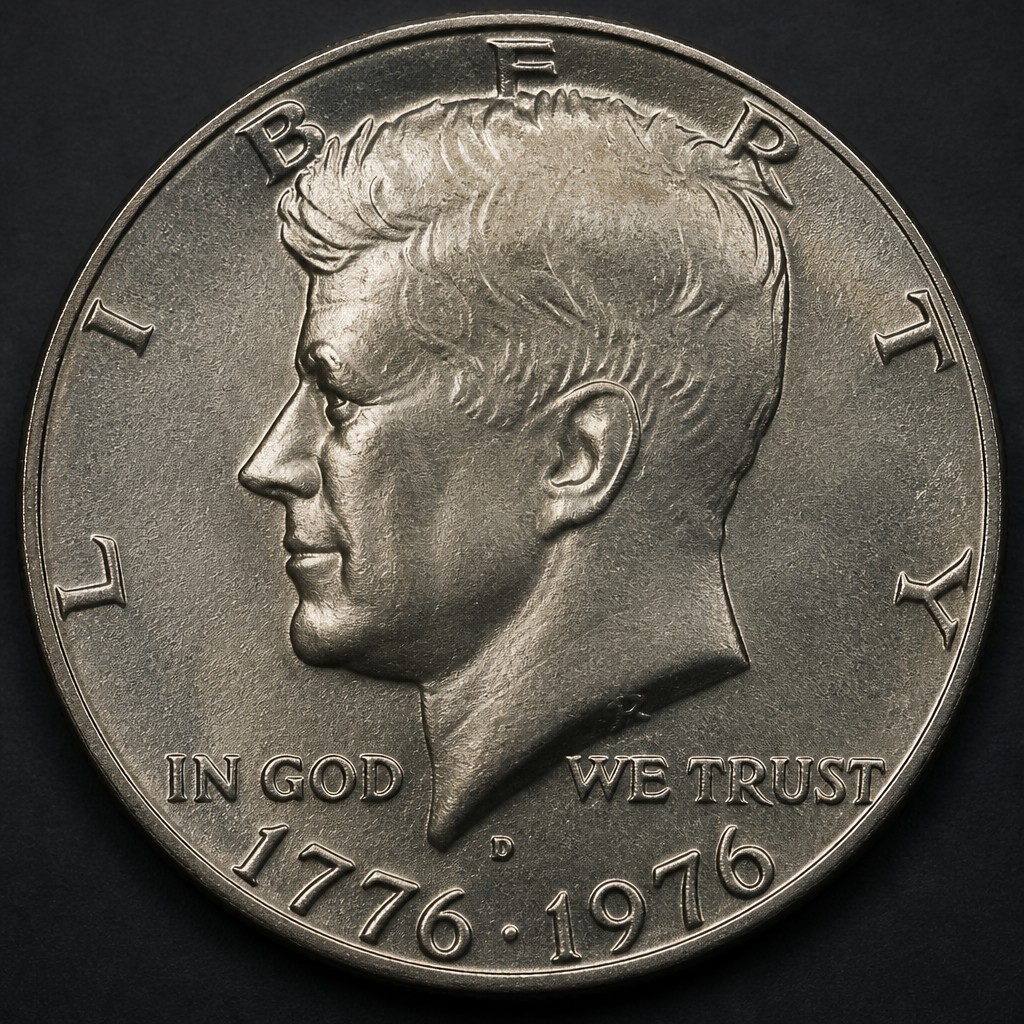
What It Is
To mark the 200th anniversary of American independence, the Mint issued special reverse designs on the quarter, half dollar, and dollar coins for the nation's Bicentennial. All examples, whether struck in 1975 or 1976, carry the dual date "1776-1976" rather than a single year, since the Mint wanted every coin from both years of production to commemorate the anniversary equally.
Obverse Design
The obverse retains the familiar left-facing bust of President Kennedy by Gilroy Roberts, with LIBERTY above and IN GOD WE TRUST to the left, but the date reads "1776-1976" instead of a single year.
Reverse Design
The reverse is the notable change: a special design by Seth Huntington depicting Independence Hall in Philadelphia, with the Liberty Bell and building facade rendered in detail. UNITED STATES OF AMERICA and HALF DOLLAR appear around the design, along with E PLURIBUS UNUM.
Size, Weight, and Metal
Circulation strikes are copper-nickel clad, weighing 11.34 grams with a diameter of 30.6 mm and a reeded edge, matching the standard post-1971 Kennedy half dollar specifications. The Mint also produced special 40% silver versions for collectors, sold in Bicentennial silver proof and uncirculated sets, weighing 11.50 grams.
Mint Marks
Mint marks appear on the obverse just above the date, near Kennedy's neck. No mintmark indicates Philadelphia, "D" indicates Denver, and "S" indicates San Francisco, used for proof coins and the silver collector sets.
Telling It Apart From Similar Coins
The dual date "1776-1976" and the Independence Hall reverse make this coin instantly distinguishable from every other Kennedy half dollar, which uses a single year date and the standard heraldic eagle reverse. The only real point of confusion is between the common copper-nickel clad version and the scarcer 40% silver collector version, which can be told apart by weight and by a visible clad line on the edge of the silver pieces or their bright cameo proof finish.
Judging Condition at a Glance
Look at Kennedy's hair and cheek for wear, and check the fine architectural lines and columns of Independence Hall on the reverse, since these fine details flatten first with circulation. Proof and uncirculated collector coins typically show sharp mirror or satin fields with no handling marks.
Authenticity Red Flags
Because the copper-nickel version was struck in huge numbers, it has little added value, so watch for sellers misrepresenting a common clad coin as the scarcer silver version. Confirm silver claims by weighing the coin and checking the edge for the characteristic silver-clad line. Also be alert for cleaned or artificially toned coins being passed off as original proof pieces.
Frequently asked questions
Why does the 1976 half dollar show the date 1776-1976 instead of just 1976?
It's a dual date used on all Bicentennial coins struck in both 1975 and 1976 to honor the 200th anniversary of American independence.
How can I tell if my Bicentennial half dollar is silver or clad?
Weigh it: silver collector versions weigh about 11.50 grams and show a visible clad line on the edge, while common copper-nickel clad coins weigh 11.34 grams.
What is shown on the reverse of the Bicentennial half dollar?
Independence Hall in Philadelphia, designed by Seth Huntington, replacing the usual heraldic eagle reverse.
Are Bicentennial half dollars rare?
The copper-nickel clad circulation version was struck in very large numbers and is common; the 40% silver collector versions are scarcer but were also produced in substantial quantities for sets.
Where is the mint mark on this coin?
On the obverse, just above the date near Kennedy's neck truncation.