
How to Identify the 1976 Bicentennial Eisenhower Dollar
A large dollar coin with the dual date 1776-1976 and a Liberty Bell over the moon reverse, issued to commemorate America's 200th anniversary.
Read the full 1976 Bicentennial Eisenhower Dollar encyclopedia entry →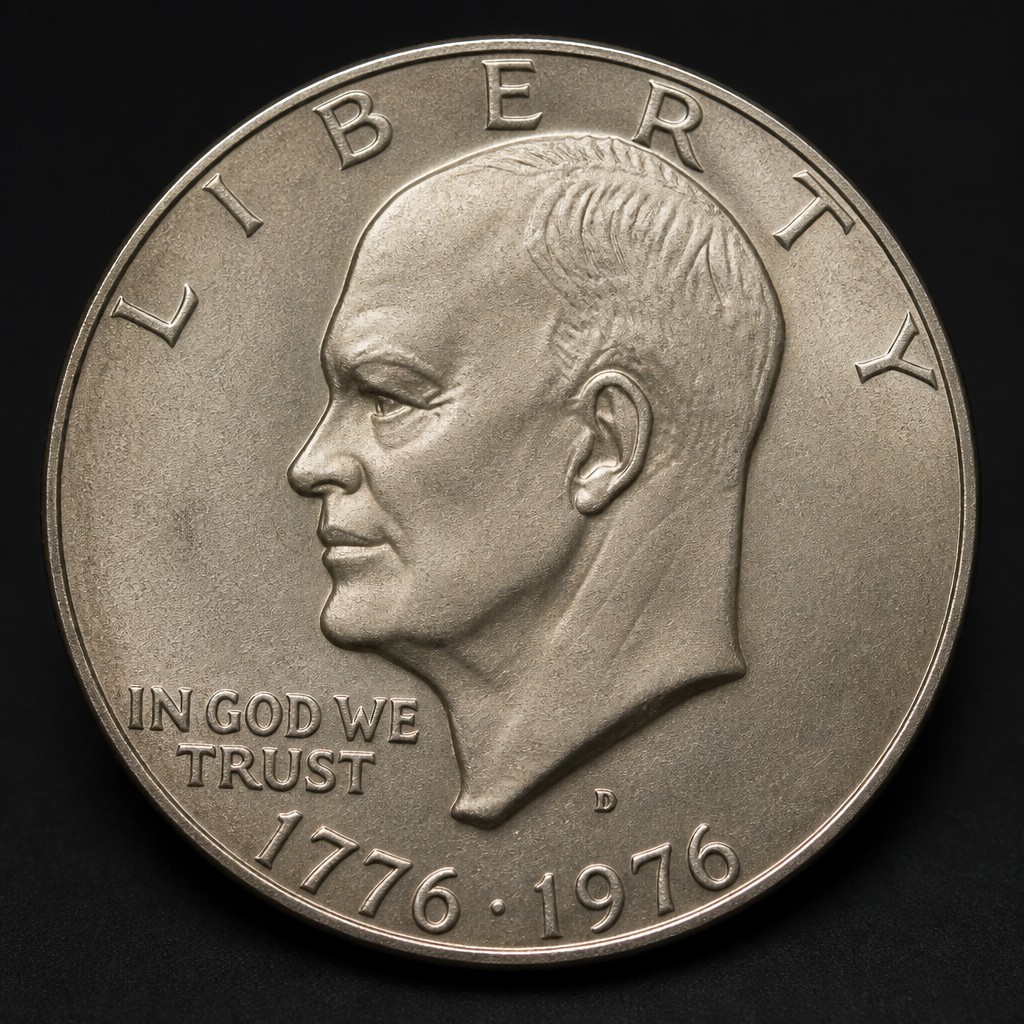
What It Is
The Bicentennial Eisenhower Dollar was struck for the nation's 200th anniversary celebration, replacing the standard eagle-on-the-moon reverse with a special commemorative design for coins dated 1975 and 1976. As with other Bicentennial coinage, every coin from both years carries the dual date "1776-1976."
Obverse Design
The obverse shows Frank Gasparro's left-facing bust of President Dwight D. Eisenhower, with LIBERTY above, IN GOD WE TRUST to the left, and the dual date "1776-1976" below.
Reverse Design
The reverse, the result of a public design competition won by Dennis R. Williams, depicts the Liberty Bell superimposed over a rendering of the moon, replacing the regular Apollo-inspired eagle landing design. UNITED STATES OF AMERICA and ONE DOLLAR appear around the rim.
Size, Weight, and Metal, and the Two Design Types
Circulation strikes are copper-nickel clad, weighing about 22.68 grams with a diameter of 38.1 mm and a reeded edge. Collector versions in 40% silver clad were also sold in special sets, weighing about 24.59 grams. Collectors further divide these coins into "Type 1" (a lower relief design with thicker, more rounded lettering on the reverse) and "Type 2" (higher relief with sharper, thinner lettering), both varieties existing within the clad and silver issues.
Mint Marks
Mint marks are found on the obverse just above the date. No mintmark indicates Philadelphia, "D" indicates Denver, and "S" indicates San Francisco, used for proof coins and silver collector versions.
Telling It Apart From Similar Coins
The Liberty Bell over the moon reverse and the "1776-1976" date make this coin unmistakably different from other Eisenhower dollars, which show an eagle landing on the moon and a single-year date. Confusion mainly arises between the common clad version and the 40% silver collector version, which differ in weight and in the visible clad line on the silver coin's edge.
Judging Condition at a Glance
Check Eisenhower's hair and cheek for smoothing, and examine the fine lines of the Liberty Bell and the crack detail for wear. Proof coins from San Francisco typically show deep mirrored fields, while clad business strikes show a duller, satin-like finish that shows bag marks and light scuffing more easily given the coin's large size.
Authenticity Red Flags
Given the premium collectors place on the silver versions and certain Type 1 or Type 2 varieties, verify claims with an accurate scale and a close look at the lettering style on the reverse. A silver coin should show a visible layered edge; a clad coin claimed as silver but lacking that line, or weighing close to 22.68 grams instead of 24.59 grams, is not genuinely silver.
Frequently asked questions
What does the reverse of the Bicentennial Eisenhower dollar show?
A Liberty Bell superimposed over the moon, designed by Dennis R. Williams, replacing the usual eagle-on-the-moon design.
What is the difference between Type 1 and Type 2 varieties?
Type 1 has a lower relief design with thicker, rounder reverse lettering, while Type 2 has higher relief and sharper, thinner lettering.
How do I tell a silver Bicentennial dollar from a clad one?
Weigh it: silver clad versions weigh about 24.59 grams versus 22.68 grams for copper-nickel clad, and silver coins show a visible layered edge.
Where is the mint mark located?
On the obverse, just above the dual date near Eisenhower's neck.
Are all 1976 Eisenhower dollars silver?
No. Most circulating examples are copper-nickel clad; only specific collector sets contain the 40% silver versions.