
How to Identify the 1974 Eisenhower Dollar
The 1974 Eisenhower dollar honors President Dwight D. Eisenhower and commemorates the Apollo 11 moon landing on its reverse, struck in both copper-nickel and silver-clad versions.
Read the full 1974 Eisenhower Dollar encyclopedia entry →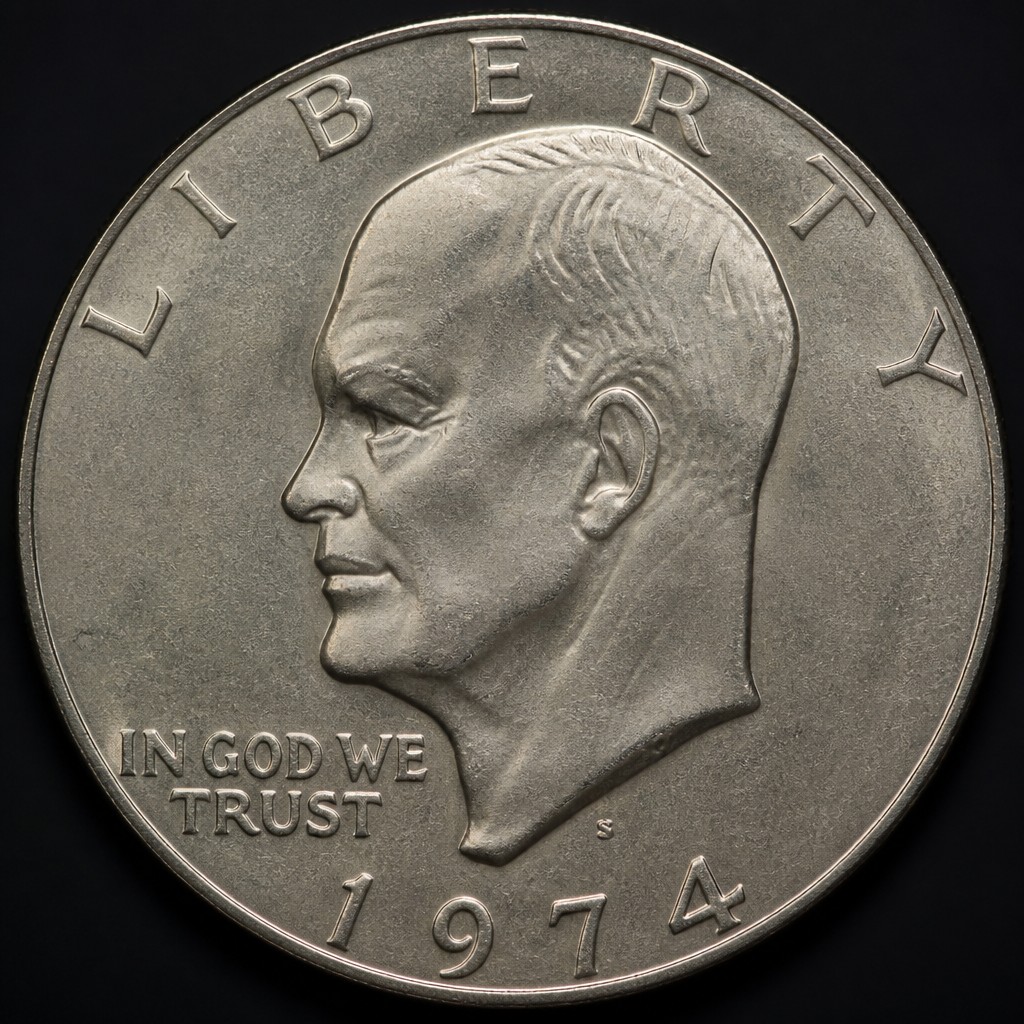
What It Is
The 1974 Eisenhower dollar is part of the large "Ike" dollar series struck from 1971 to 1978, honoring President Dwight D. Eisenhower. It was produced for circulation in copper-nickel clad composition and also issued as collector versions in 40% silver clad from the San Francisco Mint.
Obverse Design
A left-facing portrait of Eisenhower fills the obverse. "LIBERTY" arches along the top rim, "IN GOD WE TRUST" appears below the portrait, and the date sits beneath that.
Reverse Design
The reverse commemorates the Apollo 11 mission, showing an eagle descending toward the moon's surface with an olive branch in its talons, with the Earth visible in the background. "UNITED STATES OF AMERICA" arches over the top, "ONE DOLLAR" appears below, and "E PLURIBUS UNUM" is lettered near the eagle.
Size, Weight, and Edge
This is a large dollar coin at 38.1mm in diameter. Copper-nickel clad circulation strikes weigh about 22.68 grams, while 40% silver clad versions weigh about 24.59 grams. Both have a reeded edge.
Mint Marks
The mint mark is located on the obverse, below Eisenhower's neck truncation near the base of the bust. No mark indicates Philadelphia, "D" indicates Denver, and "S" indicates San Francisco, which struck both proof and uncirculated silver-clad versions as well as some proof copper-nickel coins.
Telling It Apart From Similar Coins
Distinguishing a silver-clad 1974 dollar from a copper-nickel version can be done by checking the edge: silver-clad coins show a distinct copper-colored inner core visible as a thin line, similar to other clad coinage, but the overall coin has a slightly different weight and a more subdued, grayish tone compared to the brighter copper-nickel circulation strikes.
Judging Condition at a Glance
Look at Eisenhower's cheek and hair above his ear, along with the eagle's leg and the fine details of the Earth on the reverse, for the first signs of wear. Well-preserved coins show sharp definition in these areas along with strong, unblemished luster.
Authenticity Red Flags
Check that the weight matches either the copper-nickel or silver-clad standard rather than falling in between, which could indicate a plated or altered coin. Examine the edge for a visible copper core consistent with clad construction, and be wary of coins that feel unusually light, have a uniformly silver-colored edge suggesting solid silver plating, or show doubling inconsistent with known genuine varieties.
Frequently asked questions
What does the reverse of the 1974 Eisenhower dollar depict?
An eagle descending toward the moon with an olive branch, commemorating the Apollo 11 moon landing, with Earth shown in the background.
How can I tell if my 1974 dollar is silver-clad or copper-nickel?
Silver-clad coins are heavier, have a more subdued grayish tone, and were only struck at the San Francisco Mint for collectors, while copper-nickel coins were the standard circulating version from all mints.
Where is the mint mark on this coin?
On the obverse, below Eisenhower's neck truncation near the base of the bust.
What size is the Eisenhower dollar compared to other US dollar coins?
It is a large dollar at 38.1mm in diameter, noticeably bigger than the smaller Susan B. Anthony or Sacagawea dollars that came later.