
How to Identify the 1971 British Columbia Dollar
A Canadian commemorative dollar marking the 100th anniversary of British Columbia joining Confederation, issued in both nickel and collector silver versions.
Read the full 1971 British Columbia Dollar encyclopedia entry →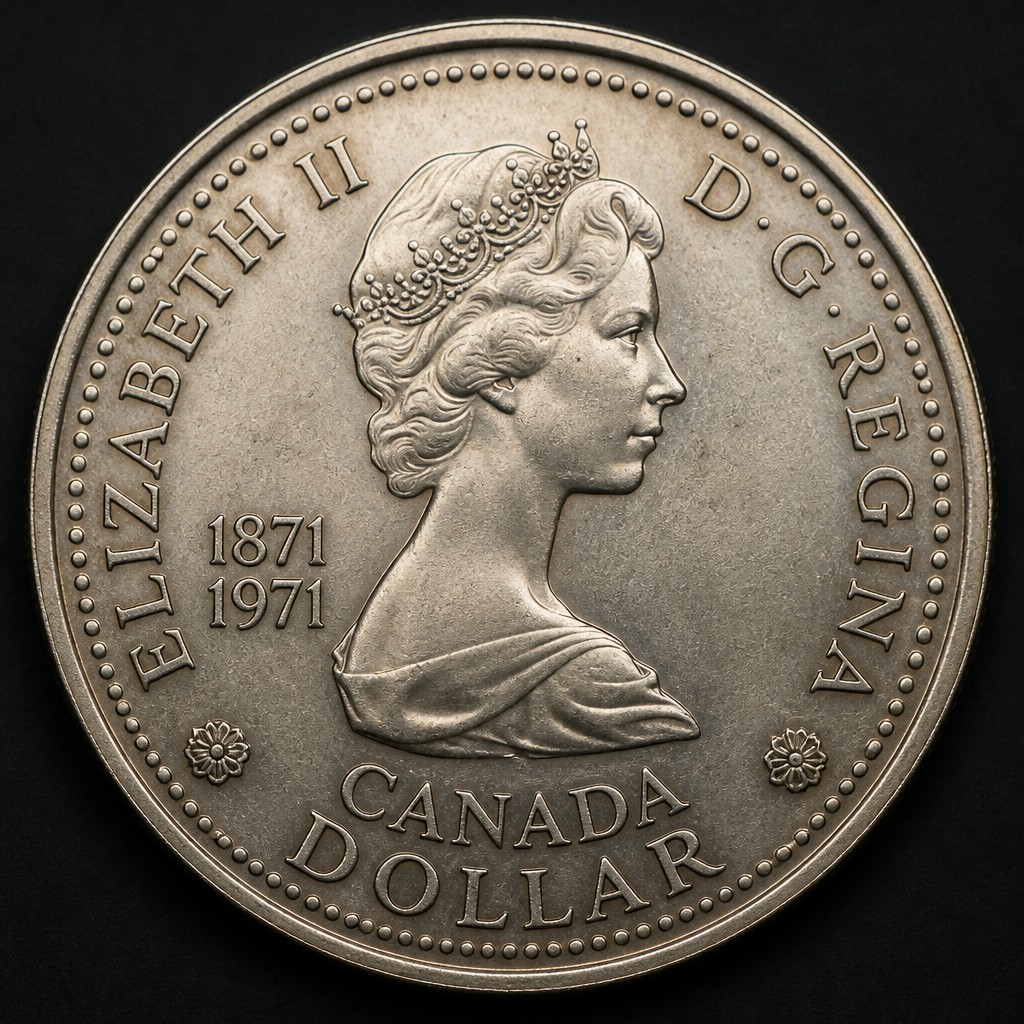
What Is This Coin?
This coin commemorates the 100th anniversary of British Columbia joining Canadian Confederation in 1871. By this date, Canada's circulating dollar coins were made of nickel rather than silver, though the Royal Canadian Mint also produced a separate silver version for collector specimen sets. This dual-composition approach was common for Canadian commemorative dollars of the early 1970s, letting the mint serve everyday circulation needs while still offering a traditional silver keepsake to collectors.
Obverse Design
The obverse shows Queen Elizabeth II's portrait from the design series introduced in 1965, with the legend "ELIZABETH II DEI GRATIA REGINA" surrounding the bust.
Reverse Design
The reverse presents a maritime scene evoking British Columbia's Pacific coastline and its history of coastal exploration, with a sailing vessel, mountainous backdrop, and the flanking dates "1871" and "1971." "CANADA" completes the design, tying the local commemorative theme to the national issuing authority.
Size, Weight & Metal
Regular circulation strikes are made of pure nickel, weighing about 15.62 grams with a diameter of roughly 32.13 mm and a reeded edge — notably smaller and lighter than the older silver dollars. A separate silver version (lower fineness, sold only in specimen or proof-like sets) was also produced for collectors and will feel different in weight and have a brighter finish than the nickel circulation coin.
Mint Marks & Where to Find Them
No mint mark appears on either version. Telling the nickel and silver versions apart comes down to weight, color, and context: silver specimen versions typically arrive in original mint packaging, while nickel coins circulate freely and show a duller gray tone.
Telling It Apart From Similar Coins
The coastal, maritime-themed reverse combined with the flanking 1871–1971 dates distinguishes this from other Canadian commemorative dollars, such as the totem pole design (1958) or the goose design (1967). Comparing the weight and metallic color helps separate the common nickel circulation strike from the less common collector silver version. Its reduced diameter compared to pre-1968 silver dollars is also a quick visual cue that this coin belongs to the later, smaller nickel-dollar era of Canadian coinage.
Judging Condition at a Glance
Wear appears first on the ship's sail and hull details and the highest points of the queen's portrait. A coin with crisp, well-defined ship rigging and mountain relief indicates better preservation than a smoothed, low-detail example. Nickel coins tend to show handling marks and scuffs somewhat differently than silver, often appearing as duller gray patches rather than the deeper toning seen on worn silver issues.
Authenticity Red Flags
Watch for a coin claiming to be the silver specimen version that lacks the expected weight or shows machine-made surface flaws inconsistent with an original collector strike. For circulation nickel coins, standard casting red flags apply: blurred design elements, incorrect weight, or poorly formed edge reeding. A basic weight check is especially useful here since it quickly separates genuine nickel and silver versions from underweight counterfeits of either type.
Frequently asked questions
What event does this coin commemorate?
It marks the 100th anniversary of British Columbia joining Canadian Confederation in 1871.
Is this coin silver or nickel?
Regular circulation strikes are nickel, but the Royal Canadian Mint also issued a separate silver version sold only in collector specimen sets.
How do I tell the nickel and silver versions apart?
Compare weight and finish: the silver specimen version is generally brighter and came in original mint packaging, while the nickel circulation coin has a duller gray tone.
What does the reverse design show?
It depicts a coastal, maritime scene with a sailing ship and mountains, evoking British Columbia's Pacific coast history, flanked by the dates 1871 and 1971.