
How to Identify the 1970-S Washington Quarter Proof on 1941 Canadian Quarter
A visual guide to one of the most famous U.S. mint errors: a 1970-S proof quarter struck over a leftover 1941 Canadian quarter planchet, showing remnants of the original coin.
Read the full 1970-S Washington Quarter Proof on 1941 Canadian Quarter encyclopedia entry →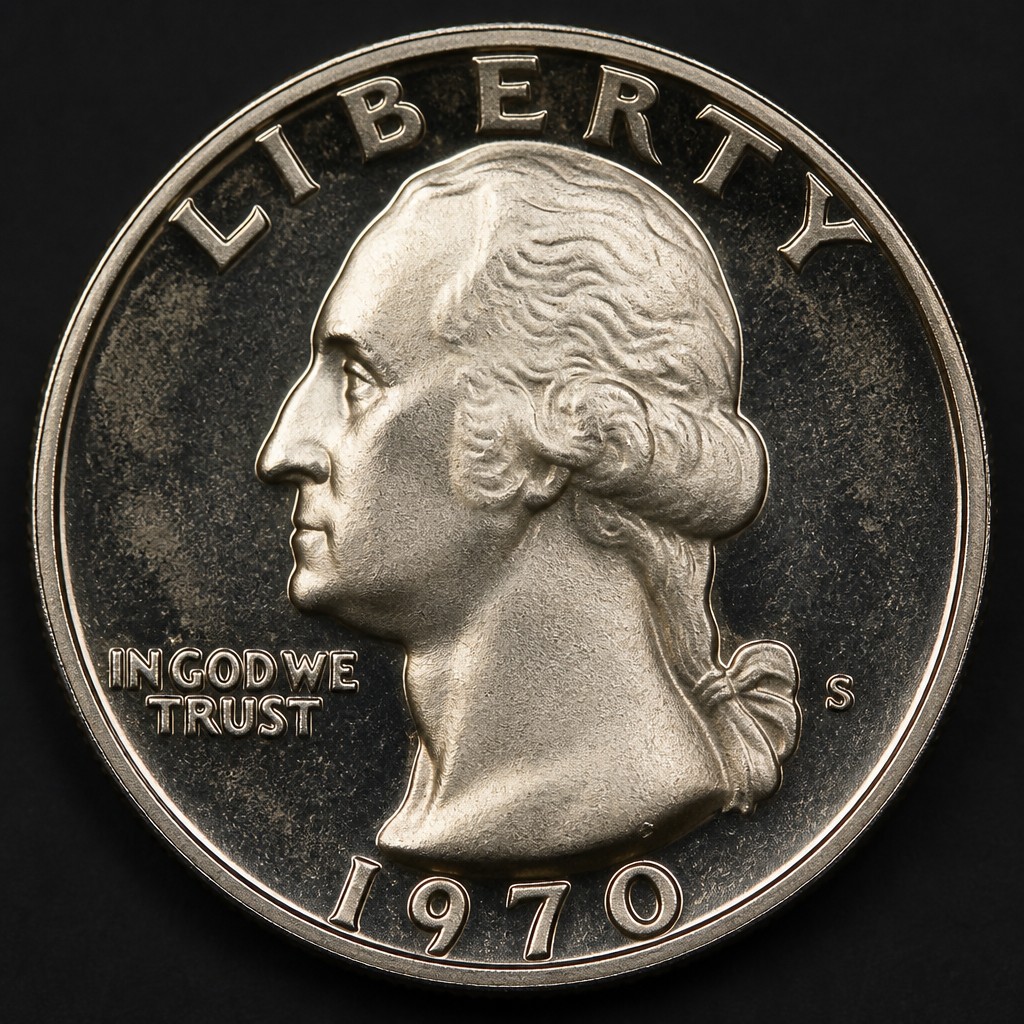
What It Is
This is one of the most celebrated error coins in U.S. numismatics: a 1970-S proof Washington quarter struck at the San Francisco Mint on a planchet that was actually an already-struck 1941 Canadian quarter, rather than a blank U.S. planchet. Only a small number of examples are known, and each is individually documented and closely studied by specialists.
Obverse (Front)
The primary design struck onto the coin is the standard Washington quarter obverse: Washington facing left, "LIBERTY" above, "IN GOD WE TRUST" beside his neck, "UNITED STATES OF AMERICA" along the rim, and the date "1970." Because the underlying Canadian coin was slightly different in diameter and thickness, some remnants or ghost outlines of the original Canadian design or lettering can appear at the rim or in weakly struck areas.
Reverse (Back)
The reverse shows the standard Washington quarter eagle design with "UNITED STATES OF AMERICA," "E PLURIBUS UNUM," and "QUARTER DOLLAR." As on the obverse, faint traces of the underlying 1941 Canadian quarter's design (which featured King George VI on its obverse and a caribou on its reverse) may be visible in areas where the American dies did not fully obliterate the original coin's relief.
Size, Weight, Metal, and Edge
A 1941 Canadian quarter was struck in 80% silver and is very close in diameter to a U.S. quarter but differs slightly in weight and alloy from the standard U.S. clad quarter used by 1970. This error piece will weigh and test differently from an ordinary 1970-S clad or silver proof quarter, reflecting its mixed origin. Its edge may also show inconsistencies compared to a normally reeded clad quarter edge.
Mint Marks
The "S" mint mark appears on the obverse above the date, consistent with all 1970 proof coinage from the San Francisco Mint, since proof sets that year were produced exclusively there.
Telling It Apart From Similar Coins
This error should not be confused with an ordinary 1970-S proof quarter, which shows no trace of another coin's design and has consistent weight and edge characteristics for its clad composition. Because so few genuine examples exist, any coin claimed to be this error should be compared very carefully against documented, certified specimens and should show unmistakable underlying design ghosting, not just toning or minor planchet flaws.
Authenticity Red Flags
Given the extraordinary rarity and value of genuine examples, this is one of the error types most likely to attract altered or fabricated fakes. Legitimate specimens have been examined and certified by major third-party grading services; a coin lacking such certification, or one where the "underlying design" looks vague, inconsistent, or artificially added rather than a genuine remnant of a prior strike, should be treated with strong skepticism.
Frequently asked questions
How did a Canadian coin end up being struck as a U.S. quarter?
It's believed a previously struck 1941 Canadian quarter planchet was accidentally mixed in with U.S. planchets at the San Francisco Mint and fed into the coining press during 1970-S proof quarter production.
How rare is this error?
Extremely rare; only a very small number of verified examples are known, making it one of the most significant modern U.S. mint errors.
How can I tell if remnants of the Canadian coin are visible?
Look for faint ghost outlines or partial lettering at the rim or in weakly struck areas that don't match the Washington quarter design; genuine examples have been documented and authenticated by professional grading services.
Should I assume an unusual-looking 1970-S quarter is this error?
No. Given how rare and valuable genuine examples are, any suspected specimen should be evaluated by a reputable professional grading service rather than assumed genuine from appearance alone.