
How to Identify the 1967 Bobcat Centennial Quarter
A one-year-only Canadian quarter marking the 1867–1967 Centennial, featuring a crouching bobcat by artist Alex Colville in place of the usual caribou.
Read the full 1967 Bobcat Centennial Quarter encyclopedia entry →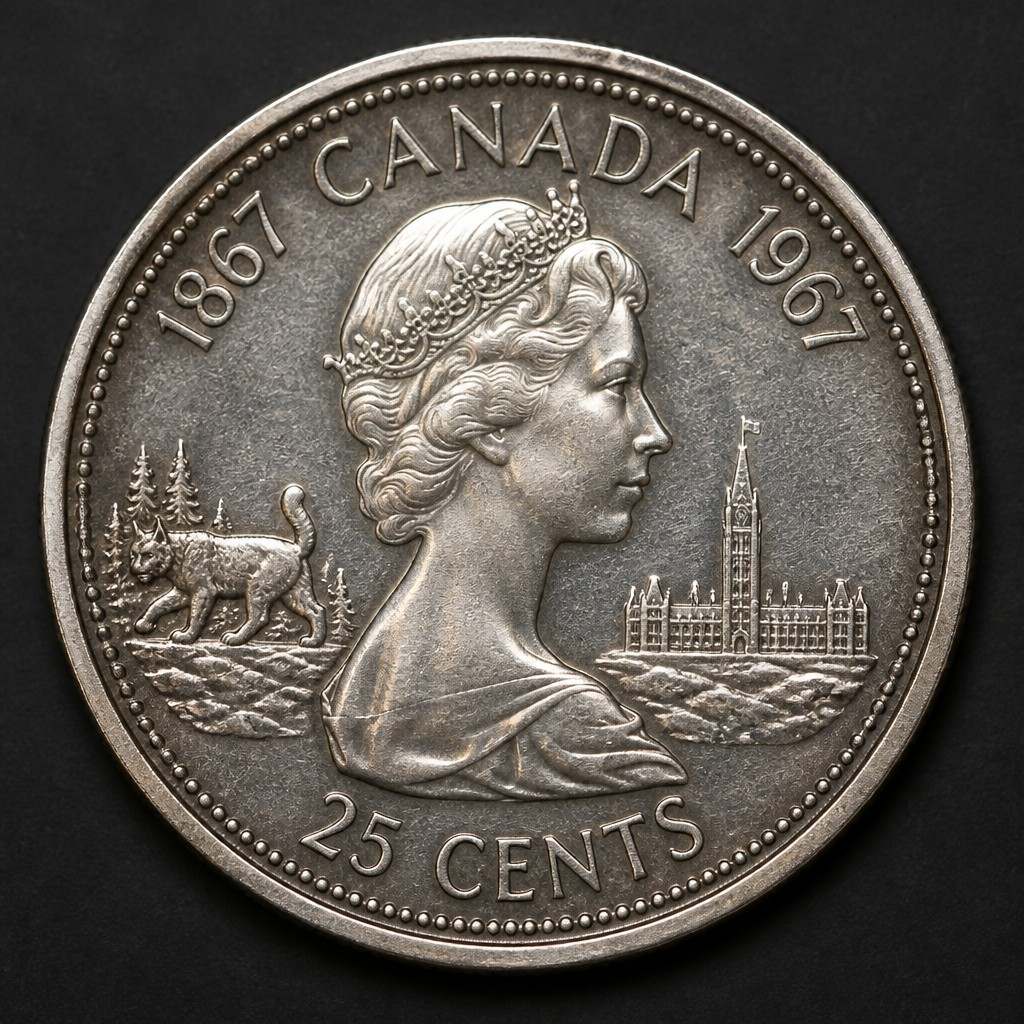
What Is This Coin?
Issued to celebrate 100 years since Canadian Confederation, this quarter temporarily replaced the familiar caribou reverse with a wildlife scene designed by artist Alex Colville, part of a full set of Centennial animal designs across all circulating denominations that year. The Centennial series was widely popular with the public, and many households saved examples straight from circulation, which is part of why nice-looking pieces remain relatively easy to find today.
Obverse Design
The obverse shows Queen Elizabeth II's youthful portrait used on Canadian coinage through the 1960s, with the legend "ELIZABETH II DEI GRATIA REGINA" around the bust. No date appears on the obverse; both dates sit together on the reverse.
Reverse Design
Instead of a single date, the reverse reads "1867–1967," flanking a crouching bobcat rendered in a naturalistic, low-relief style. "CANADA" arches above and "25 CENTS" curves below. The bobcat's alert posture and detailed fur texture make this design instantly distinguishable from the standing caribou used in every other year. The overall composition keeps the animal low and compact within the coin's field, giving it a very different visual weight than the more elongated, upright caribou silhouette.
Size, Weight & Metal
Like other quarters of the era, this coin is struck in .800 fine silver, weighs approximately 5.83 grams, and measures 23.88 mm across with a reeded edge. Because it's a one-year silver issue, well-preserved examples often retain strong cameo contrast between the frosted animal and mirror-like fields on specimen strikes.
Mint Marks & Varieties
No mint mark appears on this issue. Collectors do look for minor die variations in the depth of the fur engraving and the sharpness of the dual date, though such differences are subtle and mostly of interest to specialists rather than for basic identification. Because the entire Centennial series was produced in large volumes at the Ottawa facility, basic identification rarely needs to go beyond confirming the dual date and animal design.
Telling It Apart From Similar Coins
The dual date "1867–1967" is the clearest giveaway; no other Canadian quarter carries two dates. If a quarter shows a single "1967" with a caribou instead, it's simply a regular-design coin from that year, not the Centennial variant.
Judging Condition at a Glance
Look at the bobcat's shoulder and hip fur for sharpness — these high points flatten first with wear. A coin with full, crisp claws and whisker detail plus intact luster in the surrounding fields grades higher than one with a smoothed, low-contrast animal.
Authenticity Red Flags
Given the coin's popularity, watch for pieces with unusually dull, grainy surfaces (a sign of casting rather than striking) or a diameter/weight that doesn't match genuine specifications. Genuine strikes have sharply defined reeding and crisp lettering with no doubling or blur. Because this coin is common in circulated grades, there is little incentive to fake ordinary examples, but pieces marketed as gem uncirculated or specimen-quality deserve closer scrutiny given the added premium those grades can carry.
Frequently asked questions
Why does this quarter have two dates?
It commemorates the 100th anniversary of Canadian Confederation, so it displays 1867 (Confederation) and 1967 (the anniversary year) together instead of a single date.
Is the 1967 bobcat quarter made of silver?
Yes, it is struck in .800 fine silver, the same standard used for regular Canadian quarters through 1966 and into this transitional year.
Are all 1967-dated Canadian quarters the Centennial design?
No. Some 1967-dated quarters were struck with the regular single-date caribou design; only the dual-dated 1867–1967 pieces carry the bobcat.
Is this quarter rare?
It was struck in large numbers for circulation, so common circulated examples are not scarce; only exceptional uncirculated or specimen pieces command a premium.