
How to Identify the 1965 Silver Washington Quarter (Transitional Error)
A visual guide to the extremely rare 1965 Washington quarter struck on a leftover 90% silver planchet during the Mint's changeover to copper-nickel clad coinage.
Read the full 1965 Silver Washington Quarter (Transitional Error) encyclopedia entry →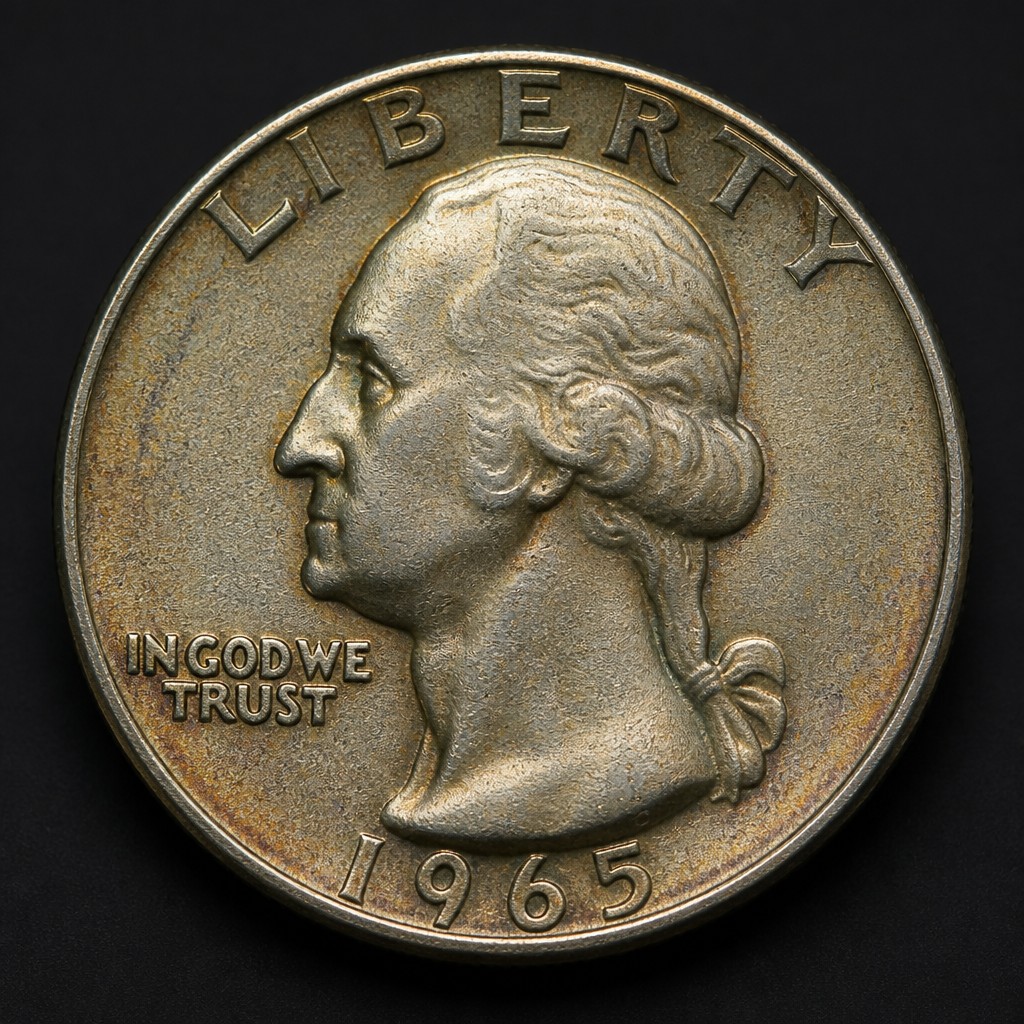
What It Is
In 1965, the U.S. Mint switched circulating quarters from 90% silver to copper-nickel clad composition to address a nationwide coin shortage. During the transition, a small number of 1965-dated quarters were mistakenly struck on leftover silver planchets intended for 1964-dated coins, creating a genuine transitional error that is extremely scarce and closely studied by error specialists.
Obverse (Front)
The obverse is the standard Washington quarter design used since 1932 (with minor 1990s-era modifications not yet present in 1965): Washington faces left, with "LIBERTY" above his head, "IN GOD WE TRUST" to the left of his neck, "UNITED STATES OF AMERICA" along the rim, and the date "1965" below. No mint mark appears, because the Mint suspended mint marks entirely from 1965 through 1967 to discourage coin hoarding.
Reverse (Back)
The reverse shows a heraldic eagle with wings spread, perched on a bundle of arrows with an olive branch beneath, encircled by "UNITED STATES OF AMERICA" and "QUARTER DOLLAR," with "E PLURIBUS UNUM" above the eagle.
Size, Weight, Metal, and Edge
A normal 1965 clad quarter weighs 5.67 grams and shows a visible copper-colored stripe sandwiched in its edge. A genuine silver transitional error weighs about 6.25 grams (matching pre-1965 90% silver quarters) and its edge appears a uniform silvery-gray with no copper core line, since it is a single alloy through and through.
Mint Marks
There is no mint mark on any 1965-dated quarter, silver or clad, since the Mint omitted mint marks in 1965-1967. This makes weight, edge appearance, and specific gravity the primary identification tools rather than any mark on the coin.
How to Tell It Apart From an Ordinary 1965 Quarter
The overwhelming majority of 1965 quarters are ordinary copper-nickel clad coins worth face value. A genuine silver transitional piece is identified by an accurate weight of approximately 6.25 grams (versus 5.67 grams for clad), an edge lacking the telltale copper stripe, and ideally a specific gravity test or professional certification, since visual inspection alone of the coin's faces cannot reliably distinguish silver from clad.
Authenticity Red Flags
Because genuine 1965 silver transitional quarters are exceptionally rare and valuable, be highly skeptical of casual claims. A coin that looks slightly duller or more silvery than a typical clad quarter is not sufficient proof; a plated or silver-washed clad quarter can mimic the color of silver but will still show a copper stripe on the edge once examined closely, and will not match the correct silver weight. Independent weighing on a precise scale and verification by a professional grading service are the only reliable ways to confirm authenticity.
Frequently asked questions
Why don't 1965 quarters have a mint mark?
The U.S. Mint suspended mint marks on all coins from 1965 through 1967 in an effort to discourage hoarding during the coin shortage and the transition to clad coinage.
How can I tell if my 1965 quarter is the rare silver version?
Weigh it precisely: a genuine silver piece weighs about 6.25 grams versus 5.67 grams for a normal clad quarter, and its edge will show a uniform silvery-gray color with no visible copper stripe.
Are most 1965 quarters silver?
No, the vast majority are ordinary copper-nickel clad coins; the silver transitional pieces are the result of a rare production mistake and are extremely scarce.
Can I identify a silver 1965 quarter just by looking at its color?
Not reliably. Toning, plating, or a lightly worn clad coin can all appear silvery in color; weight and edge examination, ideally combined with professional verification, are needed to confirm a genuine silver planchet.