
How to Identify the 1965-1970 Kennedy Half Dollar (40% Silver)
A transitional Kennedy half dollar struck in reduced 40% silver clad composition after the Mint moved away from 90% silver coinage, identifiable by its lighter weight and layered edge.
Read the full 1965-1970 Kennedy Half Dollar (40% Silver) encyclopedia entry →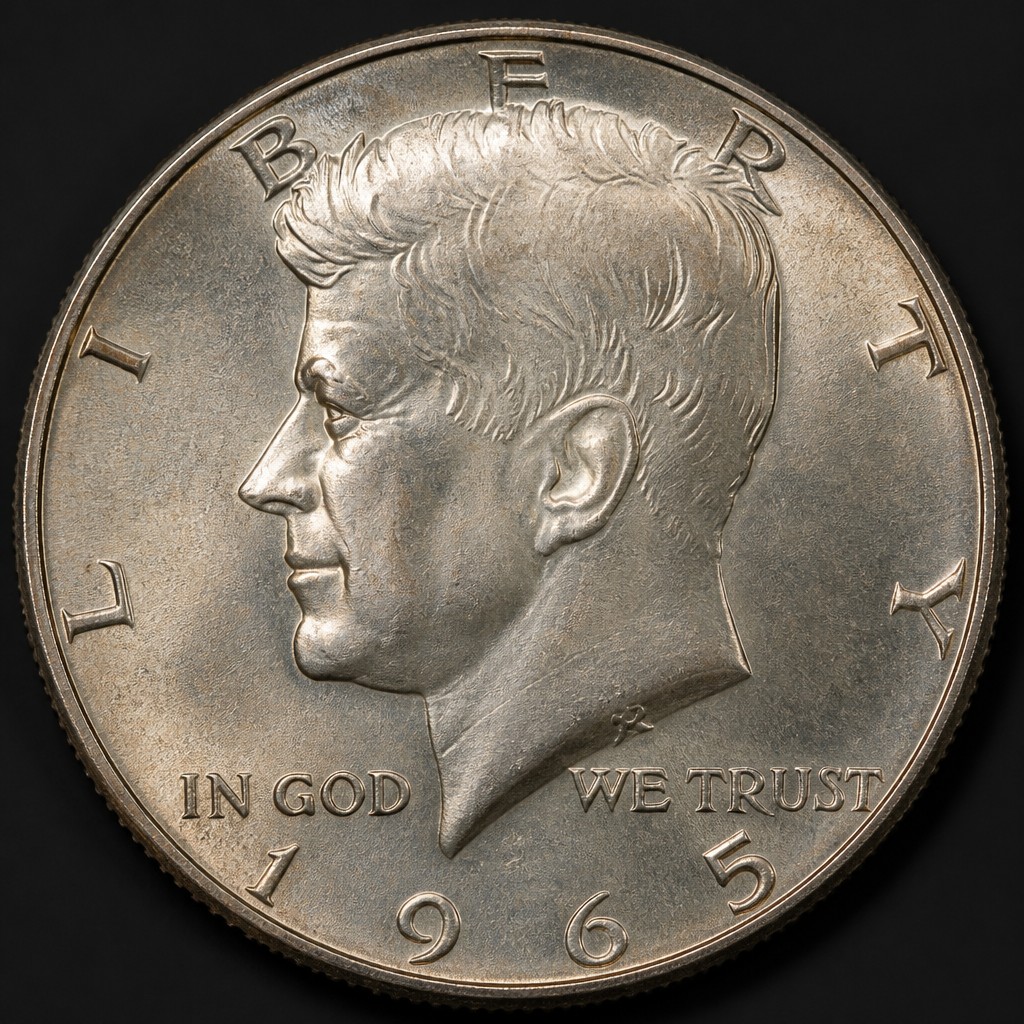
What It Is
Facing a nationwide coin shortage and rising silver prices, the U.S. Mint reduced the silver content of dimes, quarters, and half dollars starting in 1965. Kennedy half dollars struck from 1965 through 1970 used a 40% silver clad composition, a middle step between the earlier 90% silver coins and the copper-nickel clad halves introduced in 1971.
Obverse Design
The obverse is unchanged from the 1964 issue: a left-facing bust of President Kennedy designed by Gilroy Roberts, with LIBERTY above, IN GOD WE TRUST to the left, and the date below.
Reverse Design
The reverse also carries over Frank Gasparro's heraldic eagle design, with the eagle's wings spread, a shield on its breast, olive branch and arrows in its talons, stars above, UNITED STATES OF AMERICA around the rim, and HALF DOLLAR at the bottom.
Size, Weight, and Metal
These half dollars are built as a clad sandwich: outer layers of 80% silver and 20% copper bonded to an inner core of about 21% silver and 79% copper, averaging 40% silver overall. They weigh 11.50 grams and measure 30.6 mm in diameter with a reeded edge, noticeably lighter than the 12.50-gram 90% silver 1964 issue.
Mint Marks
No mintmarks appear on half dollars from 1965 through 1967, since the Mint temporarily removed them to discourage coin hoarding during the shortage. Mintmarks returned in 1968, with Denver ("D") and San Francisco ("S", proof only) mint marks appearing on the obverse just above the date, near Kennedy's neck truncation. Note that no 1970 half dollars were struck for general circulation; 1970-dated coins exist only in mint sets (Denver) and proof sets (San Francisco).
Telling It Apart From Similar Coins
The clad edge is the best visual clue: tilt the coin and look at the rim for a thin darker line sandwiched between the outer layers, which indicates a clad composition rather than solid silver. Weighing the coin is the most reliable method, since 11.50 grams confirms 40% silver, distinguishing it from both the heavier 1964 (12.50 grams) and the lighter post-1971 copper-nickel clad half (11.34 grams).
Judging Condition at a Glance
Examine Kennedy's hair detail above the ear and the eagle's breast feathers and claws. Sharp, well-defined lines indicate light circulation, while smoothed, flattened areas point to heavier wear.
Authenticity Red Flags
Be cautious of coins claimed to be 40% silver that feel unusually light or show no visible clad line on the edge, both of which suggest a common copper-nickel clad coin misrepresented as silver. Also watch for re-punched or altered dates trying to pass a common date off as a scarcer one, and compare surface texture and luster to known genuine examples if something looks off.
Frequently asked questions
How do I know if my Kennedy half is the 40% silver type?
Check the date (1965-1970), weigh it (about 11.50 grams), and look for a thin darker line on the edge showing its clad, layered construction.
Why are there no mint marks on 1965-1967 half dollars?
The Mint removed mintmarks from all coins during those years to discourage hoarding and speculation during a nationwide coin shortage.
Was a 1970 Kennedy half dollar made for everyday circulation?
No. 1970-dated halves were only issued in Denver mint sets and San Francisco proof sets, not released into general circulation.
How is 40% silver different from 90% silver in the coin's structure?
The 40% silver coin is a clad sandwich of silver-copper outer layers over a mostly copper core, while the 90% silver coin is a single uniform silver-copper alloy throughout.
Can I tell 40% silver apart from copper-nickel clad by color alone?
Color alone is unreliable since both can look similar with wear or toning; weighing the coin is a more dependable check.