
How to Identify the 1955 Jefferson Nickel Poor Man's Doubled Die
How to spot the doubled lettering on the reverse of the 1955 Jefferson Nickel, an affordable doubled die variety nicknamed for its accessible price.
Read the full 1955 Jefferson Nickel Poor Man's Doubled Die encyclopedia entry →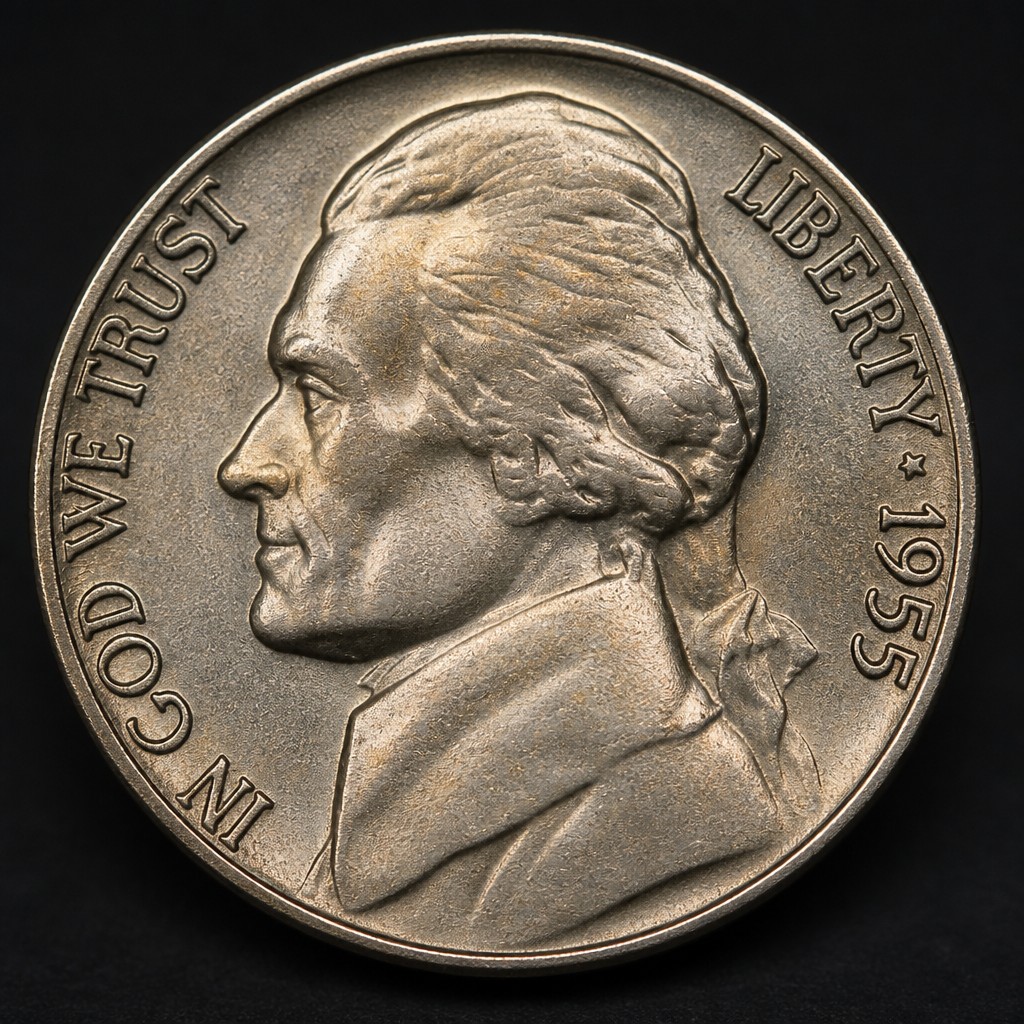
What It Is
The 1955 Jefferson Nickel Poor Man's Doubled Die is a die variety showing noticeable doubling on the reverse inscriptions. It earned its nickname because it offered budget-minded collectors an attractive, easy-to-see doubled die to pursue that was far more affordable than the famous 1955 doubled die Lincoln cent produced in the same year, which quickly became one of the most expensive and celebrated error coins of the twentieth century.
Obverse Design
The obverse is the standard Jefferson profile facing left, with LIBERTY at the left rim, IN GOD WE TRUST at the right rim, and the 1955 date at the lower right. The doubling associated with this particular variety is not found on the obverse, so collectors should focus their attention on the reverse.
Reverse Design
The reverse shows Monticello with MONTICELLO and FIVE CENTS lettered below, E PLURIBUS UNUM above the building, and UNITED STATES OF AMERICA around the top rim. On the doubled die variety, look closely at the lettering of MONTICELLO and FIVE CENTS for a doubled or shadowed appearance in the individual letters, which can sometimes be seen without magnification on a well-preserved example but is easiest to confirm with a loupe.
Size, Weight, Metal, Edge
This coin is 21.2mm in diameter, weighs 5.00 grams, and is composed of 75% copper and 25% nickel with a plain edge, matching the standard postwar Jefferson Nickel specifications used throughout the 1950s.
Mint Marks
The 1955 Jefferson Nickel doubled die variety is known from Philadelphia strikes, which carry no mint mark on the reverse near Monticello, consistent with typical Philadelphia coinage of the era, since Philadelphia did not add a mint mark to its coins until 1980.
Spotting the Doubling
Use a loupe to examine the letters in MONTICELLO and FIVE CENTS. True doubled die doubling shows a rounded, separated secondary image of the letter, sometimes described as a shelf or shadow with distinct spacing from the primary letter. This differs from ordinary die wear, which simply looks soft or mushy rather than showing two distinct, well-defined outlines side by side.
Grading at a Glance
Since the doubling is a die characteristic rather than a wear indicator, grade the coin the same way as any Jefferson Nickel: check the smoothness of Jefferson's cheek and hair on the obverse, and the sharpness and separation of Monticello's steps on the reverse, independent of the doubling itself, which does not change based on how much the coin has circulated.
Authenticity Red Flags
The most common mix-up is confusing true doubled die doubling with "machine doubling," a minor strike effect caused by die movement that produces a flat, shelf-like smear on letters rather than a fully rounded, separated secondary image. Machine doubling is common on many ordinary coins and does not carry the same recognition or value as a genuine doubled die. Always compare the doubling pattern carefully to known diagnostics before assuming a coin matches this specific variety.
Frequently asked questions
Where does the doubling appear on this variety?
In the reverse lettering, mainly MONTICELLO and FIVE CENTS, visible under magnification.
Why is it called the 'Poor Man's' doubled die?
It offered an affordable doubled die option compared to the much pricier 1955 doubled die Lincoln cent from the same year.
How do I tell true doubling from machine doubling?
True doubled die doubling shows a rounded, clearly separated secondary letter outline, while machine doubling looks like a flat shelf or smear.
What mint produced this doubled die variety?
Philadelphia; coins from this mint carry no mint mark near Monticello.