
How to Identify the 1953 Coronation Voyageur Dollar
The 1953 Canadian silver dollar paired a new young-portrait obverse of Queen Elizabeth II, struck for her coronation year, with the familiar Voyageur canoe reverse, and exists in two obverse varieties.
Read the full 1953 Coronation Voyageur Dollar encyclopedia entry →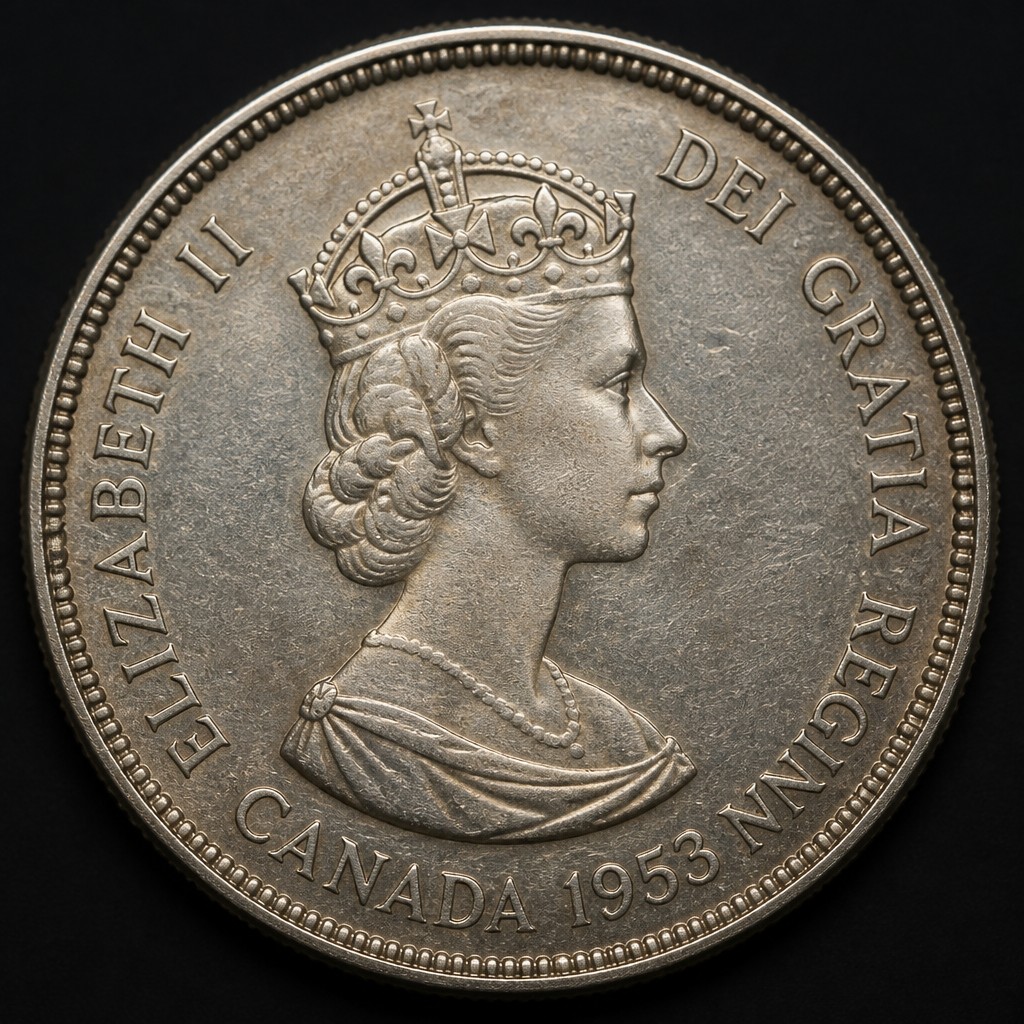
What It Is
The 1953 Voyageur dollar is a regular-issue Canadian silver dollar notable for introducing the first Canadian coinage portrait of the newly crowned Queen Elizabeth II. While not an official "coronation medal," collectors commonly associate the coin with her 1953 coronation because it was the first year her portrait appeared on Canada's coins.
Obverse Design
The obverse shows a young Queen Elizabeth II facing right, wearing a laurel wreath rather than a crown, with the legend "ELIZABETH II DEI GRATIA REGINA" around the rim. Two obverse varieties exist for this year: the "No Shoulder Fold" (NSF) variety, where the fabric of the Queen's gown appears smooth at the shoulder, and the "Shoulder Fold" (SF) variety, which shows an extra fold line in the drapery. The NSF was the original 1953 design; the SF variety was introduced later in the year and continued into 1954.
Reverse Design
The reverse carries the well-known Voyageur design by Emanuel Hahn, showing a Voyageur and an Indigenous guide paddling a canoe past a small islet, with the date split by the canoe. "CANADA" arches above and "DOLLAR" appears in the exergue below.
Size, Weight & Metal
The coin is 80% silver, 20% copper, weighing about 23.33 grams with a diameter of roughly 36 mm and a reeded edge, consistent with other Canadian silver dollars of the 1950s and 1960s.
Mint Marks
Canadian dollars of this era were struck exclusively at the Royal Canadian Mint in Ottawa and carry no mintmark. Any mintmark present would indicate the coin is not a standard Royal Canadian Mint issue.
Telling It Apart from Similar Coins
Distinguishing NSF from SF requires close inspection of the drapery at the Queen's shoulder under magnification and good light; the SF variety shows a distinct extra fold of fabric. Collectors should also avoid confusing this coin with the 1948-1952 King George VI Voyageur dollars, which share the same reverse but carry the King's older portrait on the obverse. It also helps to compare the islet detail in the canoe scene and the general sharpness of the design, since the reverse dies were refined only slightly across the run of Voyageur dollar years.
Where It Fits in the Series
The 1953 issue sits at a transition point in the long-running Voyageur dollar series, which began in 1935 and, aside from special anniversary years, continued using this same canoe design into the 1960s. Because the reverse tooling changed little year to year, the obverse portrait, its inscription, and the shoulder-fold variety remain the most reliable ways to place a coin precisely within that broader run.
Judging Condition at a Glance
Wear first appears on the Queen's cheek, hair, and the leaves of the wreath on the obverse, and on the Voyageur's arm and the top of the canoe on the reverse. Full luster in the fields and sharp definition in the wreath leaves indicate an uncirculated coin, while a smoothed, low-relief look across the portrait signals heavier circulation.
Authenticity Red Flags
Given the coin's silver content, check weight and diameter carefully; a lightweight or oddly sized coin suggests a counterfeit or plated fake. Look for soft, mushy lettering, a grainy surface texture, or a visible seam around the edge, all common signs of cast reproductions rather than genuinely struck coins.
Frequently asked questions
What are the two varieties of the 1953 dollar?
No Shoulder Fold (NSF), the original design, and Shoulder Fold (SF), introduced later in 1953, distinguished by an extra fold of drapery at the Queen's shoulder.
Why is it called the Coronation dollar?
It was the first Canadian dollar to carry Queen Elizabeth II's portrait, coinciding with her 1953 coronation, though it was not an official coronation commemorative.
What is the coin's metal composition?
It's 80% silver and 20% copper, matching other Canadian silver dollars from this era.
How do I spot the shoulder fold variety?
Examine the fabric at the Queen's shoulder under magnification; the SF variety shows a visible extra fold line that the NSF variety lacks.
Does this coin have a mintmark?
No, it was struck solely at the Royal Canadian Mint in Ottawa, which did not use mintmarks on these dollars.