
How to Identify the 1951 Nickel Commemorative Five Cents
A special 1951 Canadian five-cent design marking the 200th anniversary of the discovery of nickel as an element, struck ironically in actual nickel metal even as regular coins that year used steel instead.
Read the full 1951 Nickel Commemorative Five Cents encyclopedia entry →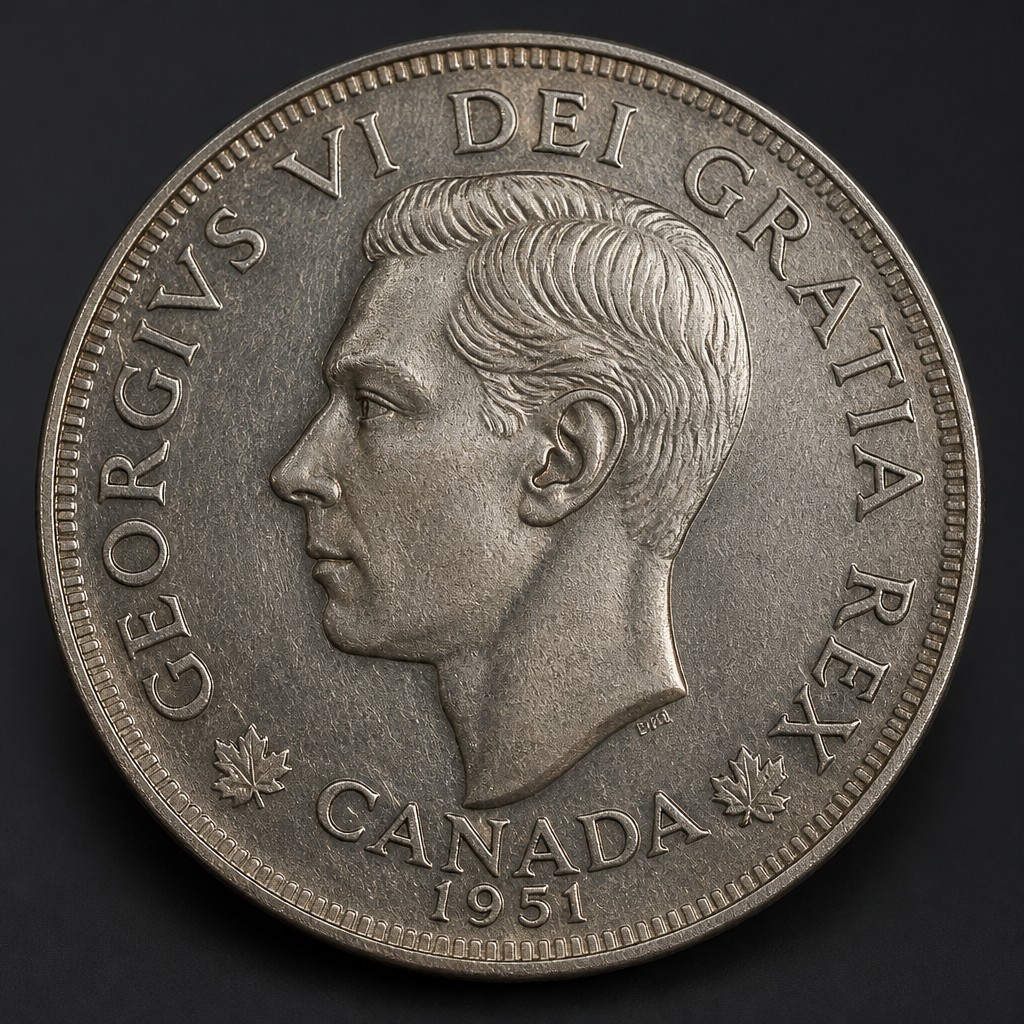
What It Is
This coin was issued in 1951 as a one-year commemorative design celebrating the 200th anniversary of Swedish chemist Axel Fredrik Cronstedt's identification of nickel as a distinct chemical element in 1751. Rather than the usual beaver reverse, this five-cent piece carries a unique industrial scene honoring the metal itself.
Obverse Design
The obverse shows King George VI's portrait with the post-1948 legend GEORGIVS VI DEI GRATIA REX, without the earlier reference to India.
Reverse Design
The reverse depicts an industrial refining scene associated with nickel production, flanked by the dual dates "1751" and "1951," along with CANADA and the denomination. This design replaced the standard beaver motif for this single year only.
Size, Weight, Metal & Edge
The coin is round, unlike the twelve-sided wartime nickels, and measures similarly to other five-cent pieces of the era. In a notable twist, it was deliberately struck in genuine nickel metal to honor the anniversary, even though Canada's regular-design five-cent coins of that same year were struck in chrome-plated steel instead, because the Korean War had again created a shortage of nickel for coinage.
Mint Marks
Produced at the Royal Canadian Mint in Ottawa, it carries no mintmark.
Telling It Apart From Similar Coins
The refinery-style reverse design is unique to 1951 and is not repeated on any other regular Canadian five-cent issue, so the imagery alone confirms the coin's identity. It should not be confused with the standard beaver-design five-cent coin also dated 1951, which uses ordinary steel and looks and feels different. It is also worth noting that this is a one-year type, unlike the long-running beaver design used in most other years of the George VI and Elizabeth II periods, so its distinctive reverse makes it relatively easy to spot even for those unfamiliar with the full series.
Judging Condition
Check the high points of the refinery structure and the king's portrait, especially the hair and laurel wreath, for wear or flattening. Because the design was only used for a single year, well-preserved examples with strong, unworn detail throughout the refinery scene are especially appealing to collectors of this specific type.
Authenticity Red Flags
A simple magnet test is a useful identification aid here: the genuine commemorative nickel-metal coin should not be attracted to a magnet, while the regular 1951 beaver-design steel coin will be. A coin claiming to be this commemorative that behaves magnetically, or shows a color and finish inconsistent with nickel's typical silvery-white tone, should be examined more closely.
Frequently asked questions
What does the 1951 commemorative design celebrate?
It marks the 200th anniversary of the identification of nickel as a chemical element in 1751 by chemist Axel Fredrik Cronstedt.
Why was it struck in nickel when the regular 1951 coin was steel?
Wartime-related nickel shortages during the Korean War led Canada to strike ordinary five-cent coins in steel that year, while this commemorative was deliberately struck in real nickel to honor the metal.
How can I tell it from the regular 1951 beaver design coin?
The commemorative shows a refinery scene with dual dates 1751-1951, while the regular coin uses the standard beaver-on-a-log design.
Is the coin magnetic?
No, since it is genuine nickel metal, it should not be attracted to a magnet, unlike the same year's regular steel five-cent coin.
Does it have a mintmark?
No, it was produced at the Royal Canadian Mint in Ottawa without a mintmark.