
How to Identify the 1949 King George VI Silver Dollar
Canada's 1949 silver dollar marked Newfoundland's entry into Confederation, pairing a King George VI obverse with a reverse depicting the sailing ship Matthew.
Read the full 1949 King George VI Silver Dollar encyclopedia entry →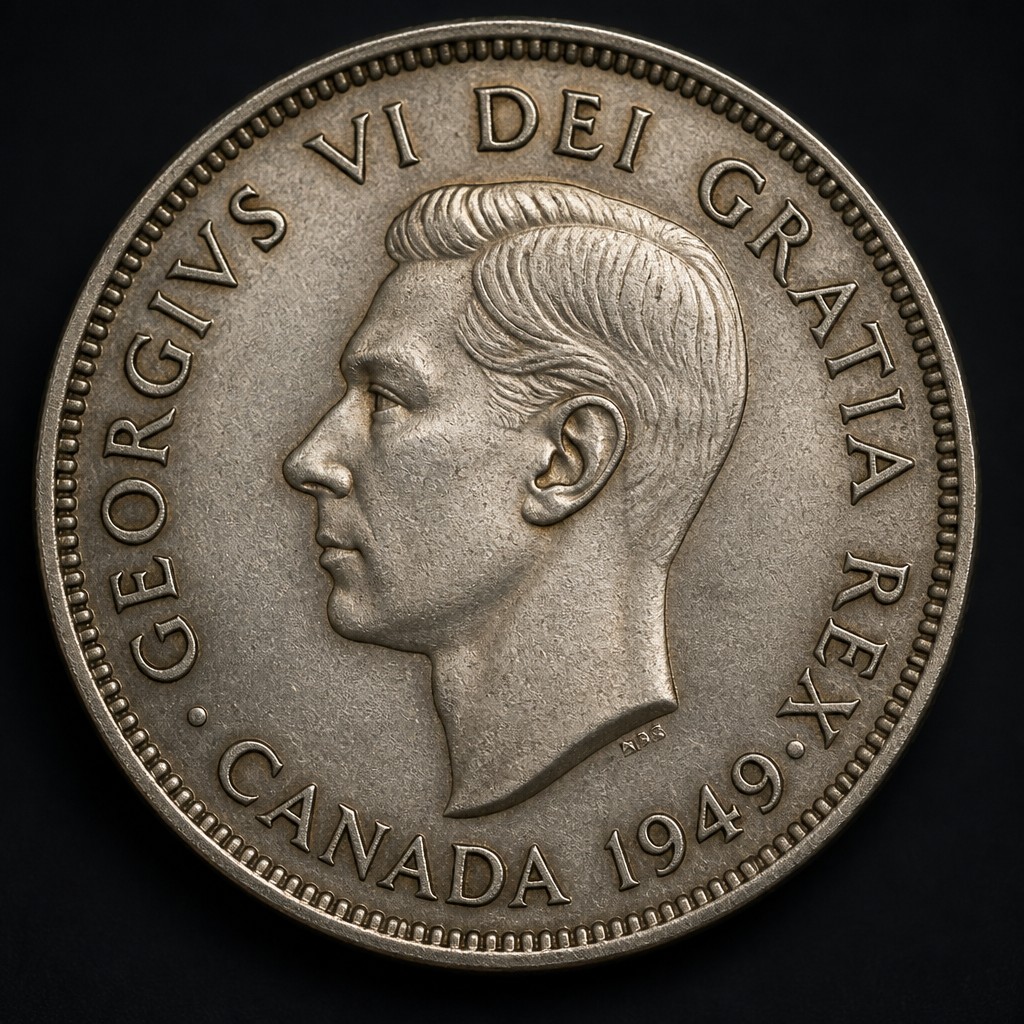
What It Is
The 1949 Canadian silver dollar is a commemorative issue struck to mark Newfoundland joining the Canadian Confederation that year. It replaced the standard Voyageur reverse used on other dollars of the era with a special one-year design, making it a favorite target for Canadian type collectors.
Obverse Design
The obverse shows King George VI facing left, wearing no crown, in the standard portrait used on Canadian coinage of the late 1940s. The legend reads "GEORGIVS VI DEI GRATIA REX ET IND: IMP:" (shortened on later strikes as the "IND: IMP:" title referencing India was dropped after 1947, so genuine 1949 dollars omit this Latin phrase, a useful date-consistency check).
Reverse Design
The reverse features the sailing ship Matthew, the vessel John Cabot used on his 1497 voyage to Newfoundland, shown under full sail on rolling waves. "CANADA" and "1949" appear above and below the ship, with "DOLLAR" as the denomination. This design was used only for this one year, so any coin with the Matthew reverse should read 1949.
Size, Weight & Metal
The coin is struck in 80% silver, 20% copper, matching other Canadian silver dollars of the period. It weighs approximately 23.33 grams with a diameter of about 36 mm and a plain reeded edge.
Mint Marks
All 1949 silver dollars were struck at the Royal Canadian Mint in Ottawa, and Canadian dollars of this era carry no separate mintmark. If a coin shows any mintmark letter, it is not a genuine Royal Canadian Mint dollar of this design.
Telling It Apart from Similar Coins
The Matthew ship reverse is unique to 1949, so it won't be confused with the more common Voyageur canoe design used on Canadian dollars from 1936 through the 1960s (aside from other special anniversary years). Compare the ship's sails and hull detail carefully, since worn coins can lose fine rigging lines that help confirm authenticity.
Judging Condition at a Glance
On the obverse, check the high points of the King's hair and cheek for wear. On the reverse, the ship's sails and the wave details closest to the hull wear down first. Uncirculated examples show full mint luster in the fields with sharp rigging lines; well-circulated pieces show a smooth, flattened look on the ship's hull and the King's portrait.
Authenticity Red Flags
Because this coin carries real silver content, verify weight and diameter against the listed specifications. Cast counterfeits often show a grainy or pitted surface, a seam line around the edge, or noticeably soft design details compared to a crisply struck original. A coin that doesn't respond as expected to a simple ping or "ring" test, or that shows an incorrect edge reeding count, warrants a closer look by an experienced grader.
Frequently asked questions
What makes the 1949 dollar special?
It has a one-year-only reverse design showing the ship Matthew, commemorating Newfoundland joining the Canadian Confederation in 1949.
What is the coin's silver content?
It is 80% silver and 20% copper, the standard alloy for Canadian silver dollars of that period.
Does it have a mintmark?
No, it was struck only at the Royal Canadian Mint in Ottawa, which did not use mintmarks on its dollar coins at the time.
How do I know the coin is genuine and not a common Voyageur dollar relabeled?
The reverse design itself is the giveaway: genuine 1949 dollars show the sailing ship Matthew, not the canoe and paddlers of the standard Voyageur dollar.
What details wear down first on this coin?
The King's cheek and hair on the obverse, and the ship's sails and rigging on the reverse, are the first areas to show flattening from circulation.